Episode Transcript
[00:00:01] Speaker A: The best insight, instant feedback, accountability, the all new Talk Radio Freedom 106.5.
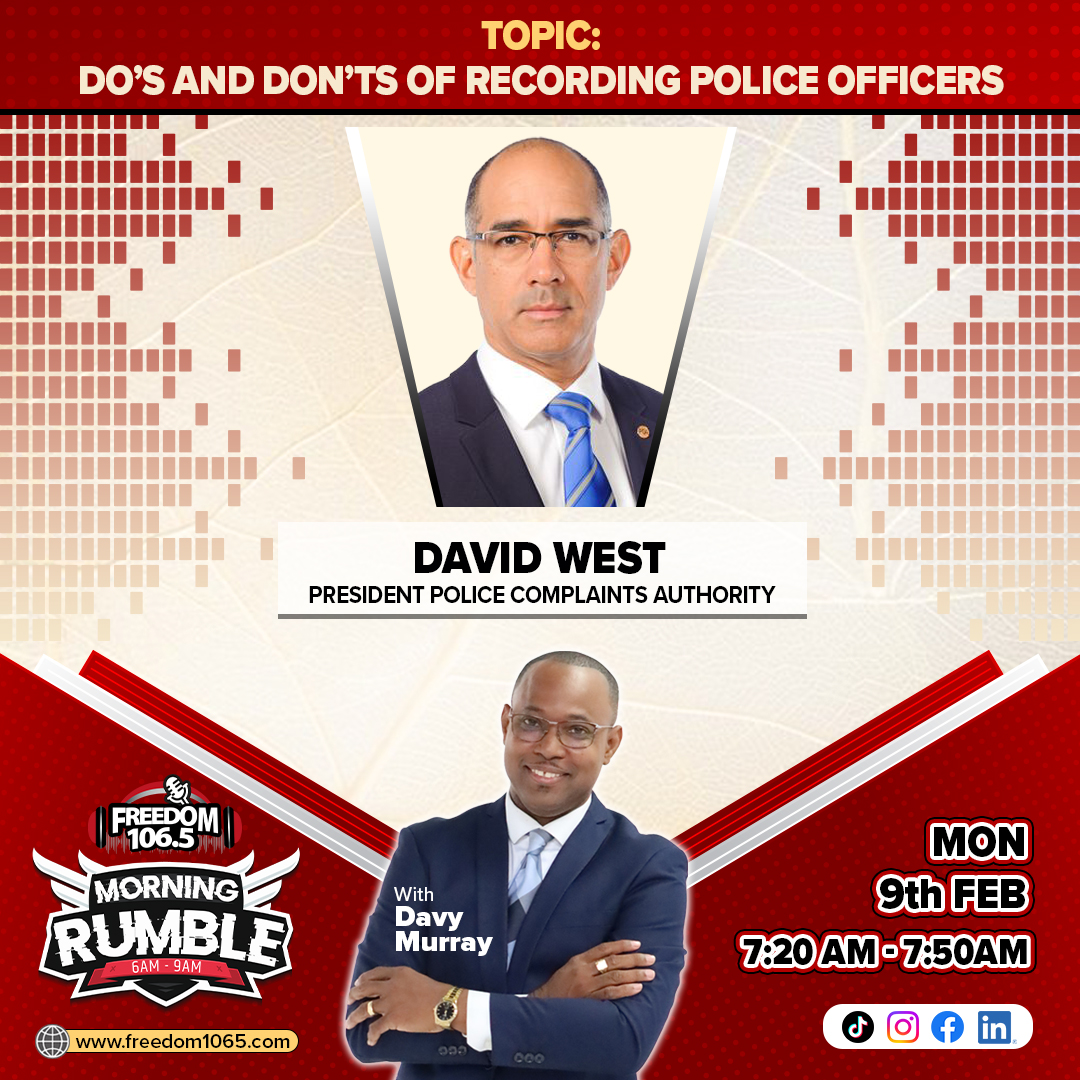
[00:00:09] Speaker B: So we're switching gears very quickly now as we get set to chat with the president of the Police Complaints Authority.
Mr. David west is joining us online this morning and he's here with us on Freedom 106.5 FM.
I believe this is his first time with me on the program. Hello, good morning, Mr. West. Good morning and welcome.
[00:00:28] Speaker A: Good morning. Thank you very much for having me.
[00:00:30] Speaker B: Indeed so. And a lot is taking place. I want to keep this interview very, very strict, to the point and get what we need to get out so the public could understand the Police Complaints Authority a little better. And I want to break it down in such a way where the average citizen understands their rights as it relates to police officers recordings. And we will look at ways as how civilians should treat with officers and how we how the PCA is assisting with bridging the gap and building that confidence and trust in police officers yet again. So Mr. West, good morning to you. We have had a lot of talk in the public's domain, even coming from government ministers where they are hoping or they want to kind of muzzle persons or prevent persons from recording. We are being told we could record the there's rules of doing it. Can you share some light this morning as it relates to policy pertaining to persons recording police officers in their line of duty?
[00:01:31] Speaker A: Sure. It's very simple.
You are allowed to video record police officers in an interaction with them or if you see something, you can videotape them.
However, you cannot interfere with them in the execution of their duty. That means you cannot go in their face or be too close to interfere with the execution of their duty. So you have to keep a safe distance. But you are allowed to video record police officers. It is not against the law. Judges have agreed or pronounced that it is valid.
You can videotape officers. And also two former commissioners of police have also said so you can videotape.
[00:02:17] Speaker B: Police officers with officers in past and present. Well, in the past we have seen this happening where a person is attempting to record and the officer is cautioning such person about the recording, so much so that they are telling the person based on the recording, you are interfering.
All right, with me executing my duties and they attempt to take away person's phone. They took. They took it away, in some instances damaging the phone. What is the recourse for citizens in instances like this? Is the police correct in saying that you are interfering with them because you are recording?
[00:02:55] Speaker A: No. If you are a safe distance Away. And you are not interfering with them in the execution of their duty. That is a legal video recording. The police would be wrong to interfere or to grab your phone away from you because that is your right to video record police officers. We have had complaints about that before and we have made recommendations to the Commissioner of Police. What is the correct protocol as it relates to that.
[00:03:22] Speaker B: We have. Police officers are saying that. I mean, and I'm only asking you these questions because I want persons to be very clear. Officers would then say to some citizens, and I've seen video where I did not give you permission to record my images. Please stop recording me and the police officers. You can be arrested for recording me without my permission.
[00:03:43] Speaker A: That you cannot be arrested for recording without your permission because you are in a public space.
All right? So therefore you can record any incident taking place.
[00:03:56] Speaker B: So we could record it now.
[00:03:58] Speaker A: Yes, but.
[00:03:59] Speaker B: So do we.
Forgive me, Mr. West, but I have to ask you because I want it clear.
Do the public. Does the public need to ask an officer or get permission?
The officer saying, yes, you can record. Do they need.
[00:04:18] Speaker A: No, they do not need permission to record.
[00:04:20] Speaker B: They do not. How has recordings assist the Police Complaints Authority with bringing officers to justice?
[00:04:27] Speaker A: Well, as you can see, a recording is an independent activity. It is not done by any.
For example, CCTV footage is an independent recording activity. It's not done with any bias. It actually captures what is actually taking place. It is a very good form of evidence for the PCA and for anybody looking at it. It's an independent form of evidence which the PCA uses to evaluate complaints.
And we wish, and we hope the public continues to use their video phones or CCTV footage to capture images. If officers are transgressing the law.
[00:05:14] Speaker B: Let me ask you another question that came up, and I often wonder, and I know the public does as well, members of the Police Complaints Authority, employees and staff there, are they police officers or are they civilians?
[00:05:32] Speaker A: They are civilians.
The act says, or the act mandates that it's a civilian oversight body.
Okay. Now, we do have officers or we do have former or retired police officers working for the pca, but they are former or retired police officers. They are not serving members of the Trinity Police Service. They are independent civilian investigators or officers.
[00:06:01] Speaker B: I'm happy that you clear that up, because the misconception of officers, investigating officers, there is this conception that's conceptualizing person's mind that they're going to cover up. And I'm happy that you were categorically clear that there are no active members of the police Service currently employed at the Complaints Authority. Police Complaints Authority at this time and will never be.
[00:06:31] Speaker A: Not at this time, will never be because that's what the act states do.
[00:06:35] Speaker B: We need to have concerns that these former officers that are now part of the Police Complaints Authority would have built relationships with it with colleagues. They would have had their batch, as it were, and then they are now receiving a report that their batch, or maybe former friends, they form bonds they form in the police service they now have to investigate. Could the public safely say that based on the fact that you are a past police officer now employed with the pca, do we have to be concerned that you might pick up for your friend?
[00:07:03] Speaker A: That's a valid question and a valid concern and we have taken steps to alleviate that. So for example, in the employment contract they have to sign where they state that if there's any conflict of interest, meaning that they know the person that they're investigating, they must alert the authority and we will decide whether or not to remove them from the case or not. Plus, if you understand our investigative process, okay, it is very difficult for an investigator to, let's say, hide evidence against batch because what happens is that the investigator normally does report to the team lead, okay. And the team lead then goes through their file before it is passed to the legal department to make sure that all the evidence has been collected for the alleged criminal offense or disciplinary offense.
Right. Once that is done, it then goes to the authority to make sure that the eyes are dotted and the T's are crossed. Okay? So you have several layers of supervision of accountability in doing an investigation. So an officer cannot then say, for example, not take a statement from a main witness because we would pick it up, you understand?
So therefore that is how we do the investigations. So it is very difficult and even self, if the team lead is doing an investigation of his own batch, the team leads file still needs to go through legal to be checked to make sure that is not a statement or some crucial piece of evidence is left out. And it also comes to the authority to double check to make sure that what the evidence we have against that officer is enough for a criminal offence or we didn't, or we didn't get enough evidence to make a referral. So it is very robust in our investigative process.
[00:08:58] Speaker B: You know, I'm very happy that you said that because my follow up question would have dealt with transparency and accountability as to how do we hold, how are we certain that the officer or the individual assigned a particular case? How do we hold him to accountability and transparency? Given the fact that he would have crossed all his T's and dotted his I's. But you're saying it's a layered, tiered process that the investigator goes through in terms of his reporting.
[00:09:26] Speaker A: Correct and correct. And if it's a criminal offense, it goes to the DPP to go through our file to make sure that we have enough evidence to lead to lay a charge or for him to lay a charge. So you see, so that is why it is very robust. The investigative process is very robust.
It has built in checks and balances in our investigative process.
[00:09:48] Speaker B: If it is unearthened that one particular employee of the PCA did not disclose his closeness to a particular individual of the TTPs that they are investigating, what process is taken, what is done, what is taken then to deal with that said employee who did not disclose this? However, other persons say, but you know, this man and this man, these friends, up to two weeks before this investigation, they were seen hanging out. Lyman. They have a history of that, but he did not disclose it or she didn't disclose it. What happens then?
[00:10:22] Speaker A: Well, it would follow any IR industrial relations process.
The complaint would be made to the investigator. We will state the complaint made against him. He would obviously have a chance to respond, to get legal advice to respond. We would then have an internal investigation done.
And based on the outcome of the investigation and his response, we would then. The authority would then take a. Would then take the decision whether to dismiss him or to suspend the person or to determine that the infraction was not as grievous as it was. So it would take a normal IR process.
[00:11:02] Speaker B: Beautiful.
[00:11:03] Speaker A: So I think we have policies in place and we have an HR manager to ensure that it takes a normal.
[00:11:09] Speaker B: IR process because we don't want to end up in an industrial relations situation where the PC is now being sued. And, you know, so I'm happy that that is cleared up. Let's move on. Very quickly, as we continue with our interview, we are chatting with President of the Police Complaints Authority, Mr. David West.
[00:11:25] Speaker A: It's a. Director.
[00:11:26] Speaker B: Director, sorry, I'm saying President, Director, forgive me, Director of the Police Complaints Authority. As we go forward with this now, let's take a look at how citizens can get access to the Police Complaints Authority in terms of making a report.
I don't want you to speak to anything that is currently active and ongoing, but any incidents that you can anonymously chat about that persons would have come into the Police Complaints Authority and receive redress.
[00:11:53] Speaker A: So you're asking what ways they can.
[00:11:55] Speaker B: Come, what ways how do they. Well, yeah, you can share some insight on that.
[00:11:58] Speaker A: Okay, right. So there are several ways in within which you can come to the pca and there are several ways in which you can lodge your complaint. Firstly, as you stated, you could walk in to the PCA at level 24, tower D in Ryson Road in Port of Spain. Or you can go to Tobago. We have an office in Tobago in Bacolet Street, Caribana Building. You can go there, you can walk in and give you a complaint or you can email us at www.pca.orgtt or infopca.orgtt. you can email in your complaint and we will respond to you it on the. On the complaint.
[00:12:43] Speaker B: All right.
[00:12:43] Speaker A: We haven't. We have an app. We have an app you can download on your Android or IO iOS devices. IOS phone. Right. You just type in Trinidad and Tobago Police Complaints Authority and it will download for free. And you can download. And when you download, you can have several options. You can put in your report, you could attach photographs, you could record your report, or you could record a recording and attach a recording to the report.
And then you can also, if you want, you can make a report anonymously to the pca.
[00:13:19] Speaker B: What are your thoughts as it relates to the Homeland Security Minister that wants police officers to investigate police officers and not members or employees of the pca?
[00:13:30] Speaker A: I was waiting for you to come to that question and you took long.
[00:13:33] Speaker B: I had to walk through the channels now, boy. And I want. I want, you see, when I talking with people like your good self, I want the man in the middle seat in the taxi to relate to the interview. That is why I would question you. That way we will have the discussion tailored in such a manner because I don't want the middleman in the seat to say this. Boring. He doesn't understand it. The language of the jargons being spoken is not relatable. So the Homeland Security minister, former police officer, puts his mouth in gear. And while I disagree with some of the things, I still maintain the fact that I'm proud of him. You know, he came in as a police constable and he rose through the ranks all the way up to a minister today. Well done. But he said he want police officers to investigate officers. Let's get the director of the Police Complaints Authority to share his insight and thoughts on that.
[00:14:22] Speaker A: Okay, I will. I will start with the history of the PCA act. All right. Because it's important to understand why the PCA act was amended in 2006.
Okay.
Before the PCA act in 2006, you had a PCA act of 1998 where you had a board and the board was. And the board had no investigative powers. Okay. Those investigative powers were lodged with the police where a complaint would be made to the board. The board would then send a complaint to the police.
Police would investigate it and report to the board. Okay?
In 2006, that was, that was, that was not.
The Parliament didn't agree with that method because it was not transparent and there was no accountability.
So if Mr. The Honorable Member Minister looks at the Hansard on March 15, 2006, it will be clear to him why the PCA act came about.
Now. The PCA came about as a group of three pieces of legislation. I don't even remember. They amended a constitution. They amended the constitution to reform the Police Service Commission.
They amended a Police Service bill and they amended the Police Complaints Authority act when they passed a new Complaints Authority act with a three fifths majority where both houses of Parliament agreed, okay, that we needed to amend the pca.
We need to amend these legislation because there was no confidence in the police service.
All right, so the bills, all the bills were passed with a special majority.
And if you go. And I will quote from page 10 of the Hansard, if you don't. If you.
[00:16:23] Speaker B: Of course, of course.
[00:16:25] Speaker A: Where Mr. Manning deceased was speaking and he said.
Can I quote? The Police Complaints Authority Bill also will now require a special majority for approval because it now includes a unit to investigate police officers.
In other words, the investigation of police officers who are accused of committing transgressions that require investigations will not in the future be carried out by the police service itself, giving rise to themselves, investigating themselves.
A unit is set up in the Police Complaints Authority for that purpose. And we believe this is a far superior approach to the approach that currently exists.
Such a unit will have the flexibility of including persons of competence to do that job wherever such may occur.
So it is quite clear that both houses of Parliament agreed that the police investigating the police was not the best way to go. They wanted an independent Police Complaints Authority to investigate police. Okay. And let me just let you know that part of that committee that looked into the PCA act was former Attorney General John Jeremy. Then under the.
[00:17:56] Speaker B: PNM government.
[00:17:57] Speaker A: Then, yeah, Martin Joseph, former Martin Joseph on National Security, Camille Robinson Regis, Mr. Pandey was there, the Member for St. Augustine at the time, the member for Karanee east and a particular member from Separia was also part of that committee. And they agreed that the police should not investigate police.
Okay. And to go Further, I will just let you just share with you that you have several independent investigative bodies throughout the world. In the United Kingdom, you have the Independent Police Complaints Commission.
Okay.
In New York, for example, you have the Civilian Competent Review Board.
In Ontario, Canada, you have Office of Independent Police Review.
In New Zealand, you have the Independent Police Complaints Authority.
In Australia, you have the Australian Commission for Law Enforcement Integrity.
And of course you have the Office of the Ombudsman in Europe in, for example, Ireland and Sweden and Finland. And you have a national police oversight body in South Africa.
And in Kenya also has an independent police oversight body.
Regionally we have the Indicom, which is the Independent Commission for Police Complaints in Jamaica, In Belize you have the Office of the Ombudsman Police Investigations.
And of course in Barbados you have an Independent Police Complaint Authority in Barbados.
So the move is, and it's been internationally recognized that you, for independent bodies for police, the police service, you have an independent body looking at whether they committed criminal offences, serious disciplinary offences or other related matters. So that is the PCA stance. And that is my response to the honorable member, Mr. Alexander.
[00:19:58] Speaker B: Beautiful. So we are getting coming from the Director of the public of the Police Complaints Authority that it is not illegal to record persons, but you are cautioned to stay a safe distance. There is no required distance to say, well, you had to stay 10ft away once. You do not disrupt the officer in the execution of his duties. You're not holding him back, you're not up in his face, but you are taking that recording at a safe distance. And even if you're moving around and you keep that recording going, that can be sent to the Police Complaints Authority via email or even on the app, uploaded and sent to the team. And how quickly does is one assigned? You know, what is the threshold for it to be a person makes a report to say, well, yes, this warrants a police investigation.
[00:20:47] Speaker A: We have the policy that within seven days of the complaint or the initial report being made, you will get a response from the PCA indicating if it's, if it's a valid complaint, who the investigator is, his telephone number, an extension, and if it's not a valid complaint, we will say that it doesn't fall within the remit of the pca.
[00:21:08] Speaker B: Simple. I love that it does not fall within the remit of the pca. Now, as we get set to wrap, because I know you're a very busy director, you have a lot going on with you and the team with some of these recent investigations that is coming up before our very eyes. Are unfolding in our papers daily. Let's talk a little bit about your thoughts in terms of bridging the gap between police officers and civilians in terms of bringing about some sense of integrity, transparency, accountability, and even trust of the public.
What is the PCA's position in terms of assisting with bridging that gap?
[00:21:40] Speaker A: Well, what we do is that we have our outreach in various parts of Trinidad and Tobago where we outline the powers and functions of the pca. What we do and what we cannot do and what we tell them is that, you know, we are trying to educate them about what the PCA does and how they can make a report. And also, too, what we do is we also give a lecture or we have a discussion with the police academy, young police officers, where we let them know what we do and what they should not be doing to, you know, to get anything to run afoul of the law and what the PCA does and how we investigate. And it's an independent investigation.
So we hope that by doing our outreach and educational programs, we are bridging the gap between the citizens and the police. At the end of the day, we live in Trinidad and Tobago, too, and we want a fair and just society also. And we hope that the police would improve and discussions have been improving with the PCA and the police that, you know, what is transpiring and how we can better come together and the public can better understand the rules and the laws of the Trinidad Police Service.
[00:23:04] Speaker B: Let me ask this question.
When it comes to the directorship of the Police Complaints Authority, is this a political appointment where the instruments of your job is handed to you by the president?
How does one apply for your position?
[00:23:24] Speaker A: Well, what happens is that you're recommended.
Okay.
And you're recommended. And the Prime Minister then puts forward your name to the leader of the opposition.
The leader of the opposition could either agree or disagree.
If the leader of the opposition disagrees, then it's up to the president to determine whether or not they're going to go forward with the name of the person put forward.
And so therefore, I am appointed by the president, not by any political party or any political person, but the president appoints me as the Director of the Police Complaints Authority. And it's the same process for the Deputy Director of the Police Complaints Authority.
[00:24:12] Speaker B: You see, what the concern was and why I asked is because it could be perceived that if you are appointed or your name was suggested by political party A, then whatever mandates of that party, the reason for appoint, for recommending your name by political party A, they have confidence in you, you seem to be a supporter of the party.
You know, you align yourself with them a little bit so they fail based on your qualifications, you are very competent enough to head this. So when party B gets into governance, they could have a problem with you based on the fact that your name came up from the ruling party and then they lost and then this party is now in. And the reason for that question is based on what is being said in the political landscape now where the President of the Republic is concerned. You know, the ruling party is now accusing the President of being, you know, attached to the former, former government. So when it comes to the Police Complaints Authority and the leadership, the fact that you were recommended by one party and another party is in governance, you know, it gives the idea of something tainted. You know, would the ruling party respect your office enough and your integrity to know that you are going to discharge your responsibilities without fear or favor?
[00:25:35] Speaker A: Well, I don't think that applies to me.
As I said before, I'm appointed by the President on the advice of the Prime Minister and Leader of the Opposition.
You know, I am dealing with the police service. I don't understand.
I don't see the connection or the link in politics in this position.
It's apolitical. You know, I.
[00:26:05] Speaker B: You know, I understand. I am very happy.
[00:26:09] Speaker A: I am fortunate to say that I.
Let's say I know both actors on both political. On both political divides.
Okay?
All I can say is that my parents brought me up well, taught me to have integrity and neutrality, and I have not made any comment on politics, on either form of government or this government. And I do not intend to do that. That is not my function and rule. My rule and function is only to look at whether or not the police have transgressed into a criminal matter or a serious disciplinary offence. It's a limited road. It's a very narrow road. So in my view, politics doesn't play any part in this position at all.
[00:26:58] Speaker B: I thank you very much, Mr. David West, Director of the Police Complaints Authority, for chatting with me this morning and clearing the air on some of these issues that have been long standing. And I no doubt, I'm certain that persons in the maxi right now shaking their head and could find a deeper appreciation for what you, the Deputy Director and your staff do on a daily basis to hold police officers accountable for their actions if they transgress the law. I thank you very much, Mr. West, and I do wish you a very safe and great carnival season ahead.
[00:27:27] Speaker A: Thank you very much. All the best. To you and your viewers and listeners. The best insight, instant feedback, accountability the All New Talk Radio Freedom 106.5.