Episode Transcript
[00:00:00] Speaker A: You're tuned into the all new freedom 106.5.
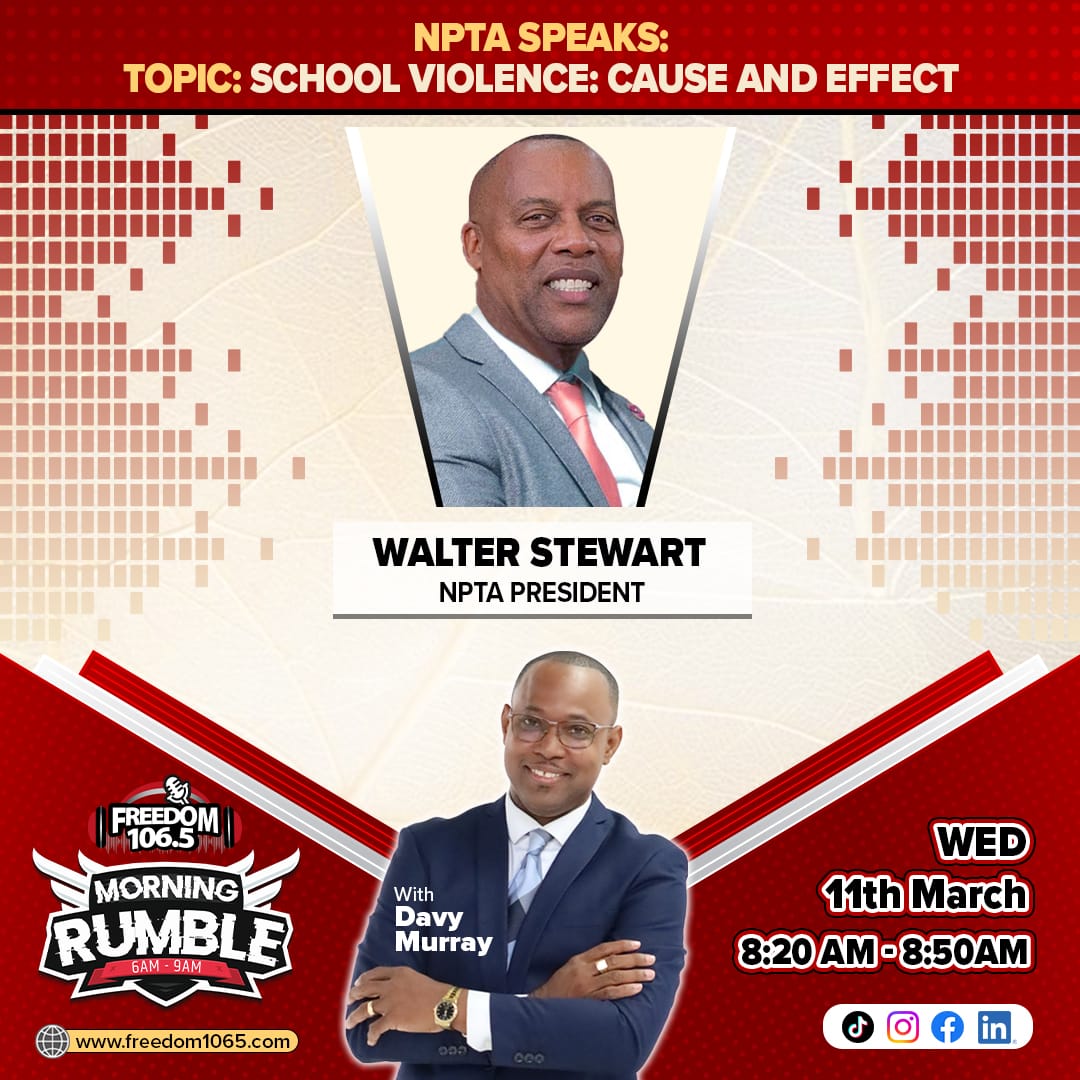
[00:00:04] Speaker B: 106.5. Good morning, sir. Is Excellency. His Excellency the President Walter Stewart.
[00:00:12] Speaker C: Good morning. NPTA speaks. And good morning to your listenership. So very happy to be here on this happy Wednesday morning.
[00:00:18] Speaker B: Indeed so. And it's a. It's a great morning. How's the weather outside?
[00:00:21] Speaker C: Oh, fantastic.
[00:00:22] Speaker B: Listen, this is my favorite time of the year.
[00:00:24] Speaker C: I'm telling you, I'm telling you, I
[00:00:25] Speaker B: don't look forward to the rain.
[00:00:27] Speaker C: I know it. I do, I do, I do.
[00:00:28] Speaker B: I wish March could go into April.
[00:00:30] Speaker C: Yeah, just the Sahara. That's the only concerned.
[00:00:32] Speaker B: Yeah. But that will ease up. That will ease up eventually.
All right, so I mean a lot has been said within recent weeks pertaining even the Prime Minister weighed in on some of these school violence. Apparently the school police and policing orient program.
I don't know, it's not yielding fruit.
[00:00:48] Speaker D: Yeah.
[00:00:50] Speaker B: The fights have moved from outside the school compound or within the compound of the school itself into the classrooms and disrupting the teaching time.
[00:01:00] Speaker C: Yeah.
[00:01:00] Speaker B: How does the NPTA feel about this?
[00:01:02] Speaker C: Let me start with the police in the first instance. And yes, when the police came into being 8th of September 2025, we gave full endorsement because we realized that with the number of suspensions, school violence, school indiscipline, there needed to be something put in place in order to address and deal with what was taking place in our schools. So we endorsed it. But after one term, and of course we almost into the second term, the end of the second term, we did not see a drastic reduction in discipline, even in those schools where there are police officers present. And that was our concern. I hasten to add that there have been gains. There have been some success stories in our schools and more so those schools with the police. But it has not been at the extent to which we had anticipated in terms of the drastic reduction in school indiscipline.
[00:01:54] Speaker B: I was recently told that the police officers themselves are facing challenges.
[00:02:02] Speaker C: Go ahead, go ahead.
[00:02:03] Speaker B: I was told reliably that school children in uniform cannot be arrested and placed in a marked police vehicle. I was told that those on the policing unit, they have to be very careful how they handle matters with students that cause a disruption in the school. So as much as the police presence is there, there are challenges for police officers to put handcuffs, escort the child into a market. You had a call in some instances. One instance I was told of a situation happening in the eastern part of the country and the nearest police Station had one marked vehicle.
They had to reach as far as Sandy Grande to get an unmarked vehicle that was on the next thing to leave to come down.
Also I was told that the officers to handle the school child in uniform cannot be handled by uniformed police.
This child had a knife.
[00:03:16] Speaker E: Yeah.
[00:03:17] Speaker B: What are you going to do? Peel orange? The knife was to stab another student.
The child was taken to the police station and put in a cell that caused problems for the judiciary.
[00:03:33] Speaker C: Yeah. Hello.
[00:03:34] Speaker B: For the, for the. Hello. Good morning.
[00:03:36] Speaker E: Yeah, good morning Davy
[00:03:39] Speaker B: Topic.
[00:03:40] Speaker E: Sorry, I wasn't listening to you.
[00:03:41] Speaker B: We're dealing with the NPTA speaks at this moment which is the school violence.
[00:03:45] Speaker E: You know how long I wanted. Well, apart from that, the number of people parents who really attend meetings of
[00:03:53] Speaker D: the PTA sometimes it's yeah, you might
[00:03:56] Speaker E: have a school with 500 children or let me say 400 children and if you get 25% of the parents going to the meeting, you get that because parents, the first thing parents must look at is what is school once again, you understand?
They don't want to know about the child's well being or anything. You know, is what the school want again.
And I don't know how, how the NPTA could try and you know, give some, some kind of solution, some kind of ideas to the parents that look, it's not just about school business, it's about your own child welfare, understand?
Because somebody parents. Well, I didn't know my child in this and I didn't know my child in that and I don't know the potential of my child because we're wrapped up in so many other things.
All right.
There are some will work through.
[00:04:47] Speaker C: All right, Let me say Devi that when you see a police officer in my day, and I'm talking a few years ago, the apprehension, the fear within you just by the sight of the police officer was enough to cause you to stand at the attention position. Almost figuratively these students these days have no regard, no respect at all for law enforcement. And this is what is frightening really because as I told another media outlet, when I saw the police on the left hand side of the road, I crossed the right hand side. I wanted to have nothing whatsoever to do with the police officer. Because of the apprehension, the fear of the police officer, these students are almost standing up to police officers without any regard or respect for the police. And this is concerning city natis.
[00:05:35] Speaker B: You know we learn that on Sesame street, you know, yeah.
A policeman is someone in your neighborhood, in your neighborhood. And we were taught on Sesame street to respect the policeman yeah.
Now this situation that I'm telling you about, it happened. The student was arrested when the seniors came to the station and realized this child, this minor in secondary school is in a station cell.
[00:06:06] Speaker C: Right, Right.
[00:06:07] Speaker B: There was order to take him out because that is problems.
So understand the limitations of police officers. This is a true story. An officer shared with me that he went through one of his colleagues in the station. He was present, he saw it.
Seniors, they take that boy station and then you get to. He said, you know, we cannot put a child. And these are things that the public is not sensitized and rightfully swear. Because if children know.
[00:06:36] Speaker C: Yeah.
[00:06:37] Speaker B: That you can't touch me.
[00:06:39] Speaker C: Exactly.
[00:06:40] Speaker B: Understand?
So I am now wondering if we have reached a stage where to improve this product.
[00:06:47] Speaker C: Yeah.
[00:06:48] Speaker B: That you all endorsed last term.
[00:06:50] Speaker C: Yeah.
[00:06:52] Speaker B: Instead of two uniformed officers.
[00:06:55] Speaker C: Right.
[00:06:55] Speaker B: How about three? Got you one uniform.
[00:06:59] Speaker C: Yeah.
[00:06:59] Speaker B: Two uniformed.
[00:07:01] Speaker C: Yeah.
[00:07:02] Speaker B: Police officers.
[00:07:03] Speaker C: And you see Devi as well. There are many acts as well governing the introduction of the police officers in school, including the Judges Rules, Children's Act, Education Act. All these things came together.
[00:07:13] Speaker F: Yes.
[00:07:13] Speaker C: To consider that. So that there might also be need to revisit as well these acts and come up with the best fit for this presently taking place in our schools as well. But I agree with you as well, if at all, you cannot arrest, and you are correct, you can't arrest a student in uniform. There needs to be an addition or a replacement of the officer. One officer in the school.
[00:07:37] Speaker B: We had to revisit this.
[00:07:38] Speaker C: Yeah, certainly.
[00:07:39] Speaker B: Because the police officer that shared this intel with me.
[00:07:42] Speaker C: Yeah.
[00:07:42] Speaker B: He said, David, it is very concerning. He said, but the public needs to be made aware. Because he got fed up, he said, because we limited the public blaming us. They're crying out to us. But you know how much rights children have.
[00:07:56] Speaker C: Yes, correct. And the students are aware of this. You know, they are fully aware of this. Why they are taking these brazen acts. Fully aware.
[00:08:05] Speaker B: They're cognizant.
He says, you have no idea that the challenges. And I sat down there and I said, talk to me.
[00:08:13] Speaker C: Good.
[00:08:14] Speaker B: I gave him my.
Oh, gosh, the word just not promise. Now, I gave him a word.
[00:08:23] Speaker C: Assurance.
[00:08:23] Speaker B: Assurance. That's the word. I gave him my assurance that I would not reveal his identity.
[00:08:27] Speaker C: Okay. And for good measure. Yeah, yeah.
[00:08:29] Speaker B: Because he's not authorized to speak on behalf of the Toronto Tobago Police Service.
[00:08:32] Speaker C: Right.
[00:08:33] Speaker B: But he listens to the program.
He met me.
[00:08:36] Speaker C: Good.
[00:08:37] Speaker B: And this happened on Sunday, or was it Saturday?
[00:08:39] Speaker C: Saturday, yeah.
[00:08:40] Speaker B: Yeah. This was recently. And he shared the incident.
[00:08:43] Speaker C: Great, great.
[00:08:44] Speaker B: So I was made up. I'm saying are you serious that I'm telling you we cannot put the. The child in a school uniform on the school compound in handcuffs and put them in a marked police vehicle in the back and rush that we can't do that.
[00:08:59] Speaker C: So. Correct.
[00:08:59] Speaker B: He's so going before the courts and child Akan or he said you have no idea. So while the public employ embrace the ideology of police officers.
[00:09:10] Speaker C: Yeah. Do they know exactly.
[00:09:13] Speaker B: Exactly the parameters in which we govern
[00:09:15] Speaker C: by and we should make ourselves aware really of what is enshrined in those accent in those laws. Yeah.
[00:09:21] Speaker B: And why he spoke out is because he said he fed up with the police officers being good ones being blamed for not being able to do their jobs effectively when they have no idea as much as we want to do this.
[00:09:35] Speaker C: Yeah.
[00:09:36] Speaker B: When we do this if we don't cross our T's and dot our I's or follow a particular trend or the policies and the act we cannot successfully prosecute and we land ourselves in hot
[00:09:48] Speaker C: water behind the scenes there was somebody who said Toothless. Bulldog.
[00:09:52] Speaker B: Toothless.
[00:09:53] Speaker C: Toothless. Yeah.
[00:09:54] Speaker B: And you know I. I raised this issue because I wanted you to say and I wanted your shocked expression.
[00:10:04] Speaker C: Yeah.
[00:10:05] Speaker B: So that you could take this back to the drawing board and and share your thoughts as to what the NPTA thinks needed is needed because I saw you sitting on next to the big bullies and.
[00:10:14] Speaker C: Right. I was not going to mention that. Let me do an open door policy.
Excuse me with the TTPS DCP Benjamin Jr Benjamin who is as worthy goal commander for this whole SOPO school oriented police unit. We do have frequent interactions with him as a matter of fact I'm sure that one is due very soon as well because as we come to the end of each term as we did last term we come to the end of the second term we normally would convene a meeting to see what progress or lack thereof has taken place with regards to the police in schools. So very soon I'm sure because to meet with DCP Benjamin again and see what progress we have and we are hoping that it's going to be positive.
[00:10:50] Speaker B: Well based on the reports we are getting with the increased violence affecting teachers time.
Let's talk a little bit about that. I did hear you speak on another product dealing with the time that is lost in the classroom when students behave indecently. Hello. Good morning. Quickly.
Good morning.
[00:11:09] Speaker F: Good morning.
[00:11:09] Speaker B: Good morning.
[00:11:11] Speaker A: I'm a simple to the program here and I do believe that the child is not too small to break the law. Too young to break the law.
He's not too young to be arrested and place where the adults are placed. I also do believe that parents should be held accountable for the crimes their children commit.
They also should be taken to court.
And in doing such, I believe the parents would pay more attention to their children.
I also believe that there are times when not all is students and students will have their thing.
Teachers also should be trained to deal with children because they could provoke children to anger as much as parents could provoke children to anger. But I do believe where the law is concerned, the law is the law. And from small they should be taught to obey the law. Thank you.
[00:12:31] Speaker C: Three issues there that the caller just mentioned. Consequences for your action. Yes, we. We agree that there has to be.
[00:12:37] Speaker B: Well, there's juvenile court. We have juvenile court.
[00:12:39] Speaker C: Exactly.
[00:12:40] Speaker B: We do have juvenile.
[00:12:41] Speaker C: We have to be guided by that. She also spoke about the draft policy. And of course we are looking at a draft policy. I'm told that the information the draft is prepared. We have not gotten sight of it as yet. But there is going to be a policy document with regards to parental responsibility. A law is to be passed with regards to that.
[00:12:56] Speaker B: Because one text is saying, when are we going to deal with the root of the problem? The home, the parents and the community. Quickly. Good morning.
[00:13:04] Speaker D: Hey, quickly.
What we seeing is that you see anything about it. We have, we have. We have a kind of change in.
In practice and custom in terms of how children relate to the adults and how adults. Because I really did children in terms of like discipline. Remember there was a day when anybody could have discipline a child. Once you're an adult and you did not go and say anything that era has gone out the door. So we depend on. Strictly on the parents. And sometimes you want to use somebody on the outside might be able to see. To see something. But look, I had a big channel like that because I happen to have had my children mother two children before and that made me big that one the biggest background they ever had before when they were young. Because when I try I being a disciplinarian coming from discipline and background when I try to discipline those children. But they didn't have an issue with it. The parents and the relatives had an issue with it. And I know today now they are kind of regretting because one of each other and kind of didn't, didn't. Didn't keep along the line and they were getting. Because they realized that what I was saying is right. It takes them only 20 years to realize what Marlon are saying. But they couldn't see in those days somebody what we could do. We can't. We can't drop our hands. We just see what we can do in our little corner. And when the Lord does come, we try to treat it as best as possible. But that is practically possible.
[00:14:15] Speaker B: All right, thanks, Morales.
One texter is saying the NPTA needs to take some responsibility as the last caller. The need to get more parents engagement, the TTPS is the best step at this time, but can build on and improve now, to be fair.
[00:14:30] Speaker C: Yeah.
[00:14:32] Speaker B: In the installment of this product and for the better part of the installment of this product to freedom. We have delved deeper and deeper into the npta.
[00:14:43] Speaker C: Correct.
[00:14:44] Speaker B: The sub bodies, which is the pte.
[00:14:45] Speaker C: Right.
[00:14:46] Speaker B: And the engagement.
[00:14:47] Speaker C: Yes.
[00:14:47] Speaker B: So the texture that the calling had said that what m teachers want to gain is money.
We had Ms. Glasgow on the program explaining in detail, a five point detail as to what the Parent Teachers association is doing. And it's more than just a big sale.
[00:15:02] Speaker C: Exactly. More than fundraising, more than. Right, yeah.
[00:15:04] Speaker B: You are clear. So what will happen?
We will continue to revisit how the NPTA is engaging parents, of course, and
[00:15:11] Speaker C: the importance and relevance of the npta.
Let's talk about the classroom disruptions because I think we started on that trajectory. Last Wednesday the minister launched the National School Code of Conduct. It's a revised version because the last one was done in 2018. So the revised version is February 2026. So he launched it. Of course, it's as far as I'm aware, not yet on the website. And we are looking towards getting that document on the website. And he revealed in that particular launch that there has been an increase in school disruptions in the classroom. So it has now moved from outside the school, the prisons of the school and now enter the domain of the classroom in the presence of a member of staff.
So that again, no regard, no respect for authority, the teacher and they are now brazen bringing their disruptions and the infractions in the classroom.
And the minister made reference to this term or last term into this term. It moved from 401 to 544 infractions in our schools in the presence of a member of staff. And this is definitely troubling and startling to us as the npt.
[00:16:27] Speaker B: Now your thoughts? Well, another call is coming through. Hello. Good morning.
[00:16:31] Speaker D: Yeah, hey, Mr. Walter Pleasant.
[00:16:33] Speaker E: Good morning.
[00:16:33] Speaker D: And to you all again, you're happening right. You see, that boy is down to discipline from respecting elders. They take for instance a day my son, he tell him dies your work, he Messages reach me I just be contacting everybody as a partner what's happening you turn toilet because I mentioned me one time because that's how you operate I was connected with everybody guard Mts everybody one time so I was a parent and the MPL but here everybody is a is somebody to watch out for your child another day again your class he ain't no I got information so you see these are the, these are the kind of watchdogs what's, what's, what's your knowledge we have to look but if we're not receptive to the people who watching our children like the guards and not teach alone we we wouldn't get anywhere so we have to kind of sanitize parents that here happening Everybody's our watchman yeah and let's just have everybody in the group to all hands on next thing blessings man bye
[00:17:31] Speaker B: thank you very much Showin Ali from San Fernando General Hospital locked in strong Good morning to you thank you so much as it relates to the teaching time yes when these disruptions happen let's speak a little bit about that but hold that thought quickly hello. Good morning quickly hello.
[00:17:48] Speaker F: Hello. Finally Devi Devi we always blame the teachers and we always wanted teachers to do everything and I don't even hear the parents is being blamed only the teachers and the teachers is roughing up the children David is not all teachers does that maybe one or two and you know we are not getting the resource what to do with these children.
If you know a child is violent and it's not only one child right. You will tell me somebody take a chair and hit somebody child in their head and kill them. How are we going to accept that?
How, how it is a parent going to accept that?
[00:18:38] Speaker A: Okay, you know I hear you so
[00:18:39] Speaker F: you, you, you have a lot of places that is empty government buildings Make a school and take all these children put them in that school let them fight and kill each other that's all I can say I don't want to say so but these children don't want to learn and it's time we accept that these children is not going to school to learn Their parents are forcing them the societies you know talking the children, children, children. Children don't fight and beat people children to that extent children go to school to learn all right and these are you know so baby I hope the authority is listening thank you make a school for these children they are different
[00:19:24] Speaker B: I hear yeah but you see they fight and kill each other I don't like that statement but thank you very for sharing. Yeah, but still.
Yeah, but that wasn't in Trinidad. That was. That was not in Trinidad.
[00:19:34] Speaker C: Sorry.
[00:19:35] Speaker F: I'm sorry.
[00:19:35] Speaker E: But.
[00:19:35] Speaker B: But that's fine. No, that's fine. You know, I. I don't have a problem with what you said. You are correct. But you see, the statement about put them in a place, let them fight and kill each other. That was a little, you know, far reaching.
[00:19:46] Speaker F: I accept. I'm sorry about.
[00:19:48] Speaker B: No problem. I understand your passion.
[00:19:49] Speaker F: My God, you tell me children have this type of vexation and anger to break up people. Children hand.
That is what I mean. I really didn't kill. But oh, gosh, it's time they do something.
[00:20:05] Speaker B: I agree.
[00:20:05] Speaker F: It's only talk, talk, talk, talk. And nothing is being done with these children.
Debbie, one thing. PTA meeting. I understand parents have to go to work. You will tell me one day a month parents make an excuse to go to a PTA meeting.
That is not accepted.
[00:20:24] Speaker C: Yeah.
[00:20:24] Speaker F: You know, they leave everything for the teachers.
No, that is wrong. Okay, baby, have a good day. You do a very good program. But anytime I call, I don't get you.
[00:20:34] Speaker B: Of course. Keep trying, baby. Keep trying.
[00:20:36] Speaker F: Yeah, I got you. After I don't know how long I got you.
[00:20:39] Speaker B: I appreciate that.
[00:20:39] Speaker F: Take care.
[00:20:40] Speaker B: Thank you very much.
[00:20:41] Speaker F: And I'm sorry again for.
[00:20:42] Speaker B: It's okay. I understand the passion. Yeah, you see, sometimes we understand the passion. You know, I get the passion that you're coming with. Hello. Good morning.
[00:20:51] Speaker G: Hi. Good morning.
[00:20:52] Speaker F: Devi.
[00:20:52] Speaker B: Good morning, my dear.
[00:20:54] Speaker G: Calling from San Francisco. Davy. I used to be a bus driver and taking children to school.
[00:21:01] Speaker F: David.
[00:21:01] Speaker G: Long ago, maybe 10, 15 years ago, David children was much obedient.
Now I don't know what kind of children. I can't even talk to them. I had 10 children current to school. And when I talk to them, I talk to them like a mother. And David, they used to listen.
[00:21:19] Speaker F: Yeah, right.
[00:21:21] Speaker G: And even outside.
[00:21:22] Speaker F: Yeah.
[00:21:22] Speaker G: You see on the street, the children, you're talking to them and they're obeying. Although they don't know you. They're just seeing you. By taking up children from school.
They've been out. No children. More than these children is a different kind. It's a different kind of era. I don't know why they just be getting on like that.
The parents. The parents have to train the children more. But the parents can only see when they're home.
When they're home, there's very nice children. But when they all. Dear Davey, is something else.
Thank you, Davey, for taking my call.
[00:21:56] Speaker B: Appreciate that. Now we Never blame teachers.
President Walter Correct.
[00:22:03] Speaker C: Correct.
[00:22:04] Speaker B: Never blame teachers. I want to put that out there. What we do say about teachers is that the responsibility is heavy on them. We tend to want them to parent our children when they're there to teach our children. Teach and guide them.
[00:22:18] Speaker C: Yeah.
[00:22:19] Speaker B: And supervise them during school hours. That's what you know.
[00:22:23] Speaker C: I know. We are coming to the end of the session and probably we should continue this conversation. Yeah.
[00:22:27] Speaker B: Next week you come in.
[00:22:28] Speaker C: Of course. Yeah, definitely. Definitely. I'm here next week. I was wanting to mention you point about the learning loss and you were correct. Every time a teacher stops the class session to address a disruption or infection in class, there is learning loss. There are 39 instructional weeks in an academic year of a school. And every minute, every second, every hour of that instructional time is critical and crucial to learning. And students have to understand that every time that you do something wrong and cause Miss or sir to be able to correct you, you are denying yourself crucial learning time. And learning loss is definitely what we have to look at when it comes to these interactions taking place now, not outside the school, you know, but in the classroom in the presence of a
[00:23:10] Speaker B: teacher because it disrupts.
The teacher may be going through a particular paragraph or one of the. On the syllabus where they reach page 59 and they're going through these sums or whatever it is. And then you come with your nonsense behavior and sometimes the teacher gets injured.
[00:23:28] Speaker C: Yeah. As well as well in the person's. Yeah.
[00:23:31] Speaker B: Hello. Good morning.
[00:23:32] Speaker E: Hello. Good morning.
Devi.
Many years ago it had a song.
[00:23:38] Speaker B: I think it's the Fossil Sing Song.
[00:23:40] Speaker E: Delinquent children.
[00:23:42] Speaker A: We still haven't got children in this present time.
[00:23:46] Speaker B: All right, thank you.
One texter is saying while it may be easy to place blame on the NPTA or teachers, this issue did not originate within the school system. The behaviors that we are witnessing are learned at home. Some students enter school with no intention of learning and instead of come prepared to disrupt the environment, this includes violence, disrespect, drug distribution, sexual misconduct and other serious offenses.
These realities can no longer be ignored or minimized. Schools must be safe, so spaces for everyone and students who consistently show no interest in learning and pose a risk to others must be removed from the general school population.
Another one says we need to create something like Riker's Island Correctional Facility for juvenile offenders and get some as an in house educational facility.
[00:24:45] Speaker E: Morning, Devi Davy.
Your school uniform should not give you diplomatic immunity if something is illegal. Out in the street, in the market, in the malls and all over the place, if it's illegal there, it should be legal in the school.
And criminal activity in the school should not be defendable because you are in the school component wearing a uniform. The laws of Trinidad and Tobago should apply.
Thank you.
[00:25:14] Speaker B: Again, I am not speaking about a situation because I feel to put my mountain gear. This happened to a police officer who shared his experience and his encounter within the last couple of weeks with me.
[00:25:30] Speaker C: Yeah.
[00:25:31] Speaker B: And this knife wielding student on the compound when the officer searched because there was a report that he pulled out the knife in some altercation.
He's a bully, an alleged bully in the school. The officers found the weapon in his possession.
They arrested him and put him in the back of a marked police vehicle.
[00:25:51] Speaker C: Yeah, yeah.
[00:25:53] Speaker B: And only to learn when he got into the. Into the station, one officer take the man, the boy and put him in his cell. When the senior came, came in and about an hour or two later, hour later, and recognize a child in school uniform is in a cell in the station.
[00:26:10] Speaker C: Yeah, yeah, yeah, yeah.
[00:26:11] Speaker B: Despite what. Yeah, he instructed with him, take that child out immediately. Yeah, that child, you had to put them on a bench or in a room and get a parents. You can't. So he says, Davy, so what? Dosta said the Lord, they don't have diplomatic immunity. And I agree.
[00:26:28] Speaker C: Yeah, yeah, we understand that.
[00:26:29] Speaker B: Then the authorities need to reconstruct.
[00:26:33] Speaker C: Yeah.
[00:26:34] Speaker B: The act, of course, as to how police are able to treat with violent students.
[00:26:39] Speaker C: That's right. Yeah. It's almost as though your hands are tight behind your back. Almost as though. So that there has to be a revisit. Definitely.
[00:26:46] Speaker B: Yes.
[00:26:47] Speaker C: Correct. Yeah, definitely, definitely. So, I mean, we continue with this. Definitely.
[00:26:53] Speaker B: We. Four minutes away from TUSCA coming in and we have to wrap the NPTA this morning.
But next week we will revisit school violence. We would revisit some of the points that President Stewart shared as to the plans to engage parent and get them more involved into the PTA meetings. Understanding it's not a fundraiser.
[00:27:14] Speaker C: Correct. Definitely.
[00:27:15] Speaker B: Let's take a final call. Good morning.
Hello.
[00:27:20] Speaker E: Hello.
[00:27:21] Speaker B: Good morning.
All right, let me see if it's on this line. All right, that's two.
So in conclusion, Walter, your parting words?
[00:27:30] Speaker C: Well, that we are looking at the. Excuse me, parental responsibility draft today. As a matter of fact, incidentally, we are. We are going to be having sight of it and we are going to be able to make our constructive amendments and recommendations relevant to this particular bill. Because the jury is out there. There are so many issues surrounding this parental responsibility that one needs to look at because you don't want to just cast a brush and everybody's taken up with that brush that you are casting. So it's something that we are looking at. But with regards to the schooling violence, it's a perpetual issue and you have to definitely look at it on an ongoing basis and see how best you can amend when necessary, collaborate when necessary in order to come up with the best fit to address this schooling discipline, not rampaging our schools.
[00:28:14] Speaker B: Would you think for a minute that we. That you would want to discontinue the sopo?
[00:28:19] Speaker C: No, not at all. Not at all. I would want to definitely call for an intensification what is taking place with regards to the SOPO and the involvement in our schools.
[00:28:27] Speaker B: So with that being said, we thank everyone for joining in this morning and being part of the NPTA speaks. We appreciate it says at my child's school, a student recently entered the compound with an 11 inch knife. Additionally, there's a growing trend where students engage in physical, physical fights, deliberately injure one another and then dismiss the incidents as play fighting. These behaviors pose serious safety risk. Yet students involved in such incidents are often allowed to remain within the school system. This raises serious concerns about accountability and safety. How are these issues being addressed and why are such dangerous behaviors tolerated? Assault is.
Is illegal in the school system. The thing about it is that that student that had that knife.
[00:29:15] Speaker C: Yeah.
[00:29:15] Speaker B: I don't know if it's the same incident, but the police did remove the child of the compound.
[00:29:20] Speaker C: Right? Right, right.
[00:29:21] Speaker B: But look at the legal ramifications. The officer. Look at the hot water.
[00:29:24] Speaker C: Yeah.
[00:29:24] Speaker B: The officers found themselves in not understanding that they put handcuffs on the child
[00:29:29] Speaker C: in uniform, in the back of a
[00:29:32] Speaker B: marked police vehicle and in a cell in his station.
[00:29:35] Speaker C: Exactly.
[00:29:36] Speaker B: Watch me.
[00:29:39] Speaker C: Without parents. Exactly.
[00:29:40] Speaker B: But the child committed the afternoon.
[00:29:43] Speaker C: That knife, that knife that was reported
[00:29:46] Speaker B: where he was wielding it.
The police catch him, they catch the weapon on his possession, they acted.
[00:29:52] Speaker C: Yeah, yeah, yeah.
[00:29:55] Speaker B: There was another incident at this, at the school.
But because of that FL first they had to call.
[00:30:02] Speaker C: Okay.
[00:30:03] Speaker B: For two uniformed on duty officers in an unmarked police vehicle. So I asked, I said, could the police officer use their private vehicle because. And change the clothes and come. He said, no, no. You had to get a police vehicle that is unmarked and two. And if it's female, you have to have a female police. But they mustn't be in uniform, Correct?
[00:30:23] Speaker C: Yeah.
[00:30:23] Speaker B: And they pick up the child and take them to the station, get the parents or guardian involved. But the child does not go in a cell.
[00:30:29] Speaker C: Right.
[00:30:30] Speaker B: The child goes in a you have to put a child to sit down somewhere secure them yeah and and deal with it folks.
You had to be in the new oh yes because we blame police officers and that is the and I want to say good morning to him I know he's locked in and he says thank you very much on our WhatsApp for not revealing his identity. I said I did give you my word I wouldn't he said but his colleagues are praising us this morning for raising the issue I can't tell you all which police station in but he's saying that grateful that we raised the issue because the officers often get blamed yeah why they're not doing something when the public is not sensitized to understand that they are limited in how they can act they are so thank you again President Stewart. We'll continue with the discussion next week inside the NPTA Speaks.
[00:31:08] Speaker A: You're tuned into the all new Freedom 106.5 106.5.