Episode Transcript
[00:00:00] Speaker A: You're tuned into the all new freedom 106.5, 106.5.
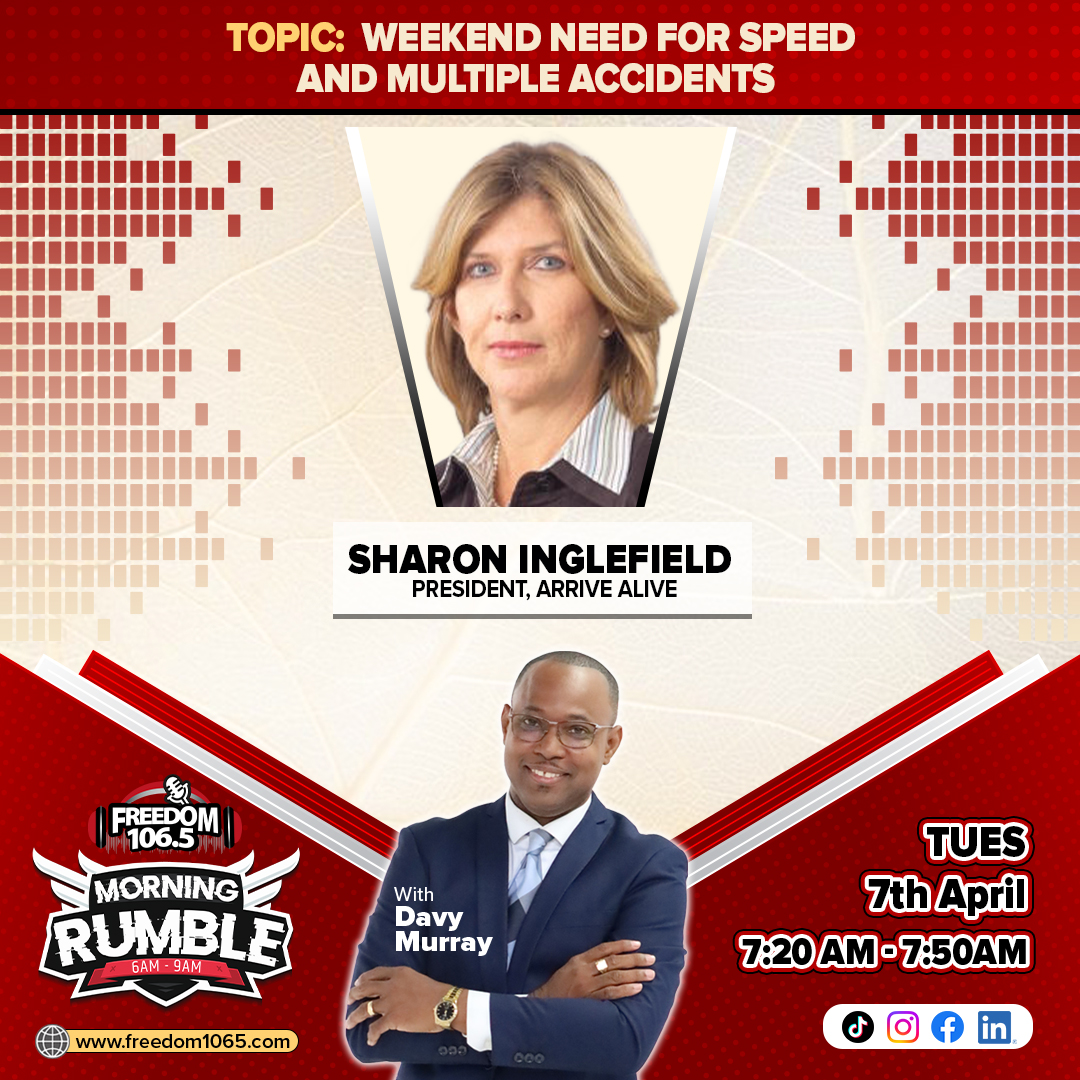
[00:00:06] Speaker B: Let's turn our attention and welcome our guest this morning. Good morning to you, Ms. Ingle. Englefield, is it? Let me just.
Yes, good morning to you, Ms. Englefield.
You are muted.
You'll have to unmute on your end.
[00:00:23] Speaker C: Sorry about that.
[00:00:25] Speaker B: Good morning.
[00:00:26] Speaker C: Good morning. Thank you for having arrival live on your program this morning.
[00:00:30] Speaker B: Good morning to you, Madam President. You know, when I looked at what took place within the last, not just over this Easter weekend, but in recent weeks, we would have seen the carnage on the nation's roadways and even persons who are in one instant driving home from a church, you know, being present at a convention, at an assembly, and coming home on the opposite lane side of the highway, driving within the permits of the law, minding his own business and lost his life. You know, when you look at these type of things taking place as a, as a fraternity, how does that, how do you all feel? What suggestions do you all want to put forward to government to help mitigate these challenges that we're facing on the roads today?
[00:01:21] Speaker C: Well, first of all, you know, we feel very despondent, very disappointed.
You know, we obviously will not give up hope, we will not give up advocating for safer roads, safer drivers.
And you know, the suggestions are much, much more the same, the same suggestions that the police officers need the tools they need to do their job. They need to be out there more consistently, more regularly on a field Friday, Saturday and a Sunday, particularly in the evenings after 8pm when most of these fatal crashes occur. The police need the tools they need to do their job. And I repeat that that means calibrated breathalyzers and speed guns for night vision. The police still don't have the tools they need. And therefore you cannot expect the officers to be out there risking their lives when they do not have the tools they need to keep the drivers, the passengers, road users in general safe.
[00:02:32] Speaker B: What do you think is needed in the immediate future?
[00:02:37] Speaker C: In the immediate future would be exactly that. Provide the police officers with the speed guns, with the calibrated breathalyzers and ensure they're out there, particularly on a Friday, Saturday and Sunday from 8pm when we know from the data that the fatal crashes occur. We know this from the data that is provided.
The majority of our fatal crashes are serious crashes at night on a Friday, Saturday and Sunday.
[00:03:10] Speaker B: You see.
Oh, my apologies, Madam President. I didn't know. You didn't finish because I was going
[00:03:14] Speaker C: to make the point okay. And the majority of these collisions are male. 80% of them are male, probably more like 90% for this year.
And they're older male drivers. The drivers that are overconfident that things speed, you know, they can drive. So it's okay to speed, it's okay to drive above the speed limits. They're not taking the road conditions into consideration. Wet roads, roads with potholes, roads that are probably not, you know, the infrastructure is not at its best with well maintained guardrails and barriers, native bridges, so that speed, speed, speed, we need to slow down. We need to remember that on wet roads, we need to adapt our speed to road conditions. The speed limit is not a target.
[00:04:08] Speaker B: Police car be everywhere. And you talk about the speed guns, the guardrails, more presence of police officers on the nation's roadway, but have arrived alive. Engaged in any meaningful discussions with citizens outside of just government stakeholders as how we can meaningfully bring about the change of the driving culture in Trinidad and Tobago. Because outside of the fact that if I see the officer go, slow down, if the officer is not present, what happens?
Why are we still having this innate within us to want to speed, to want to drive recklessly on the roads? How is our rival life thinking that we should change the mindset of our citizens to do better driving on the nation roads?
[00:04:52] Speaker C: Arrival life is out in communities. We're out there in schools.
We're invited to borrow days. We're out there all the time educated and advocating for better behavior amongst our drivers because the responsibility is really on our drivers to slow down. The responsibility obviously starts with me, the driver, to be accountable for my own road safety and the safety of other road users once I am behind the wheel of a car. So we are out there with the breathalyzer. We're out there with our booklets, our flyers, our games, providing the public with vital education. If you go up on our website, on our Facebook page, Instagram, you see we also run campaigns, myth versus fact. So we're out there trying to do our part. Unfortunately, obviously, resources are not what we would like them to be. And we cannot run an advertising campaign on television and in radio.
You know, that's. That's consistent. We obviously need a more consistent educational communication campaign, which we do not have the funds to do.
We do network with sponsors, asking them to provide us with resources so we can run a more effective road safety campaign.
But, you know, it's not always possible. So we are out there, we're asking schools, if we have not already been into your school, because we Believe that engaging with youth, educating the youth is very, very important.
We are also in consistent conversation with the Minister of Transportation, Civil Aviation with regards the upgrade of the licensing examination. So we're educating drivers on risk and hazards prior to the granting of a driver's license at the licensing office. So we're in constant communication with the Minister about that.
So, you know, it's a work in progress. It's a constant work in progress.
[00:07:02] Speaker B: The thing about it is, with the removal of the demerit points, do you think that that had any bearing on what is taking place? Is the statistics showing that under the demerit point system there was a reduction in road fatalities and the need for speed and with the removal, what does the stats show? What does the data show right now?
[00:07:21] Speaker C: Well, the data does show a decrease in the number of fatalities this year as well as last year.
And that is directly due, no doubt to the doubling of fines. So you have less drivers on the road without insurance, without a valid driver's permit and without having their vehicles inspected.
So the drivers that were breaking the law when the fines were increased, they certainly went into the licensing office with their vehicles, if they could afford it, to have proper inspections to ensure their vehicles were safe, as well as to ensure that they had a valid driver's permit and insurance. So that's very, very important to note that the doubling of fines did impact on the decrease in the number of serious collisions and deaths. However, every life matters and we are not satisfied that what we're doing is good enough. We all have to work together as stakeholders. And the drivers that continue to drive recklessly, we need to deal with them decisively, which means demerit points and it means taking them off the road if they continue the reckless driving.
So we at arrival, I do still believe that the demerit points worked. We did not have enough years for the demerit points to prove itself. We do know, according to our guesstimates, that about 40,000 drivers may have been taken off the roads due to demerit points and just repeating the same offenses over and over again. Like speeding, like not having insurance, like driving on the priority bus route, like releasing on the nation's route as many as perhaps $40,000. And we need to re educate those drivers to ensure that they understand the consequences of reckless drive and the consequences of their actions. So re education is very, very important within the Ministry of Transportation, Civil Aviation.
[00:09:23] Speaker B: All right, let's take a call quickly. Hello, Good morning.
[00:09:25] Speaker D: A pleasant good morning, Davy. And a pleasant good morning to your president. Alive. Arrive alive.
[00:09:31] Speaker E: Mom.
[00:09:33] Speaker D: Your organization has been doing a good job, but many of us will know the same things that you will advise people. What happens is that the market audience who really need this education don't really come to the meetings and so on. What I want to suggest to you is that just like you have the Alcoholic Anonymous that have groups in every area, maybe you can consider doing that and maybe people in the area can help you to find the target group who really disobeys the law on the road. I thought I should mention that to you and I wait on your response. But as I leave here a magistrate has the power to take one's license. So the demerit points may not be the only system of taking actually causing someone the license to be revoked. So we do have a system in place for errand drivers who continuously do it and so on. I'll wait on your comment. Thank you.
[00:10:33] Speaker E: Enjoy.
[00:10:37] Speaker C: We welcome your advice and we hope that you would volunteer with us because we do need to spread our wings.
Unfortunately we're a very small organization and a very small NGO and we need many, many volunteers to go out there and to do presentations within the community.
We are in fact doing that. We have maybe five or six presenters that go out within the communities to do presentations and you're welcome to invite us to your community, but we do need many, many more volunteers coming forward to do these same presentations.
So thank you for that. We do appreciate all feedback.
[00:11:19] Speaker B: Karen Essential. I thank you very much for engaging the president this morning. Let's take this other call quickly. Good morning.
[00:11:26] Speaker A: Hello. Good morning. Good morning again. David. Good morning to you guest there.
[00:11:29] Speaker B: Good morning Master Williams.
[00:11:33] Speaker A: I was scrolling through YouTube doom scrolling and I saw some very high impactful advertisements and I want to my takeaway is from what you said in terms of advertisement. I really think other than you know, occasional interviews like with DV and other interviews, I think you know the ads will be high impactful because look at what mass media multimedia is used for and it is very effective. So I want to say that that's one that's the main direction that they could have and I do hope you get support in disregard. You know that they have constant ads running that will impact people. That will impact people. Divya looks harder now Senator, you are talking about really crying when you see the advertisements about speed and stuff like that. So I really do hope you could improve on advertising your concerns and your safety concerns. You know, as far as you know being safe on the road is concerned. Thanks.
[00:12:31] Speaker B: On the Snowflake thank you very much, Master Williams. One of the things, Madam President, people have a tendency our culture, we only take note when it hits home.
So if we did not lose someone to a road accident, an rta, we didn't ourselves almost have a near death experience or something like that effect.
We don't take it seriously. We feel sorry if we see the accident. We come up, we take pictures, we want to be the first to post it up on socials. But are we, is that really reshaping our culture as a citizenry, as a society as to how we approach driving on the nation roads, we must be cognizant of the fact that we have to drive for not just ourselves, but for everyone that's around us.
Because the person that took the life in that RTA on the highway, when he left one, he left the southbound and ended up on the northbound.
He's alive.
Yes, but the other guy who was doing his due diligence is in the morgue, you know.
[00:13:36] Speaker C: Absolutely. And that's what is extremely sad, that those crossover collisions, often it's the innocent that die and the driver that's been speeding on the highway is the one that lives. And that's what's tragic. And every life does matter.
We do have campaigns on our Facebook page and our Instagram and it would be fabulous if the media would share them, share them with the public on your platforms. We have many, many ads going right back in the good old days to Kess when Kess first volunteered to do ads for us when we had that tragic collision in San Fernando when the twins died, you know, female twins died, the vehicle was actually caught up in the bridge.
A most bizarre position for vehicle to end up.
So we have lots of road safety, you know, messages and advertisements and we do share foreign ads on our Facebook page and foreign information internationally, benchmark standards on our social media. We continue to do that.
We invite all the media, all of TNT to go up and read and learn and educate yourselves and not only listen to the hearc because when we
[00:15:00] Speaker B: look at the certainty of punishment rather than the severity, I think that's the direction according to one text that Benny said that we need to go. But let's take for a minute the licensing. Would you say that in order to have someone, oh gosh, the word just eluded me now update their license? Do you think a defensive driving course should be part of the curriculum in terms of persons getting their license? Should we increase the age from 17? But as you mentioned, the data is showing more seasoned drivers are causing these Infractions. What do you think again, added to what you said earlier with the speed guns and the all these presence with the police, what additional infrastructure you think is necessary in order for us to really nip in the bud these tragic incidents that is unfolding in our own roadways?
[00:15:54] Speaker C: I think we need to completely revamp our examination process prior to granting licenses of all classes of vehicles. We need to include hazard perception, risk management, which is all part of defense driving. We need to teach about the effects of alcohol on the mind and the body, reaction time. We need to teach about destruction. We need to teach about, you know, drugs and driving.
We need to teach about sleep. All of these consequences that could result in a fatality.
You know, learning about your body not doing proper medicals and eye tests, testing all that should be part of a license and examination, that you're not paying a doctor from across the road to fake your medical examination, etc. All of that has to stop. The corruption in this country is endemic and it has to stop. It's costing us lives. It's costing us the lives of mainly our male in TNT.
As I said before, more than 80% of the of the fatalities are male breadwinners. So more and more families are in economic crisis due to losing breadwinners. So we need to revamp that licensing exam and ensure that it's more robust and that we teach the consequences of the actions that we are taking every day in our nation's rules. We also therefore need to re educate re engineer the mindsets of existing drivers and call them back in to re educate them. And the only way to do this is via penalty point system of the most serious infractions on the roads. We already have penalty points for drinking and driving and for reckless driving. We need to include it for other infractions as well, like speed. Speed should definitely have penalty points attached to it. So the drivers that are to going going beyond the speed limit, drivers that are not adapting speed to the road conditions, their speed to the road conditions, are called in and re educated on the consequences of speeding on wet roads, on roads that don't have proper infrastructure in place, roads that may have potholes. We need to re educate those drivers on the consequences of speed. Those must have penalty points attached and we need to re educate the drivers.
Arrivalive is willing to help, but we also need to open up an RFP to other again which is what was done in the first place. A request for proposal to other NGOs as road safety NGOs as well as defensive driving schools to teach and re educate those existing drivers and try to re engineer their mindsets. I think that is vital. Education is vital, but we also need to enforce the law. And the officers out there need the tools they need to do their jobs effectively and consistently.
[00:19:08] Speaker B: One texter is saying used extensively in Canada and New Zealand. New drivers face phased privileges, restrictions on night driving passengers and alcohol, mandatory supervised driving hours. This directly targets the high risk demographic among young and inexperienced drivers.
[00:19:32] Speaker C: Great idea.
All of those ideas are great ideas. But enforcement does work with education to change the mindset because we've been allowed to be lawless for too long and there will always be drivers out there that push your boundaries. So we need to ensure that we educate and we enforce the law.
[00:19:52] Speaker B: We talk about driving behavior, but could we now say there's a combination between human behavior, vehicle condition and environmental factors? Could that be considered as part of the tragic rotates that we are seeing on our nation roads?
[00:20:05] Speaker C: Yes, for sure. And most of the most of the fatalities, the serious collisions are light vehicles or privately owned vehicles.
So we need to look at that too.
Should everyone really be driving?
If the majority of the collisions are in light vehicles and they do not understand the consequences of speed, the consequences of taking drugs and driving, you know, impairment, distraction, etc. Should they actually be on our roads? Should they own a light vehicle? I mean that I know is a very difficult question to answer politically. It has political consequences.
But every life counts and every life loss is one too many. Are we going to do what's popular, not what's right?
You know, these drivers that do not understand the consequences of actions really need to be educated and need to understand the responsibility in driving and in order a light vehicle.
[00:21:12] Speaker B: Well said. Hello.
[00:21:13] Speaker E: Good morning everybody. Blessing to you and your host. Single field miss Single field Arrive alive. TTPS government is the culprit here and I will tell you why we started drunk driving. There's a no no in my book that is a no no and the penalty is not severe. Everybody drinking and driving and they feel you go reach home coupled with sleepiness, drunk driving, alcohol make you feel sleepy and you feel you'll reach home. You feel I experienced that in the earliest. You feel you're going to reach home, you're driving drunk and sleepy. How the hell are you going to reach home? You're bound to kill people, you're going to kill a whole family. And the penalty for drunk driving is not severe enough. That should be a hundred. You want to bet this? All this fatal accident in this country should stop because Alcohol is killing people on the road. Get rid of drunk drivers once and for all. The force offense, $100,000. And the second time under the influence again, I ban you for 30 years. You want to see all this thing done. It's not. There's just a smooth tire. So there's a windscreen, have a little crack that doesn't budge men. That doesn't apply. That does not make no sense. It's drunk driving. Two serious offenses here. Drunk driving and going through a red light. I said, no, no, you're going to kill our old family now.
[00:22:34] Speaker B: All right, thank you very much. Hello. Good morning.
Good morning.
[00:22:39] Speaker F: Yeah. My solution is that the bar will not need to take some responsibilities.
[00:22:44] Speaker B: The bar owners.
[00:22:46] Speaker A: Yeah. Why?
[00:22:46] Speaker F: I said that if you see somebody drinking in bar and they over drink anything, you could stop them and don't sell them anymore. If they reach a certain standard, you stop them and say, time for you to go home.
You have a designated driver, go ahead and stop them from there. Not only think about the money alone, think about.
Thank you.
[00:23:06] Speaker B: All right. Thank you very much, Ms. Single Field. In conclusion, what do you think?
The caller now mentioned the bar owners need to take responsibility. How do you feel about that? As the president of arrival live, should bao owners be made to face the brunt of the law for selling alcohol to persons who probably would have to drive home?
[00:23:26] Speaker C: Well, certainly in other jurisdictions, the bar owners do bear responsibility.
In Canada, in particular, the jurisdiction. I know about bar owners. As a matter of fact, sometimes the law implies that owners who have a party in their home, if someone dies in a collision on the way home, having been drinking at your party in your home, you can bear responsibility because you should have encouraged them to stay to spend the night.
You know, other jurisdictions take drinking and driving and drugs and driving very seriously. As a matter of fact, there's a drug Eliza. There's a drug test in Ireland and in Wales and parts of the UK and Austria. In Australia, there's a test for taking drugs and driving as well. And they take these offences extremely seriously. And the penalties not only on the driver, but the penalties also on the bar owner or the homeowner that's having the party.
So, you know, it depends on how far we want to go in TNT to protect life.
I think we've become numb to people dying, whether it's mud on the road, roads or by a vehicle or murder by a weapon like a gun or a knife.
And I think we really need to wake up and realize that life is fragile and every life counts we're losing more and more children and brothers, sisters, fathers in particular, you know, on the roads. And this needs to stop. It's all preventable and avoidable.
[00:25:00] Speaker B: Well said. And fire officer Jude Rogers in our Safety Monday segment often will tell us all fires are preventable and avoidable. Similarly with RTA's, they are avoidable. And final call this morning. Okay, call me back. Hello. Good morning. All right, cool. So, Ms.
Englefield, I want to thank you very much for chatting with us here as president of Arrivalive, sharing some insight as to what persons need to do, how we could address and mitigate these challenging factors that are affecting us on the nation roadways. Again, I am to all safe drivers like yourself, myself, I consider myself to be a safe and responsible driver. I often don't worry about myself driving. You know, I worry about situations like that where you doing what you need to do, what you supposed to do and somebody else with their reckless behavior, injure or worse yet take your life because of their bad and errand driving behaviors. I worry about that.
So thank you again and I, I look forward to chatting with you again in the not too distant future as we continue to monitor this ever challenging circumstance facing us. Have a great one.
[00:26:07] Speaker C: Thank you for having us on again. And safe driving. Safe. We have a safety, a safe week indeed.
[00:26:13] Speaker B: So thank you very much, President Englefield.
[00:26:14] Speaker C: You're welcome.
[00:26:15] Speaker B: Have a good one.
[00:26:15] Speaker F: Bye bye.
[00:26:16] Speaker C: Welcome. You too. Bye bye.
[00:26:17] Speaker A: You're tuned into the all new freedom 106.5, 106.5.