Episode Transcript
[00:00:01] Speaker A: The best insight, instant feedback, accountability.
[00:00:04] Speaker B: The all new Talk Radio Freedom 106.5.
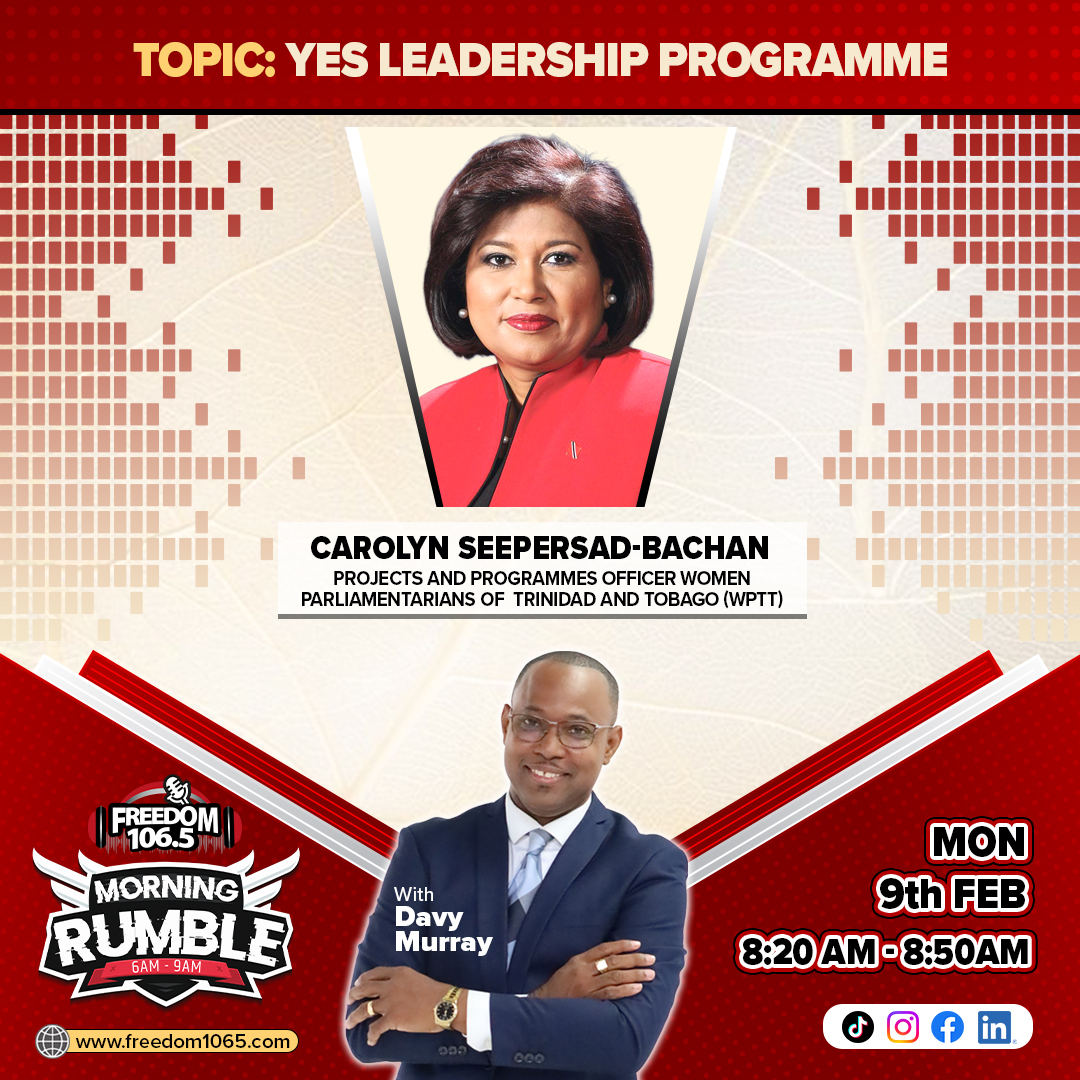
[00:00:08] Speaker A: Sitting here this morning and chatting with our former minister and I'm curious to know about this new role that she has taken on.
Mrs. Carolyn Sipasad Beachan. Good morning and welcome back to the program. How are you?
You need to unmute. You're still muted.
[00:00:27] Speaker B: Sorry. Yeah. Thank you, David, for having me this morning. A special good morning to you and all your listeners.
[00:00:33] Speaker A: Good to have you, man.
[00:00:35] Speaker B: I just want to make it very clear. This is the women parliamentarians of Trinidad and Tobago. It was first formed in 2023. I am an executive member, projects and programs officer.
I've been in that role last year as well. And before that I served as a co chair for this specific program called the YES. Leadership Program in 2023.
[00:00:58] Speaker A: Beautiful. And thank you very much for that introduction. You would have saved me having to tell our listeners. And I like it when it comes from you people. Hear what it is.
This is not Davey narrating this thing. So let's talk a little bit about what is this YES program. Why the significance? Why the importance? Why now?
[00:01:17] Speaker B: Okay, so the person, let me just say the women's parliamentarians of Trinidad and Tobago comprises former women parliamentarians and current women parliamentarians. And you know, it's because, you know, it was born out of a, you know, division of being able to empower, you know, existing former and aspiring parliamentarians, women parliamentarians. We recognize that, you know, Trinidad and Tobago, you know, we make up 50% of the population, but for some reason we don't see in what we call the decision making spaces in this country, whether it is in parliament or in the boardrooms, we don't have, you know, 50% participation. And of course there is an important need for that.
We could go into that in another, another time. But the importance of having that diversity in these decision making spaces. So one of the things that we had set out to do was to encourage more women to participate and prepare them, empower them, especially young women. So this program called the yes. Leadership Program is.
Yes. It is young women empowered to serve. And it is a program that we have just put out. This will be our third cohort, meaning this is the third year that we are running this program and what we normally do, it starts with an intense eight week workshop schedule of training sessions, all interactive and practical because we want to develop certain skill sets and then we culminate. It culminates into, well, I won't say culminate, but following that, is there is a parliamentary assimilated, parliamentary sitting, assimilated, parliamentary debate, and then thereafter a community outreach project.
Mainly because when the skill sets that they develop during that time will be like leadership, we try to get them to develop their leadership and confidence building research and debate. Because, you know, there are so many things for us as women parliamentarians that we missed and we wish we had the opportunity to develop so that we would have been able to navigate, you know, and to address the many risks and challenges that we would have faced as women parliamentarians. So we teach them, you know, you know, we try to inculcate to them, you know, proper research and debate methodologies, research to be able to develop credible arguments, you know, how to engage the media, how to advocate community impact. You know, I think one of the things that we also try to do is to try to make it as practical as possible.
And facilitating these sessions tend to be existing parliamentarians or former and in some cases subject matter experts, plus a number of external stakeholders who we engage in this particular program.
So, I mean, we have had in the past the Female Judges association, the female judges, and they interact with the girls, you know, they prepare them for the debate topic. Over the last two years, and I think we did present on this program the first year, we did what was called sextortion because that was a topic defined by the International Female Judges association, and therefore the local chapter here of female judges actually helped to prepare the girls for that debate debate. For the topic itself. Last year we did human trafficking. We are yet to define another exciting topic for debate this year, but when that happens, it's one a topic that they would be able to go out eventually to do a community engagement. Because very, very important in the committee engagement project, which will take place over the months of August, you know, July, August, is to make sure that the tools and insights and skills they would have developed, they can apply them to real communities, real addressing vulnerable, real vulnerabilities. Because as you will recognize, that's what true representation is all about, being able to advocate on behalf of your community. So basically, on some of the topics that we do cover during that whole session, as I said, you know, we try to impart on them, you know, the importance of credible sources of research if you want to be persuasive, getting into your own leader, identifying your own leadership style, knowing what that is, how to remain the authentic you at all points in time. Because many times, you know, we feel we go to Parliament, maybe we just want to read a speech and we start, you know, we go out of character. You know, we always say stay in character because that's how people build confidence in you. When you're speaking in parliament, you're not speaking to your colleagues only, you're speaking to the public and you're speaking sometimes to your constituents.
An area that we have developed as well is artificial intelligence.
Because we want them to understand that this is not about allowing AI to replace you. This is about how you use AI to enhance your own creativity and innovation. So we have an external facilitator for that, an international consultant who assists us with that aspect of the program.
They also get an opportunity to interact with diplomats because we do a session on diplomacy and etiquette and we last year we had a nice interesting session hosted by the ambassador for the Kingdom of the Netherlands. And they, you know, where they had all the diplomats present at this reception hosted by, you know, the embassy. And you know, they had to discuss different topics with those diplomats.
[00:06:52] Speaker A: One of the things I want to ask you, not cutting you, is what is the association looking at doing in the not too distant future to get the younger persons in, interested even into Parliament, in Parliament? And how does one get into parliament from your experience? You know, we accustomed, we born and we meet certain persons there already. But then we saw in past administration and even in present we see new faces, new ministers. There was a time when every Monday morning I didn't want to be a school child because I know, I remember who is the minister of this now. You know, I learned last week it was this person and always somebody else. So what is the association doing to attract younger females to get into position of power and understand the role they play when they get there.
[00:07:36] Speaker B: So the issue here is what you're, you know, is exactly what this program is attempting to address is to encourage more women into those decision making spaces, whether it is in the boardroom, whether it is in the parliament, whether it's at local government. I think the issue is that when we do interact with them, especially younger women, you know, we are trying to encourage them because, you know, let me just say this. One of the things that we do with this program is they get to interact. They get assigned a former and a current parliamentarian who they interact with and they share their, their own problems, their own challenges and they get to consult with us. And yet it's interesting because when I served in serving in that capacity, when you try to guide these young, young women, it's amazing how many of them are hesitant to enter the field of politics because they feel the risk are so Great. They feel that, you know, they look on and they see how women, what they suffer, the challenges they face in family life, in their, in the reputation of women, you know, the harm, the reputational damage that could take place. And therefore, this is one of the reasons. So they ask how. And you know, one of the things we are trying to do is to develop those skill sets, develop those tools to help them navigate in that area so that they not only enter the politics or the political decision making space or the boardroom, but they are able to sustain it and remain there. Because too many times we see women entering into the politics, but then they fall out very quickly afterwards because they are unable to sustain it. So how do we ensure that they sustain it? Recognizing that what we are trying to do is that we are, you know, is to bring that diversity, bring that gender lens to legislation and policymaking, to influence part of it as well. As we develop these young women, I want to say is about trying to develop young people as well, to be future parliamentarians who can be transformative, you know, to assist and contribute to modernizing the parliament and to face some of the contemporary challenges we face in the national development.
Because one of the things that we also have as a problem, if you notice that. Well, to me is that parliament as it is right now, there are two ends of the spectrum. On one end, you could just be a rubber stamp parliament, or you can be a parliament that is transformative, meaning that you can actually influence national development, you can influence policies, and I hope one day we could get there through these change agents that we are developing today, you know, that can take on those 21st century challenges.
[00:10:20] Speaker A: I mean, I love the initiative. It's always advocating for young people.
Now as we're dealing with women, you know, there's a very fragile environment where persons feel this terminology of sextortion, where sexual harassment in the workplace. How do you navigate sexual advances when you are moving up in power as a female? Because especially in what is perceived to be male dominated in terms of parliamentarians, even CEOs of companies. So you're elevating yourself. And there's this whole thought process and notion that sex is traded for you to get into position, for we to pay attention to you, for we to acknowledge in the room, you know, there would be certain talks thrown at women. How do you. Is the association helping women to navigate, identify these unwanted advances and how to deal with them in such a manner where it's not going to leave a bitter taste in these men in the mouth of those in Authority, but see you as a viable component and partner within the space.
[00:11:28] Speaker B: One of the things that we attempt to, and I want to tell you that's one of the things that we see in our young women who come in, it's about building their confidence and building respect for themselves, knowing who they are and what they're worth. Okay. Their own value system. We try to ensure, encourage that they have a value system that they adhere to all the time. One of the things that I do want to say that, you know, I'm glad that you raised your sex torture. That was our first debate for Cohort 1 and it was quite an interesting debate today that cohort of young women continue to go out into communities and advocate, you know, explaining to women that they don't have to be victims of sextortion and how they can become victims and how to avoid those pitfalls. You know, because it was a, you know, even last year, if you look at what has happened there, we use. The second debate was on human trafficking. And again when they were went out into the community outreach project last year we did one in Siparia area, the Faisalbad area. The issue was how do you avoid yourself becoming a victim? Because most of the victims of human trafficking, 90% of them are young girls and women.
[00:12:38] Speaker A: And with that being said, you know, when you get into these schools or the areas that you're choosing to bring in these young persons and develop these young minds, what sort of feedback do you get? Is it difficult to convince young women you too can be a future leader? You too can enter politics? I mean, how do you help them to navigate? They're coming in bright eyed and bushy tailed and then they're meeting these stalwarts, they're meeting those that are going to watch them and push back. How do you help them to navigate those challenges?
[00:13:10] Speaker B: Well, the thing is that's what the program is about. So the program tends to be very, it's practical and interactive.
So we have a number of practical sessions to help them develop their, you know, self esteem, self confidence. That is I think the most important thing. Understanding their own leadership style and how to lead and to lead effectively and the most importantly, how to serve as well. So, you know, one of the things I have noticed, you know, and I think we are very proud at the end of the program. We have had two, two such years, is that when they do come in, you see a very, very shy young lady. But you know, emerging at the end of the day when you look on, on the debate, you would not think that was the same young lady, because they emerge with such self confidence, you know, some, you know, such self esteem. And I think that is what we need to be able to instill, inculcate into them that they have that potential in them, but they have to be that authentic you to be able to develop and to be able to become that future leader. So one of the, I think it's very important, baby, to understand that a lot of these young women, once they start on the right course, they will get there and they will get there in the right way and be able to become, most important, effective.
[00:14:24] Speaker A: I love that. Getting there in the right way and not having to trade your body or anything of that nature to reach to the helm. Because once that starts, the respect goes out the door. Hello, good morning.
[00:14:36] Speaker C: Good morning, Devi. And to your special guest, this very sweet voice, Mrs. Beachon.
Carolyn. You know, normally when we talk to young people, they will say, I don't want to get in politics, I don't want. But the thing about it, letting them know the decision that the government make, it depends on the political atmosphere and depends on the country. So many people does not understand that aspect. They go to many different things, train and be very good, professional.
But the saying about the politics is not about the politics, it's about the laws of the country. Thank you ever so much.
[00:15:24] Speaker A: Thank you very much, Mr. Rima. The laws of the country, the climate that we exist in, how is that trans, how does that translate with women in power?
[00:15:34] Speaker B: Well, I think one of the things that we are attempting to do is to build better legislators, right, More effective. And an important, and one of the objectives of the women parliamentarians is to bring that gender lens to legislation. In fact, apart from the US Leadership program, last year we did something called gender responsive budgeting. And we, you know, and the whole issue is to be able to ensure that, you know, we, we are able to see it through that lens. And one of, so when these women are trained as well, they learn to apply that gender lens. So that's a big issue coming up all over the world. And I mean, it's now a big area of budgeting, what we call the gender responsive budgeting. Understanding the impact on not just women, women, men, girls and boys.
[00:16:23] Speaker A: How do we navigate with our young leaders, our female leaders, to understand which hat to wear, at what time? How do you help them navigate their personal lives as opposed to their professional lives, and tailor it in such a manner that they continue to build strong homes? And why, I'm asking you this, being in the Wedding business for quite some number of years as a wedding mc.
In different forums, the bride sets the temperature and the mood for how the reception turns out. And that might sound non factual, but it is.
I have observed over the years that when a bride is truly happy, she comes in there into that reception hall and she's welcome with her husband. The reception starts and she is there dancing. The atmosphere is one that transcends across. When that bride is complaining contentious, she comes in there and she complains about it. She don't like this. She's upset. The mood changes in the reception and the guests, they feel that tension.
So how do we help them to navigate women, especially as it relates to being a homemaker, a wife, a mother and understanding. When I get into this space, I am emotionally intelligent enough to understand I need to be this at this time. And when I get into parliament and I am going through bills and looking at legislations and even on the judicial bench, that this is a different hat. And I cannot bring this emotion at home, when my son upsetted me with his exam grades into the courtroom where I need to focus. How do you help women navigate those two worlds that they have to exist in?
[00:18:07] Speaker B: I'm so happy to, you know, to hear your perspective on this. I mean, as a, what you call yourself a wedding. A wedding mc.
[00:18:16] Speaker A: I'm a planner. Yeah.
[00:18:18] Speaker B: Time.
[00:18:18] Speaker A: I am.
[00:18:19] Speaker B: Interesting, interesting. But you made a very important point and it is something that, you know, because of our makeup as women, we tend to be very emotional and we would tend to, you know, bring those issues. We tend to, you know, to confuse, I don't want to say conflict, but confuse the issues.
So it is something that our women, it's a skill that we have to develop. It's something that we have to learn to master. And you know, interestingly, in what you are saying there, that's one of the questions. When I was a guy, you know, when I participated with the last two cohorts and I had to interact with the young woman and they would get the opportunity to ask us because as I said, we assign. At least every girl is assigned to, you know, at least four girls assigned. I had four girls assigned to me. Right. To be able to guide through the process. And most of the questions, you know, you would think they are coming to you to ask you about the program and the topics. That was not the issue. Those issues that you are raising, you know, how do you manage, how do you manage your family life? And I think this is one of the impediments to women Entering into the public space or the political space because they fear. How can they handle it? They feel, you know, there's this. And it has, you know, I mean, not only here in Trinidad, but all over the world, Professional women have always suffered. You know, they, you know, they either lose their homes or their marriages or their family life. And we always feel that we can't be good at both.
So how do you separate both? How do you still. And it was interesting. I heard some of my colleagues explaining to some of the girls how they managed it. I would tell them my experiences on how to manage it, and not only how I did, but how I probably could have done it better. Hindsight is 2020 vision.
So how could you have managed it better to get a better outcome? Because at the end of the day, I always say, as a mother and as a white, I can't be in government and politics and at the same time advocating for strong family life and strong family values in our society. And at the same time, my home, I am. I don't have a strong, you know, it's suffering. Exactly. So, I mean, you know, because I don't want the problems that could emerge out of there to become problems in the nation, as we all know, you know, the lack of, you know, the importance of family life and having that mother figure and that father figure in the home. You know, the parenting is so important to many of the issues, whether, you know, we could talk about that over and over, you know, with all the social ills in our society. So we get those questions all the time. I'm happy, though, and let me say this, as female parliamentarians, we also learn from these young girls. We listen to them, we see it through their lens. You know, they bring some fairly interesting perspectives for us to take into consideration. So at the end of the program, we also learn a lot from them as they learn from us, you know, as they go forward.
[00:21:21] Speaker A: You know, I mean, I am happy that the questions that they are asking is along those lines, because the temperature in a home. A long time ago, my mother told me, you know, stereotypical, a man provides a house and a woman provides a home. And you often wonder, you know, this house and this home. And then I liken it to, you can build a house relatively quickly, $500,000. You build the rooms, you put up your windows, everything what cost. The money is. The finishing touches, the ceiling, the molding, the type of infrastructure in terms of cupboards, the doors, the. You know, because to build it just generic, it could be done, but when you have to outfit this home now to make it a home. That's where the woman comes in. She brings that warmth.
It doesn't necessarily have to be pieces put down in a strategic way in the house, but just her attitude, her warmth turns that entire house, that was just a house into a home. And if you want to understand what I'm talking about.
As we get set to close this interview, we're getting closer and closer to nine. Look at Sound of Music. Mrs. Carolyn Passatt Beach. And I sure you saw that movie Sound of Music.
Look at the Governor.
[00:22:32] Speaker B: It's a favorite.
[00:22:33] Speaker A: It's a favorite. I can't watch that show with my mom. She sings the whole thing. And I can't hear the show. But looking at the. The Governor and his seven children, they had a beautiful house.
But when Floral and Maria came in and he fell in love with her and he decided to marry her, that house became a home.
Because that is what she brought, she brought home. So when women get into these spaces of authority where they are CEOs, and I am very proud of them, I. I don't have a problem having a boss as a female, you know, being able to encourage women to do it and not have to be fearful. I'm going to lose my husband, I'm going to lose my family because I'm pursuing this career.
How do you help them to help their spouses to understand that I'm doing this at this time? But I'm still here for you guys, you know, because I think when they ask you that question, and I love how you said not just what I did, but what I could have probably done better, I think that is more. That is relatable. They are seeing you as a person. Ms. Baechan, you went through that. Ms. Baechan is now saying, you know, if I had done this, maybe I would have gotten this outcome.
I think you have. You just touched me in a different level this morning.
[00:23:51] Speaker B: You know, I want to add something.
[00:23:53] Speaker A: Yeah.
[00:23:54] Speaker B: Because I hear you focusing a lot on the female on the, on, on the woman.
I also want to say, to make that home, you need a father figure.
[00:24:03] Speaker A: Definitely.
[00:24:04] Speaker B: You know, it's two ways. I always say women hold up, you know, half the sky.
[00:24:09] Speaker A: Yeah. Boy, all you really does do it.
[00:24:11] Speaker B: Is the other half. But it is also important is for both parents to work and collaborate to be able to achieve this. So I know you're getting close to the close off of your program. I just want to remind you, well, this program, this is the third year, the first year myself together with Sophia Choate co chaired the yes Leadership program and the Projects and Programs officer at the time was Hazel Manning. Last year I became projects and programs officer and it was co chaired by Stacey Ruknarain and Amrita Dana Rhine. This year I'm projects and programs officer again. And yes Leadership is just falling under. The Projects and Programs officer is being co chaired by Christine Yualo Hussain and Maria Dillon Remy. So what we have is really remember we get, you know, we are nonpartisan and we are able to get the perspectives from all sides.
[00:25:06] Speaker A: Beautiful.
[00:25:06] Speaker B: The application process has started.
You know, the applications went out, they called for applications on last Monday and they close on the second Monday, the second of March from which we will select 50 participants. And from those 50 participants, you know, they will, you know, they will be informed sometime during the month of March. And then we take off, we launch the program on the 9th of April where we go through the, as I said, the eight week program where they will get to interact with, you know, women parliamentarians, existing and formal together with a number of stakeholders, as I mentioned to you, external stakeholders that you know and then they go on to the committee outreach project. They application itself they can find, it's a Google form and it's on our Facebook page. Women parliamentarians of Trinidad and Tobago and our Instagram page.
In addition to that, you would find they would be, they are required. How they are being evaluated is that they are required to provide a personal statement which is in the form of a video, no more than three minutes. And the reason for that again too is because this is all about you. This is about how you come across. This is not a speech you're making because at the end of the days, you know, body language, behavioral patterns, all of that make it is what makes you the individual. And if you want to build that credibility and you want to build the confidence that the public will have in you, it has to be authentic. You. So this is why we insist on the video, the three minute video and the upload the link to that video on the Google form. So I just wanted to just.
[00:26:48] Speaker A: I appreciate that and I look forward to maybe later on this year you birthing a woman in power leadership conference that we will come and cover and you bring and I am seeing a situation where you would have a panel discussion, you would bring past and probably present ministers and CEOs and former CEOs and business entrepreneurs and see how they navigated the challenges between personal life and business life and was able to succeed and some of the things that they would not have done or would recommend be done. I think that would be a very interesting one day seminar that Freedom 106.5 FM can come and cover at the Hyatt.
[00:27:25] Speaker B: So I should suggest that to the women parliamentarian and bring them together. I would take it back to them.
[00:27:30] Speaker A: Let's invite. Let's invite not just women in leadership. Men can partake, pay a fee.
School children from Nap Sags, all these schools, young ones, teachers, upper six, lower six can bring in these students on this given day because when you look at students in Form 5, Upper Lower 6, these are students that are about to leave the school environment and go into tertiary education, even on the tertiary level. Invite these persons to come in, be part of the panel or even in the audience where questions can be raised and they can now have a learned idea as to what to expect in the world of work and prepare their minds to take leadership as a woman in society. Yeah, boy, that's a good recommendation. Or no.
[00:28:10] Speaker B: Very good. I must take it back to wptt.
[00:28:12] Speaker A: Davy Murray, make me the chairperson to come and cheer the meeting.
Anyway, it's a good thing and you should look at it. And it was really a pleasure chatting with you, Ms. Baechan, always refreshing and not talking about energy matters, but something that is equally important. So thank you again.
[00:28:29] Speaker B: Thank you very much and thank you for having me this morning. It was a pleasure and God bless you and all your listeners.
[00:28:34] Speaker A: Amen. And be safe this carnival. All right? Be safe. Have a good one. With that being said, folks, we set to wrap the program this morning. I always advocate for strong women in business, strong women in leadership. I have no problem if my wife or the woman in my life, whoever is making more money than me. I good with that. Let me take this call quickly. Tusca is ready to go. Good morning.
[00:28:56] Speaker C: Good morning, Davey. Yesterday I listened to our program and when the gentleman finished call, you say, okay, Davy.
[00:29:08] Speaker A: All right.
[00:29:10] Speaker B: The best insight, instant feedback, accountability, the all new Talk Radio Freedom 106.5.