Episode Transcript
[00:00:01] Speaker A: You're tuned into the all new freedom 106.5. 106.5.
[00:00:06] Speaker B: Shall we chatting with the president, is it? The president?
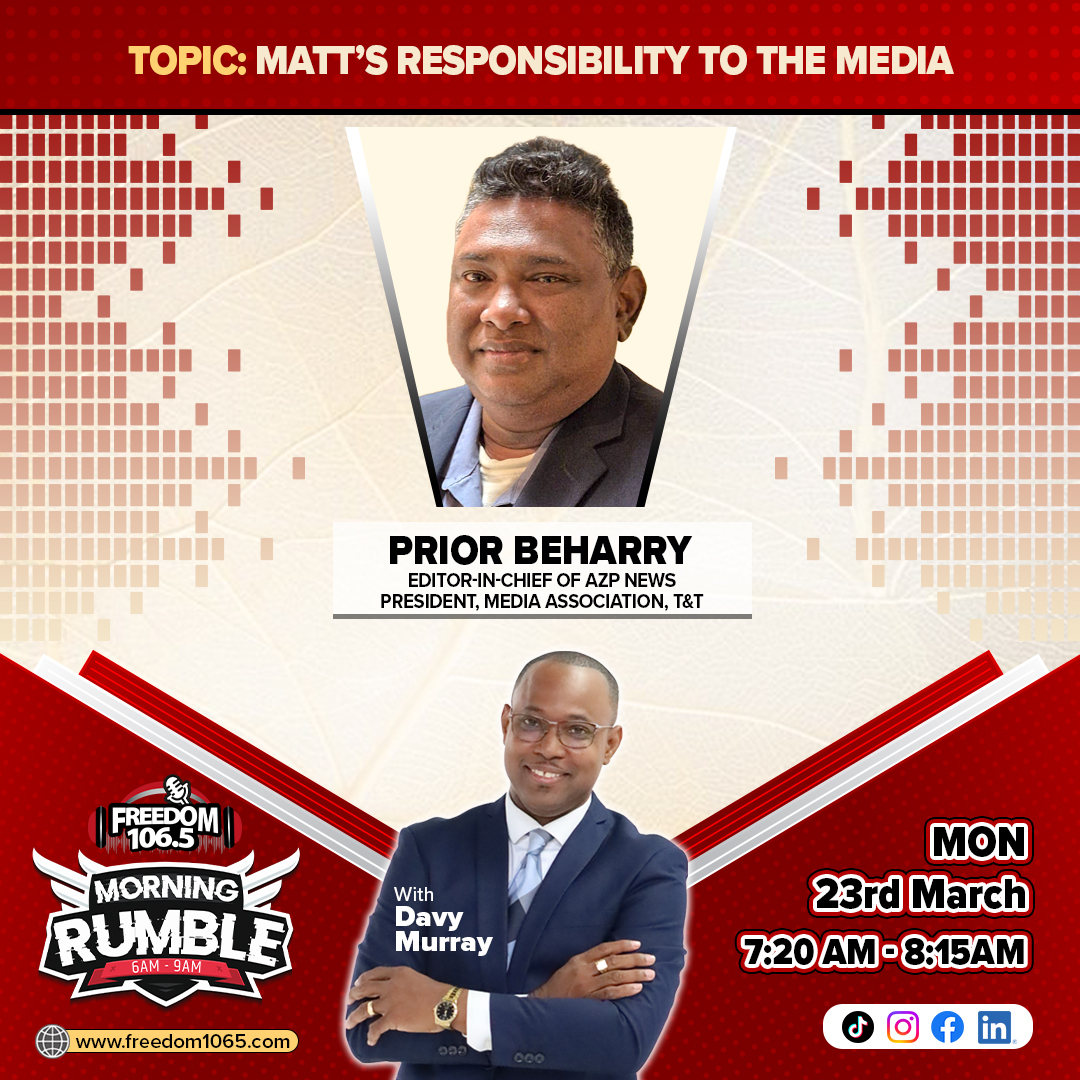
The president of the Media association of Trinidad and Tobago. The responsibility of the media, Priya Bihari, chief editor of AZP News and the President of the MAT in Trinidad and Tobago. We chatting and as you guys would have learned. And good morning to you, Melissa. Good morning to you. Yeah, that was our first financial lesson. Another tip.
Oh, boy. That's the producer. Good morning to you.
With that being said, we are streaming live on Facebook. You can check us out on Facebook and view the interview and join the over 220, 85 individuals. I think we over 300 persons now streaming with us live on Facebook. Join the bandwagon and get in the know. Good morning to you.
Rajkumar Ramroop. Good morning to you. All right, now, as we get into our conversations this morning, for those of you who don't know, we were sent a letter.
All right. We were sent a letter because, you know, Dr. Rowley made some statements. So a media release went out from the. The Telecoms Authority of Trinidad and Tobago, this company is known, is fondly known as T.
And the letter states, the Telecommunications Authority of Trinidad and Tobago. TAT reaffirms its unwavering commitment to responsible broadcasting and the protection of all citizens from harmful or discriminatory content.
Public discourse surrounding recent statements about the Hon. Prime Minister has aired on a certain television broadcast has underscored the critical importance of maintaining taste and decency in our media landscape. Broadcast concessionaires are therefore reminded of their obligations under the terms of their concession, particularly section D9 which states that the concessionaire shall not a transmit any program, information or other material which degrades or portrays in a negative manner or discriminates against or encourages discrimination against any person or group by reason of race, origin, class, religion or sex.
TAT is actively reviewing the matter and will take appropriate regulatory action where any broadcaster is found to be in breach of its concession. By upholding these standards, we continue to build a media environment that is fair, respectful and reflective of the values of Trinidad and Tobago. And it ended there.
Now good morning to you, President Bihari. Welcome to Freedom.
[00:03:13] Speaker C: Thank you very much and good morning to you, Davy. It's a pleasure to be on Freedom 106.5 FM. I know the issue here is in terms of tat is a regulator of this, I think the spectrum and you have to get a license. For example, if you are a cable operator through TAT and they have expressed certain concerns about what was reported.
But as a media entity, you report the truth all the time. You have to say what happened and that whatever statement that the former Prime Minister made, it was part of a news report. And being a journalist and a media entity, the first and the paramount principle that we or tool that we use is the truth and accuracy.
So when that was reported, it was reported contemporaneously, meaning right after it happened. And of course it was reported properly and truthfully. So in other words, that entity cannot be blamed for saying what that person said.
[00:04:15] Speaker B: There was a particular broadcaster some years ago, and I'm only tying this story very quickly with you. A Prime Minister, now deceased, left a barbershop and ran up into a radio station for two young broadcasters, one talk show, two talk show hosts, but one wearing two hats as a news presenter as well. And one of the things the DC's Prime Minister stated, he had a problem with the formation of an opinion during the editorialization of the news during an official newscast. Yes, but he said that the news article was accurate.
[00:04:51] Speaker C: Of course, accurate.
[00:04:53] Speaker B: The figures was accurate.
[00:04:54] Speaker C: You have to distinguish between news and write a talk show host, for example. So you, you could come and say things that we wouldn't put in news report, but a journalist, a media house would report what you said, what was, what happened here. Right.
[00:05:09] Speaker B: Now we know what, we know what the concerns are over the, the, the article, the, the statements by the former Prime Minister, Dr. Rowley. Now, Dr. Rowley invited persons into a press conference. Conference.
[00:05:20] Speaker C: Exactly.
[00:05:20] Speaker B: He invited the media at his home so he can hold this conference in not retaliation, but in response to what the Prime Minister said.
And he used certain words.
What was the responsibility of the journalists and media personnel present during that press conference? What were their reporting responsibilities like? What are they to explain?
[00:05:46] Speaker C: Of course I said they have to report what is accurate. And that was not the only story that they reported on. They reported other issues. She spoke about Balize House, for example, how the former Prime Minister raised issues about how the new Balize House has been funded. So the response, he responded for that. The, the media did stories on that, on exactly what, what he said. And in other words, he used that word to describe the former Prime Minister and the current Prime Minister. And the media reported that and his accuracy. And you see, you have to be very wary about trying to tell the media that we cannot report something that is the truth because it's not for us to judge. We do, when we do, news reporting is basically what you call he said, she said Reporting, So we just report what the person says. So if you have a politician who is making a fool of himself, it is not for the media house to judge, it is for the public to judge. And that's what we do. We disseminate the information in a fair and accurate manner and then that is for you to judge. So you cannot blame us for reporting what was said at the press conference.
[00:06:54] Speaker B: Now, with Tad getting involved and saying that the use of certain language can border on decency, Dr. Rowley did not curse. There was no obscene language used, but he used words.
The media's responsibility to report accurately what was said. Where does it borderline on discrimination or even indecency Based on what Dr. Rowley said at that press conference?
[00:07:19] Speaker C: That is the point. If there is an issue with what you have said, if a defamatory every defame, you can be sued. So there is the regulation, you know, the regulatory institution, the form in which you can do something. If someone, if you feel that someone. If you feel that someone defames you, you take that, you sue them, you take them to court. So there shouldn't be any regulatory body in terms of that. I mean that, for example, has been trying to get a broadcast code for years because of the actual operate and they have. That has not been something that has been formulated. That broadcast code has been difficult because you have to have consultation with the public, with the media, and it's very difficult for anyone to have that broadcast code. And I think the second issue with that broadcast code, if it goes to Parliament, I think it has to be passed by a special majority.
So it's very difficult to bring that to form some form of law. But again, the point is that if there's an issue and you feel you are defamed, there is an avenue for you to go to court, sue the person if you think, you know, defamatory.
[00:08:28] Speaker B: Now let's look at what Dr. Rowley said in that press conference. Could we at any point in time see that as defamatory?
[00:08:39] Speaker C: Now that is. That is for a judge, a lawyer to determine is a legal matter. I mean, we report. And of course there is a judgment call, you know, in a newsroom, editorial policies, you know, what to report.
And what other report was. I don't think that we would report any curse words, you know, for example. Right, right. But if you say something that is in the jargon of the country that everybody knows, you know, there are certain statements, you know, Mr. Pandey was famous for using a lot of Hindi words too, you know, and we use that. I mean, it was accurate reporting and sometimes he was very nasty against people, his political opponents. But reported, I mean, we have not reported any, you know, words, you know, we remember, we deemed obscene language, you know, in true sense. But first, for example, I know for a fact that sometimes in court reporting there's, there's obscene language. And, you know, it has been reported sometimes, but it has to be contemporaneous, the reporting, and it has to be accurate. I think in the, in this issue with Dr. Rowley, everything has, was accurate, was accurate. It was reported the same day and the day after that, the issues occurred.
[00:09:45] Speaker B: Now, when we look at these type of things, right, and you talk about accurate journalism, accurate and accurate reporting.
[00:09:52] Speaker C: Yes.
[00:09:53] Speaker B: Is it that when, is it that tat is now saying to the public that when reporters go out on these press conferences, they have a responsibility, yes, to report accurately, but to also taper down if the language is not, of course, obscene language, where persons are using curse words, but are they to taper down certain things? Dr. Rowley himself stood up and say, doe jadc. You remember that?
[00:10:19] Speaker C: Yeah, yeah.
[00:10:19] Speaker B: So how, you know, when, when these things happen, how does taat expect journalists to not report what is being said accurately?
[00:10:28] Speaker C: Well, I cannot speak for that one thing, Let me make that clear. But what I can say is that journalists will continue. Media in this country would continue to operate in a fair and a fearless manner and we would do our reporting as we have always done. And if it is someone says something, we'll report it. Just like when the Prime Minister says the PNM funded their Di Balizi house by Naco means drugs, etc. Under the pedophiles in the PNM. We reported that. I mean, as I said, we don't judge. We do not judge. That is for report. And then when the PNM responds, when the opposition leader responded and said that's not true, we reported that too. So that is what we do. And, and, and, and when we report, we have to do it in an accurate manner. And that is what we always do. I mean, of course we make a judgment call sometime. If someone, you think that a statement. I'm a defamatory. Right. But then the law has evolved so much that if someone defames you, for example, Davy, you could sue, but you don't sue the media manufacturer, the media house, to the person that says this, the statement.
[00:11:39] Speaker B: But, but more often than not, they go after the entire media house. They go after the conglomerate.
[00:11:43] Speaker C: Well, they go after the media house. If, for example, it is an investigative report that is unique to that media house. But if it's something, a statement made by somebody, you know, they usually go to the party. The court says that, you know, there's a one, Steve. Media house proves that it's done in public interest.
And that is what journalists always do. Media houses, we always seek the public's interest.
And seeking the public interest is reporting accurately and reporting what takes place at a press conference from a former prime minister or what a prime minister says, and we'll always continue to do that.
[00:12:19] Speaker B: Now, we have an article that dropped a couple days ago where the Telecoms Authority of Trinidad and Tobago has issued a warning that it is actively reviewing recent content aired on a local television and will take regulatory action where necessary. Now, this has to go with the same statements of Dr. Rowley and what he said.
D I say it jam it.
That's a. A part of the vernacular in Trinidad and Tobago. That's part of our local plans, our local language.
[00:12:48] Speaker C: Right? Well, m can t sorry t deals with broadcast, right? They are broadcaster, because the broadcasters, they are in charge of what they call the spectrum in Trinidad and Tobago. And they have to deal with people who use the spectrum. And. And of course, you know, they regulate them. But when CNC history reported that, they reported it as a news organization, a media house. And we will continue to report things. When, you know, you talk about Mr. Pandey, Mr. Pandey had called a reporter insulting a time, you know, and we reported it. You know, he. He said that he was at war with the media. We reported it. You know, the people use very, you know, maybe comical weight to describe young. You know, we report it. You know what I mean? So that is what we do, you know, but we don't report something that is not true. It's accurate. And of course, when you.
When you cover Parliament, for example, there is what you call parliamentary privilege. So you cannot be sued for saying what you report or whatever person says in Parliament. So we reported accurately and we reported as we did because Dr. Rowley responded at his press conference to what the Prime Minister had said in Parliament the Friday before. And we reported that, and he responded. So if you're looking maybe from a legal standpoint and somebody wants to sue Dr. Rowley, he could say that it is qualified privilege. In other words, he was responding to someone, what someone said about him.
[00:14:11] Speaker B: Now, what does the Media association of Trinidad and Tobago thoughts on journalists that when you look at it right, where tat seems to want to stymie or curtail broadcasting Broadcasters from reporting accurately. If that happens. What is Matt's position in terms of mediating involvement with, you know, bringing that situation under control?
[00:14:37] Speaker C: I want to say again, we have had no issue with really people trying to stymie or stop our reporting. Matt, executive, we, we became a new executive in January and I think we have a number of working journalists. You know, I think now is a good time to let you know. My executive is the vice president, Kean Haynes from Guardian Media.
[00:14:58] Speaker B: Wonderful.
[00:14:59] Speaker C: Our secretary is Mr. Philip Madison. He's a freelance copy reader. He actually worked in the Guardian. Assistant secretary is Shivani Lal. She is working reporter 97.
And also our treasurer, Mr. Vindhar Suraj. He also works at 97. And we have two floor members, Yvonne Webb from, from South Trinidad and Jermaine Cruikshank, who everybody knows. A wonderful, a long standing, wonderful photographer. So, yeah. So Matt would not stand by and let anybody stop us from reporting what is accurate. What we see as news, what we see as journalism, we see will continue, continue to do that. And I must make the point though that that is only for broadcast. You know, they deal with people who broadcast, like for example, TV people, I mean radio, you know, like that. So we would always report from a new standpoint. We report accurately and we report fearlessly. I want to make that point. So. And we always seek the public interest. And if sometimes, if the public interest is that we have to break the law, we will do it in recognition and in defense of the public interest. Everything the public has a right to know, we will do that because that is what we do. Always seeking the public's interest.
[00:16:13] Speaker B: Something with the law you mentioned?
[00:16:15] Speaker C: Yeah, I said we would break the law. If he thinks in the public interest,
[00:16:18] Speaker B: the journalist, they would probably go against the law just to get the accurate story out as quickly as possible.
[00:16:25] Speaker C: I want to make 1.2. We have an SOE going, right, a state of emergency. And we have, I think It's a Regulation 11. I think, you know, some. So it's not really clear. I mean, we have no issue. I want, I must say I want to make this clear that during this SOE or any, any previous SOEs, we have not been stopped from reporting anything. Ahmad has not had any reports, whereas where we are tried stymied from reporting anything. You know, we just concerned about that regulation where it may not be clear, you know, but, but no one has really been, I think no journalist really has been charged or anything under that.
[00:17:03] Speaker B: Do you think the time has come in this country or based on the trajectory in which we see tat and you know these code of ethics coming out. Should journalists now declare their political affiliation, if any at all before accepting the job or before going out, should they be made to tat tell the public that they support any one party or the other?
[00:17:26] Speaker C: There is no need for that. Why I say that a journalist has his tools just like a doctor has his tool. A lawyer has his tools. A doctor, you know, has a stethoscope, has his medicine, you know, does a diagnosis. A lawyer has law books. I think a journalist has tools. So the number one tool for journalists as I said is accuracy. One, two, you get the other side.
So when you do that you do your job in a proper form, in a proper manner. So when you are a sick person you go to a doctor, the doctor don't want to know if he's a uncn, you're a pnm, you know, he would do his job using the tool he tools he has. And that's what we'll do. We'll seek the public interest no matter what. So when Dr. Raleigh says something about someone we would go and get the response from them and we report accurately what he says. So as the one you do, once you do that there there's no need to show to say you know who, which political party you, you prefer or, or you voted for. But the point is that when you do your job, you do it accurately and you do it with the tools that is available that will show that you are fair and fearless.
[00:18:31] Speaker B: All right now Newsday, let's talk a little bit about that Matt's position in what transpired there.
[00:18:38] Speaker C: Well Matt is not a trade union.
We are very concerned of course that you know, the media landscape has changed and you know Newsday, that model of advertising where they green earning revenue is not really working. If you look at go across to Guyana for example, the Starbucks news, a long standing paper has also closed down and the editor in chief, Mr. Prasad, Anand Prasad spoke about what had happened in terms of the media landscape and advertising. People are going online and that is because as you said I'm the editor in chief of AZP news.com I think we are the only fully online independent newspaper in the country right now and we cover both local, regional, international.
So there's that niche we have here where everything now is online because people don't really the digital one of today, you know when they have the tablets and iPhones and and Android phones they will get everything on social media and on their phones they don't know how to open a newspaper, read it. So that is something Matt is looking at. We may have to put some seminars and look at the changing landscape of the media and how the media should could be viable where social media seems to be the norm, where people get, get their news. But the point is, as I'm making a point, a blogger on Facebook or wherever on YouTube is not a journalist because a blogger would use information and just put it out there. A journalist would check that and fact check that and then also get. Make sure that is accurate before putting that out there. And also if it even is accurate, we have to get the other side. So if somebody says that, that Davey, what was whining and jumping somewhere, you know, we would call you, you know, but a blogger would just put that out. And I think it's not you, you know, so. And I saw recently there was a, a major judgment against a social media user, you know, and I think that that would happen and, and it would lovely the playing field eventually where people would know the courts would rule and would sort of determine who could be a journalist and how much what you could report on social media, you know, because our media, we get our stories from anywhere, even social media, even a blogger. But before we publish, we verify it.
[00:20:56] Speaker B: One texter is asking me this morning and your calls are now invited, respectfully of course at 625-2257 and 6273223. Good morning, Davey. When a person is charged for obscene language, why don't media report the words? Because those words are used. Why are they left out?
[00:21:13] Speaker C: No, I think we do, but maybe we would just put da da da. You know, you put f da da da da. You know what I mean? Because, you know, I mean, I mean, you know, sometimes you have little children reading and then, you know, you know, you don't want to, you know, be. But we can report it. We can use the whole word. Right? But, but, but you don't it really. Editorial policy, you know, also it's, it's
[00:21:35] Speaker B: a policy by the editorials.
One person says did the PM, Prime Minister Prasad accused Dr. Rowley himself of building the house with drug money.
So I guess this question is being phrased in such a manner that we are asking, you know, I mean that's a kind of unfair question to ask the president this morning whether. Because Dr. Raleigh responded to something.
[00:21:57] Speaker C: Exactly.
I said the media, we don't take sides. What, what the Prime Minister said at Parliament. Reported it. What Dr. Rowley said in response to that, reported it. That is what we Do Alan, is for you, the union, the public to judge.
[00:22:10] Speaker B: All right.
[00:22:10] Speaker C: Hello.
[00:22:11] Speaker B: Good morning.
[00:22:13] Speaker D: Hello. Good morning.
[00:22:14] Speaker B: Good morning.
[00:22:15] Speaker D: Yes. Prior.
[00:22:16] Speaker C: Yes.
[00:22:17] Speaker D: Do you know when Mrs. Ptesa replied?
[00:22:19] Speaker C: Yes.
[00:22:20] Speaker D: You all reported what she said in the parliament.
[00:22:22] Speaker C: Yes.
[00:22:23] Speaker D: I was listening to the Paladin, Mr. Imbert. He will do all this. Check, check on what he said first and how come I really see and see triggered could report what Dr. Rowley say you all will do that.
Thank you.
[00:22:40] Speaker C: Yeah. No, madam, as I said once, we do a lot of reporting in parliament. I mean, ICP news, CSG, TV6, everybody you know, do a lot of reporting in Parliament.
And so once it's said in Parliament, it is what you call a parliamentary privilege. And we can report it as we. As we see fit. And when we do, and we have to do any issues that we are reported accurately and reported in a contemporary contemporaneous manner, meaning as soon as it. As soon as we can publish it. Maybe the same day or the day after. Hello.
[00:23:13] Speaker B: Good morning.
[00:23:14] Speaker E: Good morning, sir.
[00:23:15] Speaker B: Good morning.
[00:23:16] Speaker C: Good morning. The gentleman there with you said that there's a report what Roy said because what he said is true.
[00:23:25] Speaker B: No, no, no, no, no, no, no, no, no. Don't confuse.
[00:23:27] Speaker C: I said what he said. He. We reported what he said after he said. Not that what he said was true.
[00:23:33] Speaker F: Yes.
[00:23:33] Speaker C: We are not a judge, you understand? We just report what what you say. What is the news item of the day? If you go to a function where there are speech made, we report accurately what the speech, the person made the speech said. That is so what Dr. Raleigh said. We just reported what he said and we reported that accurately. Not that what he said was accurate.
[00:23:51] Speaker B: But. And that's the difference. I want you to be. I want persons to be very clear.
[00:23:55] Speaker C: Exactly.
[00:23:55] Speaker B: Journalists. A journalist or a reporter's responsibility.
[00:23:59] Speaker C: Yes.
[00:24:00] Speaker B: Is to report accurately and not judge. And not judge.
[00:24:04] Speaker C: Right.
[00:24:04] Speaker B: So Prior is sitting here this morning and he is saying something to us. We are in an interview. Whatever statements he makes, if any other reporter or journalist is listening and they have to use it as a news item, they report exactly what he said.
[00:24:19] Speaker C: Exactly.
[00:24:19] Speaker B: All right. Hello, good morning.
[00:24:22] Speaker C: Be that.
[00:24:23] Speaker D: That is a real big joke. That's what she is because.
[00:24:27] Speaker B: But we're not here to discuss that though.
[00:24:29] Speaker D: Yeah, but they see if I use that word G, I get ban on the see difference.
[00:24:35] Speaker B: All right. Hello, good morning. Before you respond. Good morning.
[00:24:40] Speaker C: Your guest there saying that, oh, the bloggers operate different from the media. Yes. It's very fighting. I want to find out from him. If you call the Prime Minister and find out if she's a German. Before he, before he.
[00:24:52] Speaker B: I did say tastefully and respectfully.
[00:24:56] Speaker C: The point I want to make is that when we report something, you know, Trinidad and Tobago, you know, we always have, you know, a very moveland culture, if you want to say that. And, and that has, has to be reflected in our reporting. So when we cover parliament, when you cover political meetings, you know, you know, during election times, we report accurately what people say and that is part of the culture. And when people go back in history and look at what they say, we. They see how our culture has evolved and the statements people make. And the only media reports, we judge the people by what they say.
[00:25:27] Speaker B: Let's talk a little bit about editors, those persons that have to review what the reporters write before going out. What is the responsibility of the editor?
[00:25:34] Speaker C: Well, one of the reasons we know, especially because I've been an editor, I was News Editorial Guardian in about 2007, you know, there. But that's how old I am. I'm David. So.
So one thing you have to keep an eye on, of course, you know, the normal thing, grammar, structure, accuracy. But you have to look at the law, you know, make sure that the statement in the article would not be be defamatory and would not allow you to, you know, face any sort of litigation.
And you know, I must say when I was newsletter regarding and even as AZP editor chief, we have that been sued, you know, you know, I mean, because you have to keep an eye on. And after a while it becomes easy, you know, you know exactly what to report and what not to report. And even like if my reporter brings an accusation against somebody, I would tell her, I said, go and get a comment from that guy to see if that is true.
[00:26:27] Speaker B: All right? So at this time, I'm inviting callers to send messages to Facebook. If you have a question, you can send it to Facebook right now on Freedom and do so in a respectful manner. And if you're getting in on the program this morning, please be respectful, all right? And remember that the views of our callers is not the views of freedom. 106.5 FM. All right? So please be respectful in the things that you're saying this morning.
[00:26:51] Speaker F: Morning, Davy. And to your guest from March, tell me something. The newspapers, they have an editor's opinion.
If that is something inaccurate, can can the newspaper be sold based on the editor's opinion? As again, someone who is a contributor and does an article and the newspaper clearly states that the opinion of this article orever it Is is not that of the newspaper or the one of our former media.
All right. And can the newspaper still be sued if they do publish an opinion from a contributor that that could be slanderous. Thank you.
[00:27:39] Speaker C: Yes. And anybody could be sued, you know, or anybody could consume newspaper or someone who they think that would write something that is liable. I think the. Any law is not defamatory, but I think slander has to be spoken with and I have to do written with. Sorry. So. So people could.
Could rep. Could sue anybody. I mean, even though it's reported and the editor goes through it and someone wants to sue.
That is our environment in which you operate.
That is what regulates the media to a certain extent.
[00:28:12] Speaker B: And the view of the caller a few moments ago, I want to put that out there to be very clear. The J word used. We had freedom. That is his view. That is not reflect us. So we retract that immediately.
All right. We pulled that back immediately from that caller and I urge you guys be respectful and responsible. We take another call. Hello, good morning.
[00:28:31] Speaker D: I get back on you three type of frivolous.
[00:28:34] Speaker B: Good morning.
[00:28:36] Speaker A: Morning again. Morning to the president there.
[00:28:38] Speaker C: Morning.
[00:28:39] Speaker A: My views are not the views of freedom and the president attacked here. I just wanted to ask in terms of is it the journalist responsibility or would it be deemed political if they juxtapose a story where there's a contradiction from before? So for instance, you have an issue that is being presented at this point in time. I don't want to point out any particular issue. But do you think it's responsible journalism to juxtapose it against what was said like years ago as it was posted once?
[00:29:12] Speaker C: It is in context. But in terms of news reporting, the word news, it means it has been new. So for example, we would start with what is said today or yesterday. And then if we had to put it in context, we will also, you know, go back to when, you know, it might have been first said or something like that. You understand, right?
Yeah, yeah, yeah, yeah.
[00:29:33] Speaker A: Okay.
[00:29:33] Speaker E: Thank you.
[00:29:34] Speaker C: No problem.
[00:29:34] Speaker B: All right. Thank you very much for sending for calling. Let's take another call quickly before they break.
[00:29:42] Speaker G: He just made a statement there about parliamentary privileges.
And therein lies this whole issue that causes the whole uproar every now and then. The thing is, not because you're in Parliament means you could behave how you want and be protected by the parliament. That's like telling me that I could hide behind my wall and, you know, throw a big stone at the neighbor or anybody passing.
[00:30:10] Speaker D: Right.
[00:30:10] Speaker G: Without having to worry about the repercussions of my actions. The thing is, this is where reform has to take place, where these kind of things needs to be stamped out from our governing and government policies. Not because you are parliamentarian or a politician or a minister or MP means that you are entitled or you feel you're allowed to say things and do things that as you feel, you know, I'm comfortable with without repercussions. Yeah. Next thing you know, one of the parliamentary privileges is that they. They may incorporate a privilege where you are allowed to just go and take money from the treasury and spend as you see fit.
[00:30:51] Speaker F: Right.
[00:30:52] Speaker G: So this is something that needs to be stamped out.
[00:30:55] Speaker C: What, what happened is that I think when the Standing Orders would change, you know, were updated in Parliament recently. If, if someone, if a Member of Parliament says something about you, you have. You can write to the speaker and, you know, he could put on record your response to that. And the other issue is that if there is the whole issue of privilege of, you know, a member can be taken to the Privileges Committee. If, if it can be proven that what he said, he knowingly. No. What he said, he knowingly felt no. Knew that it was not true or accurate. So. So they are safeguards, you know, they are safeguards. So. But even if that has happened, we could report it still because it was said in Parliament, you know, and afterward the member would face the consequences.
[00:31:38] Speaker B: The J word that was used by Dr. Rowley, you said that children reading could be. Could access these. These things, right?
[00:31:47] Speaker C: Yeah.
[00:31:48] Speaker B: These news articles. Now, we wouldn't put the curse word, even though we can put it exactly. There is no law exactly against us from reporting accurately the person cursed and said this word. We would kind of dot, dot, dot, and, you know, highlight, so you get the context of what the person said. Why would we print the J word bold in a headline? And that we allow, you know, it's
[00:32:14] Speaker C: not really an obscenity in the sense that, you know, something that would be. We would report it that, you know, because it was said in a contemporary contemporaneous manner. It is something that is part of the culture. And, you know, children now maybe, you know, they are a little more aware than before. And the other issue is that we report that because that press conference was streamed live on Facebook and the whole world would have seen it, and then other people would have used it on Facebook and social media. So it's. So it's not that people would not have known that it was not. It was used.
[00:32:49] Speaker B: But isn't that in the same context as if Dr. Raleigh would have cursed and used an obscene word. Would it not be in the same context?
[00:32:55] Speaker C: Because it'll be our editorial policy.
[00:33:00] Speaker B: Editorial policy would blot out.
[00:33:03] Speaker C: Yes. Yeah, because you know, that is what we do. For example, we don't really show the faces of children.
[00:33:10] Speaker B: Now that's a question I wanted to ask you on, but I have to take a break. I'll probably keep you about 10 minutes into the next hour as we can touch on that because I want to get the, the public, I want you to explain to public why those laws are in place, Matt's position on it, whether they would like to see those laws change. Folks, this is the morning rumble. We take a quick commercial break, your news at the top, your sport report and be coming back.
[00:33:32] Speaker A: Engage with Davey on the all new Talk Radio Freedom 106.5.
[00:33:53] Speaker B: Good morning again, Trinidad and Tobago. Welcome Back to Freedom 106.5 FM. Davey Murray is my name chatting with the president of the Media association of Trinidad Tobago and the Chief Editor of ZP News, Mr. Bihari Prior. Behari is in the building as we continue our discussions respectfully and briefly with what we talk about with the, with the broadcast code of conduct in Trinidad and Tobago, the responsibility of journalists in this country and reporters, editors and those that write these stories. So as we continue with our discussions this morning, let's listen to this texter who sent his message.
Good morning everybody.
[00:34:31] Speaker C: So my question is if those things, that word was streamed live, live on
[00:34:38] Speaker B: whatever areas, does it make it right
[00:34:41] Speaker C: for the news to publish it?
Yeah, what we report accurately and if that something is said, we will report it. You know, we don't not report it. As I said, it's not for us to judge if a journalist or so if a politician says something, we report it. And now everything is stream live. You know, the government, opposition, anybody. You know, some people go and do a live anywhere you want and it is something that we report because it'll always be out there. And any point is when you have a news report, people would trust the news entity, the media house, you know, rather than seeing something on social media. Because so many times we see things on social media that is not wrong
[00:35:25] Speaker B: that turned out to be false. Exactly. All right. Hello. Good morning.
[00:35:28] Speaker E: Good morning.
[00:35:29] Speaker C: Morning.
[00:35:30] Speaker E: Morning gentlemen.
[00:35:31] Speaker B: Morning. Morning to you.
[00:35:32] Speaker C: Morning, sir.
[00:35:33] Speaker E: Prior, you know, our society has many checks and balances. Yes, it has things that you can use in order to, what should I say? Redeem yourselves in one way or the other. When a man set up on a political platform and he said pseudo racist, like Ken Gordon, who used race in order to advance themselves.
The man didn't like that.
Precise.
So if anybody is offended by what Dr. Rowley said, the first thing I tell them, remember Newton's third law of motion.
An action provokes an equal and opposite reaction.
In my view, Dr. Rowley's reaction was proportionate. Because I am not a drug dealer. I don't want my grandchildren.
[00:36:28] Speaker B: Eric, what's your question?
[00:36:30] Speaker E: Okay, the point I want to make you simply this. The person who is offended should go to court.
I want to see the affidavit when they go to court. This man has defamed me.
I am not a jammet.
Right. They should go to court.
[00:36:46] Speaker D: All right.
[00:36:47] Speaker B: Now, to be honest and to be fair, using the word jamet is not illegal.
[00:36:52] Speaker C: Exactly.
[00:36:53] Speaker B: We did not owe.
Based on your learned self when it comes to reporting accurately facts and figures,
[00:37:05] Speaker C: even in playway, for example, you know, 16 is jump.
And people see that children, when they go to, you know, the pastoral pass by a play machine. Of course, you'll be 18 years and you can't be in a uniform to play, but they would see it. So it's not that. It is a word that is strange. You know, something that is very.
[00:37:27] Speaker B: It's out there. It's out there. Now, there's a responsibility for Trinidad and Tobago for us to not report sometimes the names.
[00:37:36] Speaker C: Yeah.
[00:37:36] Speaker B: Or faces of adolescents, minors. But before you respond, might I say in today's Guardian yet again and in other peoples as well, on page five, the name of a young boy was given.
[00:37:55] Speaker C: How old was he?
[00:37:56] Speaker B: He was. He is 16.
[00:37:58] Speaker C: On what.
[00:37:59] Speaker B: And he was held under a Prevention detention Order.
Jalen George. It's in the papers. It has been reported, right. That he was held.
Why are we allowed. How is it that we. We can't children's names and reveal their identity. But this was done. We didn't show a picture. We don't have a picture of Jalen George, but we do have his name and his age and where he's being held.
[00:38:23] Speaker C: There are certain laws. For example, our only Sexual Offenses act, you cannot report the name or the victim no matter what. But you can, I think a few years ago, about 25 years ago, the law was changed where you can name the accused and put his photo in the paper. That is term in terms of the Sexual Offences Act 1. But in terms of a minor being charged, we don't report it unless, you know, they are found guilty.
Now, this is a different scenario in which we are under state of Emergency. So certain rights are suspended. And if someone has been charged under, well, has been detained under a pdo, a Preventative Detention Order, and his name was shown because it was a regulation and the regulatory, regulation because it must be published. Published. If you are doing a pdo and if his name is there, it is.
It would have been cassetted and I mean, it's public. So we, on the law, we report that.
[00:39:22] Speaker B: I want to be clear. Yeah, I want to be clear so that those listening could understand if a child, a minor. I want to say the word minor.
[00:39:31] Speaker C: If a minor was charged for, for an offense, let's say stabbing, shooting, wounded
[00:39:37] Speaker B: with intent, we would not report his
[00:39:40] Speaker C: name unless and after he is convicted.
[00:39:43] Speaker B: So only if the minor has been
[00:39:45] Speaker C: found guilty before the courts, we could report his name.
[00:39:48] Speaker B: But then his name can be reported and a picture can be published.
[00:39:50] Speaker C: Yes, but prior to that we would not report it.
[00:39:54] Speaker B: Would not or is it not allowed? Is it prohibited?
[00:39:57] Speaker C: Restricted law? I don't think it is prohibited. But, you know, it's very gray area, you know, because my meds with the law and accused and, and we have a right. A person must not be tried in, in private. But so we, we would not publish it until, you know, he maybe is found guilty.
[00:40:13] Speaker B: But we do publish adults and they, and they are not found guilty because they are accused.
[00:40:19] Speaker C: But.
[00:40:19] Speaker B: Right. So if I'm. That's what I'm saying. I'm trying to draw the.
[00:40:22] Speaker C: You, you have to look at this, at the sensitivity issue. You know, a minor, you know, of course, you know, you treat a minor differently from an adult.
You understand, for example, he may be in school, you know, and he may stigmatize him. Something like that, you know, like if he's accused.
[00:40:36] Speaker B: Depending on what he's accused of.
[00:40:37] Speaker C: Yeah, depending on the accused. But when you found guilty, you would, we would report it, you know, because,
[00:40:43] Speaker B: you see, I just wanted to be clear. I wanted to know, for the benefit of those viewing us, if this was gazetted, if this is law. Because the thing is, right, a person being arrested and charged does not mean that they are guilty of the crime.
[00:40:57] Speaker C: Exactly.
[00:40:57] Speaker B: They must be found guilty before the courts. But we, we put their picture, their name, where they're from, what they charge with.
[00:41:04] Speaker C: In a democracy, and you know, a person must not be tried in private.
[00:41:07] Speaker B: In public? No, in private, sorry, private.
[00:41:09] Speaker C: So once you are charged, we would ensure that people know your charge. And then also we would cover the trial and we would know, you know, for transparency and for scrutiny. That is why things happen in Public.
[00:41:23] Speaker B: I just, I'm not too clear. This is David Murray speaking here.
You know, because we report these things of the accused. We don't want to taint the, the court or prejudice the case as it, but we can tell you, hey, Mr.
[00:41:40] Speaker C: Right.
[00:41:40] Speaker B: Malcolm X.
[00:41:41] Speaker C: And then when someone is charged and he uses photo and he's accused something.
[00:41:44] Speaker B: But he's accused. But was he.
[00:41:47] Speaker C: We, we be careful in how we use the facts of the case, the charges. We don't go into some detail after he's charged.
[00:41:55] Speaker B: Right, but that's the same with a minor. Because if a minor is charged for motor vehicle larceny. Right.
This is the accused. Yeah, this accused 15 year old boy was found stealing a car.
[00:42:06] Speaker C: Yeah, allegedly.
[00:42:07] Speaker B: Allegedly.
Allegedly.
[00:42:09] Speaker C: Yeah. So he's, so we weren't, we weren't using him because he's a minor. I mean, you know, the law treats a minor differently from an adult. So remember.
[00:42:18] Speaker B: So it's law.
[00:42:19] Speaker C: Yes. So for example, if, if a minor is charged for murder, he cannot face the death penalty. I, I, you know, there was a case, you know, many cases, so, so they are treated differently. So that is why we would, you know, be very sensitive in that matter. But, but if they're found guilty, we'll call the name.
[00:42:37] Speaker B: We call the name.
[00:42:38] Speaker C: Yeah. And even show the photo.
It depends on your crime, you know,
[00:42:42] Speaker B: so, so it's more of an ethic.
[00:42:44] Speaker C: Yeah, it's more of maybe a policy. But the same time the law provides instances that you keep the minor out of the.
[00:42:53] Speaker B: So let me ask you this question, very clear.
Can journalists and reporters, media houses report show the name and faces of persons under the age of 18 when they allegedly commit crimes? When it's being.
[00:43:09] Speaker C: No, it's not, I'm not sure. I'll get back to you.
But in certain instances, yes, it's law. But it depends on the charge, on the charges that are lead, you know, for example, on. Under the Sexual Offenses act, we cannot report the victim at all. At all. And if any perpetrator are minor, we would not report him either.
[00:43:34] Speaker B: Okay. So we, we wanted to be clear on that.
[00:43:37] Speaker C: So, so under the Sexual Offenses act, for example, if someone is found not guilty, we still do not give anything that can identify the, the alleged victim. So for example, when you see there are cases of incest, something like that, we just say a relative, you know, we don't say a daughter or, or you know, who, whoever, or niece or something, because we would have identified the accused. And then if you identify the accused and he says his niece or something, then it. People would know who the niece is.
I have an idea.
[00:44:10] Speaker B: Okay. Yeah, I think I understand where you're coming from. And we do have a show entitled justice here on Freedom where our lawyer comes in and she talks with us. She's a co host every week. So we probably would look at the law as it relates to children and the reporting of crimes that they allegedly commit as to how what is gazetted and what could be done or not. Here's my next question to you before I lose my trend of thought.
When someone recently, we had a whole media conference on the word on the suicide, death by suicide, committed suicide.
And there was a.
They were asked to report it differently. And what is, what is your take?
[00:44:57] Speaker C: They would have their take. But at the end of the day, we have to report what we have to report. And if someone, you know, we don't really report.
For example, we. There was a policy long ago we never used to report bomb scares because we would give, you know, something perpetrator just once and the publicity. So we don't do that now. So we said, you know, there are a lot of factors there. And, you know, there's a whole issue of mental health. So we are very. We have to be very sensitive. But then again, if there's an issue of suicide, what we do, we tend to go and get the.
The comments from a psychologist or psychiatrist just to deal with the issue. Because at the end of the day, we have a duty and we try to educate people to try to prevent them from doing these things or try to find an avenue where they can get help. So that, that is how we treat. We have to treat every story as is. I mean, you know, of course people are concerned about, you know, what you report, but then children would read it. But then we, we have certain standards and we will continue to report, as I said, accurately. But, you know, and some. Sometimes we do it tastefully. Well, most of the times I think we do it tastefully. But as I said, if a politician is a fool, school is not for us to judge. You know, we report what he says, and it's for the public to judge that.
[00:46:15] Speaker B: All right, I take one final call, and then we wrap the interview. And thank you very much.
[00:46:18] Speaker C: Morning.
[00:46:18] Speaker B: Good morning.
[00:46:19] Speaker C: Respectfully, you're reported here.
[00:46:20] Speaker E: Good morning is generally like a public
[00:46:23] Speaker C: interest in a story.
Always, always, always, anytime we report a news story is always in the public interest.
[00:46:29] Speaker D: Okay, thank you.
[00:46:30] Speaker B: With that being said, I want to thank you very much, Mr. Bihari, for coming in and chatting with us. Comprehensively and detail of what is taking place as it relates to Matt's position where accurate reporting and fair reporting, facts and figures is concerned. And I think you did well by explaining your position, the association's position on what one can expect from fair, transparent and accurate reporting. And just to summarize very quickly, curse words left out, but the local vernacular of our country, we could use it.
[00:47:05] Speaker F: Yes.
[00:47:05] Speaker C: Thank you very much. I mean, it's a pleasure to be here, Matt. As I said, we represent journalism. We are not, I want to always make this point. We're not a trade union. We are here to promote journalism and to defend journalism. And journalism is always seeking the public's interest and we'll always do that. And we always do it in a manner that is fair and accurate. And I want to thank you very much, Divi, for having me.
[00:47:24] Speaker B: You will be back again, you know, in the not too distant future. With that being said, it's 8:22. We want to thank the president Bihari for chatting with us, the president of the Media association of Toronto and Tobago and the Chief Ed of AZP News.
[00:47:35] Speaker A: You're tuned into the all new Freedom 106.5. 106.5.