Episode Transcript
[00:00:01] Speaker A: The best insight instant feedback Accountability the all new talk radio Freedom 106.5 so.
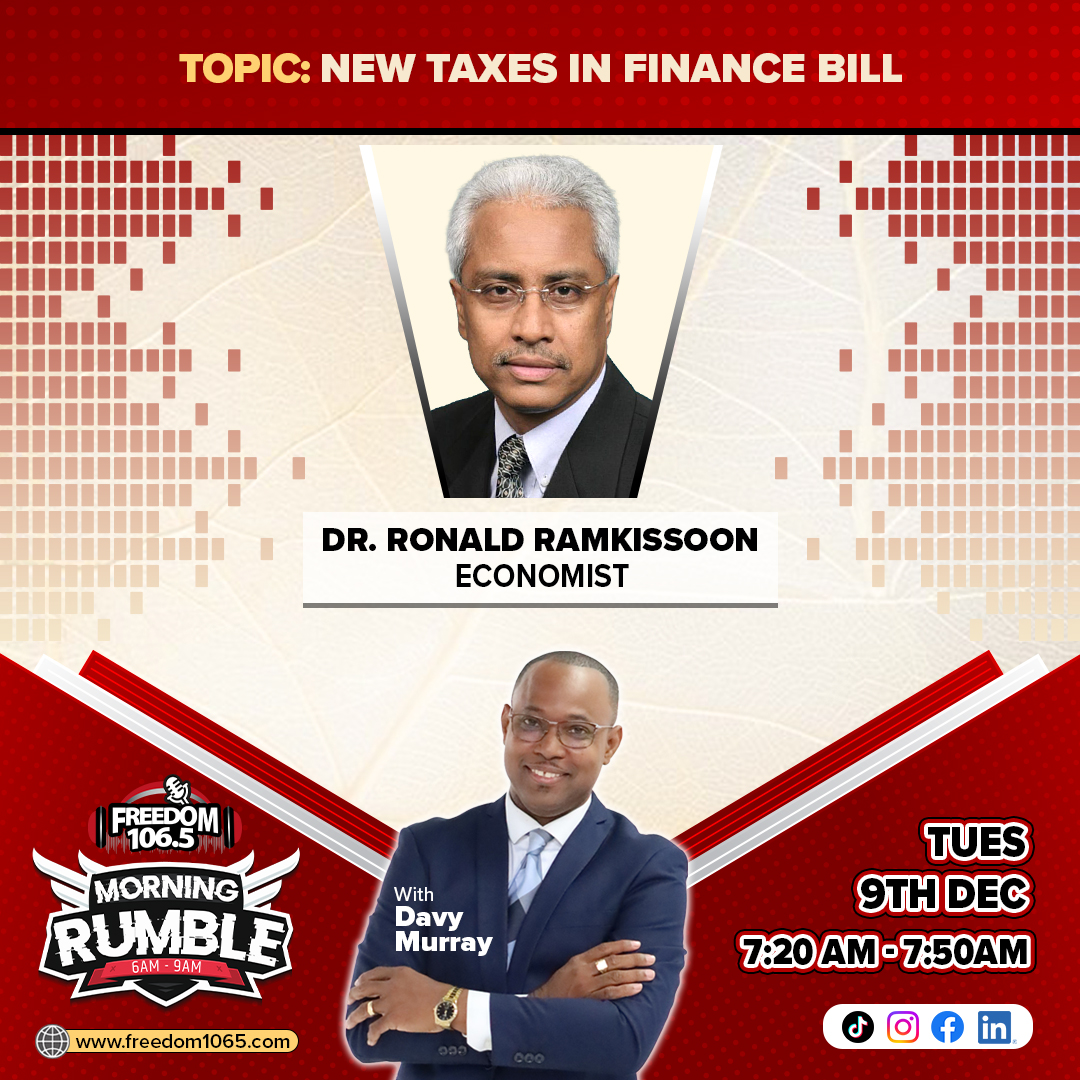
[00:00:09] Speaker B: Dr. Ramki, soon welcome to Freedom 106.5 FM. A nice warm welcome to you. Glad to have you this morning.
[00:00:14] Speaker A: Thank you. Thank you very much. Devi thank you very much. And good morning to your listeners. Good morning to you.
[00:00:23] Speaker B: We looked at an article that was written in our Guardian newspaper just a couple days ago as it dealt with new tax measures in the financial bill.
The draw praise which drew praises of caution from experts praises and a caution as well. Now with that bill, when we look at the article it seems to look at another form of taxes for the country.
The last administration was accused of taxing people continuously to gain revenue rather than looking for other ways to diversify the economy.
In your learned expression this morning, Dr. Ronald Ramkissoon, can you share your thoughts with us on this new financial bill that's before us in parliament and how it can either benefit or not so much benefit the working class?
[00:01:20] Speaker A: Okay, first, let me say prior to the elections, I think most people, economists at least, were clear that whichever administration came into office, they would have had a very difficult time in in managing the fiscal affairs, largely because we have been running deficits for over 10 years. Let's see.
And it definitely, just as in the case of a household, it is not the best way to go. It usually leads to bigger problems. In the same way we there was a sense that we are in difficult times because of course major sources of revenue, oil and gas, have in fact declined and has been declining for quite some time and therefore it would have been a difficult situation.
What we have seen in terms of the measures which were first announced in the 2026 budget and placed in a legal context in terms of the finance bill, is that there were very a range of taxes to attempt to increase revenue.
Now I think we have recognized the problems that we have today did not start today. They started a long time ago where there was a there was a tendency to increase expenditure by all politicians, not recognizing notwithstanding what economists and others were saying that are you sure you're going to be able to sustain these expenditures?
And I don't think that we will listen to over time and over administrations.
So what has happened is we have found ourselves with a largely undiversified economy and the major source of revenue has declined and we are, some will say we in a monkey Vance, which is really trying now to find a more balanced way out of this situation.
We have seen several taxes if I'm to categorize them.
Many have been placed on businesses.
[00:03:42] Speaker C: Rather.
[00:03:42] Speaker A: Than directly on individuals, on consumers.
But I think that there is a misunderstanding about how a market economy works. That is, you want the economy to grow, but who are the ones doing the investing?
And you want it to grow in a way that earns foreign exchange.
Now everyone must pay a fair share quote, unquote.
However, who is going to do the investing?
Who is going to do the employee?
Who is going to earn the foreign exchange?
And in this system it is businesses rather than consumers.
So what happens in this system is once you place the taxes on businesses, whether it is electricity, whether it is rent, whether it is whatever fuel, and all the other taxes that we have, alcohol, etc. Sooner or later they find themselves, we find ourselves where the consumer would pay some of it.
In the context of a weak economy like we have been having for quite some time with slow growth, you would find some businesses will attempt, especially the larger businesses would attempt to cushion some of those increases. But the chances are they will not be able to cushion all. And indeed those that are going to suffer most, those businesses that employ people are in fact going to be the smaller businesses.
Now I don't know that that would have been the intention, but we need to think carefully about the measures that we put in place because they can have some reverse effects from what we intended.
And I think that that is one of those. We have heard the small and medium sized businesses talking about foreign exchange, talking about the pressures they are, they are under right now. And indeed some of them talking about having to close because whereas the larger businesses can absorb some of those increases, the smaller businesses would find difficulty. And in fact I would make the point, David, that we need to pay some attention to that. We need to pay some attention. Yes, the act is there and we have passed legislation, but I think it must be revisited pretty quickly. You take for example someone who has one retiree who is trying to add to his government income also by having one apartment to rent.
Now this is not a complex. He's trying to make ends meet, he or she.
Do you really want to place on him or her the kind of, of burden that you are now going to place? I take the view that once they are means of earning income, then we want to do some kind of taxing. I know we don't. We have a big or what I consider a non issue over property versus non property. I don't know how we're making that distinction, but because we don't want to talk about the tax.
But property is property Regardless, but we don't want to deal with that right now to say that yes, we need to increase to increase revenue from businesses of consumers in a slow economy, economy that is weak.
I'm not sure should we going to be able to do and to get the kinds of revenues that we expect.
[00:07:45] Speaker B: You know, you mentioned as well the rental properties. And for the benefit of the listening audience who don't thoroughly understand this, when I did some research on it, I recognized this is a one off payment. So this is not something that is annually meaning, you know, for the benefit of those listening every year it's a payment. You register your property as for business as a rental property where a family is renting from you and you pay that one tax, so to speak after that there is no more. What we didn't get clear is if I decide to add another room, another apartment onto my property, do I have to then revisit now and register that and pay another an additional tax for that?
[00:08:33] Speaker A: David, just a clarification.
There were two elements to it.
One was a one time registration fee and you are correct that there was that one time registration fee. You don't have to pay the registration fee every year. However, the second element is where you have to pay every year.
So there's the one time fee and then there is you pay every year. I don't know whether I have not looked at the details whether you pay whether you have a renter or not, which is another issue. So if in a particular year you have not had someone renting, what happens?
But I want to say that I understand that we have to find in the short term some ways to increase revenue. But the underlying problem for years is that politicians have been very quick to increase expenditure in so many different ways.
The NIS that insurance is one of them where we to win elections, to be popular, to do things.
A lot of subsidies we give and there's to a point there is subsidies can be useful especially for the poor. But we always have to ask can we sustain that and for how long? Because when the time comes to cut back the population understandably do not want to hear that and we don't. I don't know that politicians take the time to explain.
Well listen, we are giving you this, but we could only give you this under certain conditions. And if conditions change, we will have to take it back. Of course politicians don't want to talk about that with the population. And I think there is need to explain far more than we do now. Not in a hostile manner because it is not so much that the consumer, the public have been doing what they want.
It is that our political leaders decided to increase allowances under the NIS to reduce electricity rates, to reduce water rates, to give subsidies without understanding that, listen, you must find a way of earning income to sustain this for a long time, hence diversification.
But if you cannot do that, if you're not doing that, then you to earn additional revenue to afford what we would all like, then you're not managing well. And I think the IMF and the World bank and the risk people who do these analysis and so on, they have been pointing to this for quite some time. And I think we need to stop, take stock.
Otherwise we are going to be find ourselves, don't make the revenue, continue with high expenditures, inefficient expenditures, wrong people, or let me say, let me say an ineffective public service that is in dire need of reform.
And then our answer is to borrow. So we don't want to take the hard decisions or the population not going along with that.
We want to win elections, we want to be popular. So we borrow.
And we are going in a very bad direction if that is the approach that we are going to be taking. Debbie, I'm sorry to say, you know.
[00:12:36] Speaker B: As an economist, I mean, you can't make an apology for what you are painting. You understand the economics of the, and the very fabric of our country and what is happening from past administration to now. We take a phone call very quickly. Good morning sir.
[00:12:49] Speaker C: Dr. Ramkisson, this new Minister of Finance has come in and he said that the reason why the government wasn't collecting appropriate revenue over the years is because the last administration before that, they have neglected to properly staff customs and bir.
So since Wendell Motley was Minister of Finance, Duke Horn was Minister of Finance, Karen Nunez Teixeira, all of them, all of them never had an idea as bright as that. He's the brightest person in the room. So we do not need a TTRA like Guyana, Barbados, Jamaica, Canada.
Let us just staff the BIR and the NII and we're going to collect all the taxes.
The TTRA was our road to come out of this because annually white collar criminals in this country have been stealing billions from the treasury and no one has been able to plug that gap. Now they come with a set of hodgepodge measures to collect taxes. I listen to your comments.
[00:13:53] Speaker A: David, thanks and Paula, thanks for the, for the question there.
Let me say that for years we have the country, the Board of Revenue, the Ministry of Finance has not been collecting the revenues that it is supposed to have been collecting at all different levels. We have had, of course, not only have we continued to increase the threshold level where people pay no tax. And that has some positive things about it. However, I think there's a recognition there was a big leakage and we have heard about 5 to 10 billion dollars annually in leakage. Okay. The last administration did some work, came up with the TTRE and they recognized the problem and they felt that that was the way to deal with it. And while you have countries doing different things, you have others trying things and so on, I am not here to say that that is the only way to do it. But what I would say it was a particular way that a lot of work had gone into and support from international organizations in pursuing that.
My approach might have been. But then Davi, I'm not a politician.
[00:15:07] Speaker B: I understand.
[00:15:08] Speaker A: Which might have been to say let me see if this thing could really work. Let me see if this thing is closing that gap. Let me see how many billion dollars more I am collecting every year. Okay. The present administration under our democratic system came into office and we all I think share, most of us share the.
The view that a democratic system is the best way to pursue to the issue though is will the new system result in the collection of the billions of dollars.
So we have instituted a new system. I don't know whether it has been tested. I don't know whether the forecasting and the models for forecasting when you do these kinds of taxes, what is the outcome on growth?
When you want, what is going to be the outcome? And one can say, well, let's wait and see whether we are going to be collecting so many more billion dollars and whether this is a superior system than what we had.
So I leave it there because a new administration is entitled to change.
But you want to make sure that.
[00:16:24] Speaker B: It is going to work and sustainable. All right.
[00:16:27] Speaker A: Yeah.
[00:16:27] Speaker B: Hello. Good morning.
[00:16:28] Speaker C: Good morning. Good morning.
Quick question.
Correct me if it is propaganda, but with a 400 million by $600 million from the HSF Fund US and the pronouncement that I don't know if the situation has changed by now that no banks collected any.
Any US for distribution. Could you, could you elaborate on this please? Thanks.
[00:16:53] Speaker B: I'll listen off here talking about the forex shortage that we have been experiencing for quite some time, the drawdown from the Heritage Stabilization Fund 400 and 600 million US dollars.
I hear the question, but I don't think this forum is the right forum to answer that question. I think we'd be doing a discussion advantage in attempting to answer that.
That should be better directed to those in authority that can give us more insight. Let's take another call. Hello. Good morning.
[00:17:27] Speaker C: Good morning.
Well that has a lot to do with.
But anyhow, to the economists, if you look at the ttra, what the government was supposed to introduce was supposed to stop leaking.
This measure that this administration introduced is to collect taxes from almost all the citizens. This is more revenues, revenue, new generation sort of tax compared to what the Revenue Authority was supposed to do. As you outlined, we have leakage of nine or $10 billion. That was to stop the leakage.
Right. This measure that they intend to pursue or are about to pursue is more or less putting more strain on the population. These are direct taxes, not to stop leakage. You know, this is to actually tax the population.
Enjoy your morning. I would like to hear your views on my.
[00:18:27] Speaker B: Thank you very much. And the thing about it is I wondered that, you know, Dr. Ramkesoon, when it looked, when we looked at those situations relating to taxation, how the poor man, as we just put it in Trinidad, the average citizen would face, would feel having to bear the brunt. Because what the minister said is that they tried to target certain individuals who have avoided paying taxes. The landlords and these people who got away scotch free. And let's face it, the price for an average two bedroom apartment ranges anywhere from 35 to 3,800.
Quiet, quiet per month. And when you look at the annual revenue generated and then they're not paying any taxes. I understand that. So you say okay, pay an annual tax.
That annual tax is not going to be $15,000.
It's a couple thousand perhaps, I don't know, 2,500 is your, is your one time registration. I don't know what the taxes will be. We haven't gotten the nitty gritty of the bill in terms of what it means for a person with one room, two rooms, three, you know, Dr. Ramkisson was very clear on that. So let's take another call quickly. Good morning.
[00:19:38] Speaker C: Hello and good morning calling from David. So I think the government needs to take an approach. Okay. They have their say but they need to have consultation with the public to on that because they should have a ceiling. What the last government did they basically look at for the citizen, for the residential house, $1,000, you know, quarterly or yearly. And then when the budget come and decide to raise it now you have no say on it. And if this government now, for businesses now you're supposed to have a Ceiling at least if it's 20,000 or 40,000 monthly, you could categorize that. And if you're not doing that, I think it's a failed formula now across the board. You just can't implement all these things. You're going to have effect major effect on the citizen. And now we know as a citizen when you vote in our government now we will focus to cutting the rental because when you look at the government rental for a year, you will arrive at how much? Almost a billion dollars leakage in this country. Seven billion in wastage. And that need to pay attention to before I reach to the citizen. Have a good day.
[00:20:46] Speaker B: Dr. Ramki, soon your thoughts when it comes to having these taxes passed on to citizens While the government does not. They're hoping. The minister said he was hoping that, you know, businesses are responsible to take up, absorb this cost and not pass it on to the consumer. What measures do you think should be put in place in order to regulate this and monitor the what we would call inflation in terms of consumers, regular consumers having to face the brunt of it. In the article it says that even if they want to pass on the tax to the renter, to the person applying for housing right which will restrict the supply in the housing market, the minister said, well, they could just shop around, but sometimes shopping around is not the answer. Depending on where you work, you know, the travel conditions, transport availability. What are your thoughts on this?
[00:21:39] Speaker A: Well, let me say on that issue of shopping around, I think the minister is correct. That is you the consumer has a responsibility.
And I think that that is another point. I see there's some discussion about it and a review of the act which, which controls the consumer division and so on. I think at the consumer level, consumer needs to be educated and needs to realize that they have choices.
They have choices in respect of how they live, what they spend their money on.
Consumers have choices. And I don't think that as a society we do enough to emphasize that consumers have choices in terms of what they eat, in terms of whether they exercise, in terms of whether the they follow proper diets and so on depending on whatever ailments that befall them and so on. There is a need for saving versus consumption. Some public servants are going to be getting increases at some point.
Hopefully the issue would arise again. You cannot be consuming at that rate.
We have been as a society for many years. We have been consuming at a rate that we cannot sustain. The government has tried successive governments to ensure consumption continues. But you know, we are making wrong decisions as far as consumers. And we need to look, we need to shop around as consumers.
It is not easy. I'm not making the case that life is easy and that it is simply shopping around. There are different dimensions to what happens and how we live. But I think we need to understand that we have choices in every many weeks in so many, very many ways.
[00:23:46] Speaker B: One text. Let me take a phone call quickly for you this morning. Hello, good morning.
[00:23:51] Speaker C: Morning.
Morning.
[00:23:53] Speaker B: Good morning, sir.
[00:23:54] Speaker C: First time caller.
[00:23:55] Speaker B: First time caller. Welcome to the program.
[00:23:57] Speaker C: Yeah, thank you. Thank you to your guests too.
[00:24:00] Speaker A: Thank you.
[00:24:01] Speaker C: Is the pnm. We have this country. So the pnm, see for the money from Trinidad and Tobago to start with.
[00:24:10] Speaker B: I really don't want to go down in a political.
All right. We, we want to be responsible. One text there is saying perhaps we should move away from income tax entirely and, and tax spending. Maybe with subsidies on basic food items, educational materials and medicines.
Those who earn more spend more generally. So the taxes would be borne by those who can afford it most.
That is one text to Dr. Ramki son sending us that message. Hello, good morning.
[00:24:42] Speaker C: David Boyen, Mr. Marquis Kuhn.
Sometimes when you agree you is a lose all under the last region, you're getting 4% and nothing more. Can I come and give them 10%? Okay. If they pay 4% or 5% before Christmas, your girl check though say thank God now and you're still getting 6% next year.
Think about it.
[00:25:06] Speaker B: Okay. Thank you.
[00:25:06] Speaker C: Think about it. Public servant. Are they greedy or they easy or greedy?
[00:25:10] Speaker B: Okay. Hello. Good morning.
Good morning.
[00:25:14] Speaker C: Hi. Good morning.
[00:25:15] Speaker B: Good morning. Welcome.
[00:25:18] Speaker C: I wanted to raise two points about the property tax.
So first off is the, and I think the economist mentioned it just now, but the registration pays you one time and then there's a quarterly tax.
So every quarter that's based on the current bill.
Every quarter you pay a tax. If it's you earning $20,000 or less, it's 2.5% and above that is 3.5%.
[00:25:44] Speaker B: That's quarterly.
[00:25:45] Speaker C: That's fine. Quarterly.
The second thing is currently on your income tax return there's a line item for rental income.
So based on the introduction of this tax, some persons may actually be double taxed because you should already be declaring your rental income on your income tax return.
So if the issue was persons avoiding tax, all the government really needed to do was introduce that registration aspect so that now landlords are required to register and they have their follow up compliance to ensure that persons do register.
And once you're registered, they should expect that line item on your income tax return to be filed.
So what they're doing right now though is you'll be filing the income tax. You get taxed there as long as you're crossing the personal loan threshold and you'll be further taxed with this additional surcharge.
[00:26:49] Speaker B: Thank you.
[00:26:50] Speaker A: Let me just say I hope that that is not the case and maybe the minister will clarify the situation before I want to make the point as well. There's a couple of your listeners have raised the issue of implementation.
You know, you first need to revise or review, one would think a new administration. What exists, why it exists, what is the basis of it.
And then to the extent that it needs changing, feel free to change it. If you think it is not in your philosophy, it's not going to work.
But I think implementation of measures are key. I think that that is one of the factors in respect of or in explaining why we have not collected the kinds of revenues that the country is supposed to have been collecting.
The implementation. So I think that there is need to focus.
Okay. The announcements made, we need, I believe, to make some adjustments to those. But I think equally important is to ensure that whatever has been indicated, in fact that implementation is done to make sure that we collect the taxes.
[00:28:09] Speaker B: I have one final question for you before we depart the interview this morning. And it has to do with sustainability of the economy through these supposedly stringent measures coming from this financial bill. But before we look at that, let's take this final call leading up to the end of the program. Hello, Good morning. All right, call me back if you wish. 625-2257 and 6273223. All right, so we lost that call there. So when? Oh, here it is. Hello, Good morning.
[00:28:37] Speaker C: Good morning, Mr. Davey.
[00:28:38] Speaker B: Good morning.
[00:28:39] Speaker C: And pay your guest economies, David. Now, I did protest against the property tax because I have never gotten service goods and service delivered onto me for over five decades.
I always have to see about in front of my property, spray it, clean it, cut glass it and whatever. So I was always asking the question, what I am paying for to mine other people in Trinidad or what? It is another thing, baby, why the government is taxing our joy, our happiness on alcohol and on our freedom and cigarette.
Why they're not being creative in creating all these abandoned estates, cultivating it, bringing it back to use and planting coffee, cocoa.
Right now these things have a high market value and put in the same CPAP and URP workers and put it under a corporation and let themselves invest into it, buy shares into the corporation so at least they will have something sustainable to to go by and have a future.
Why it is the government is not being productive and being so how to put it.
I don't David, this the government is not being realistic to the population and all they come out to do is just to feed on the population to mind their lavish lifestyle.
[00:30:27] Speaker B: All right. I thank you for the for your comments and I think it was going down tailored to what I was wrapping up with you. The sustainability and viability of taxing citizens of this country.
One wondered whether the land tax, the property tax would have been better as opposed to this rental, this landlord tax that is now being instituted upon the population. So my final conclusion question to you this morning, Dr. Ramki, soon, thank you again for joining with us is the sustainability of this new tax regime that is seemingly to tax those that can afford. Yet we are seeing an avenue where the consumer will be picking up the slack and probably will have to if they are to benefit from goods and services. Your final thoughts, please?
[00:31:16] Speaker A: Well, two things the consumer would in a declining or in a weak economy, one would expect that costs would be passed on. Some of it definitely would be passed on. It is the way in which the economy works.
I think we have to also recognize that we may be putting some businesses, especially SMEs, out of, out of compliance, out of work. And I think we need to revisit at some point the effect. In fact, we must always be monitoring the effect of our measures. We are very weak as a country in doing that. I think we must do that to ensure that we are able to balance or reach close to balancing that budget.
Big increases in borrowing, high expenditures, wastage by the consumer of most things because they are subsidized. I think we need to focus on better management of the fiscal affairs of this country going forward.
[00:32:31] Speaker B: Dr. Ronald Ramkissou, thank you very much for joining me this morning and sharing your thoughts as an economist as it relates to the economy and stability of our country. Thank you and have a great day and I look forward to chatting with you again in the not too distant future.
Thank you.
[00:32:47] Speaker A: Thank you very much. And thanks to your audience as well.
[00:32:50] Speaker B: All right. You're welcome.
[00:32:51] Speaker A: The best insight, Instant Feedback, Accountability the All new Talk Radio Freedom 106.5.