Episode Transcript
[00:00:00] Speaker A: You're tuned into the all new freedom 106.5. 106.5.
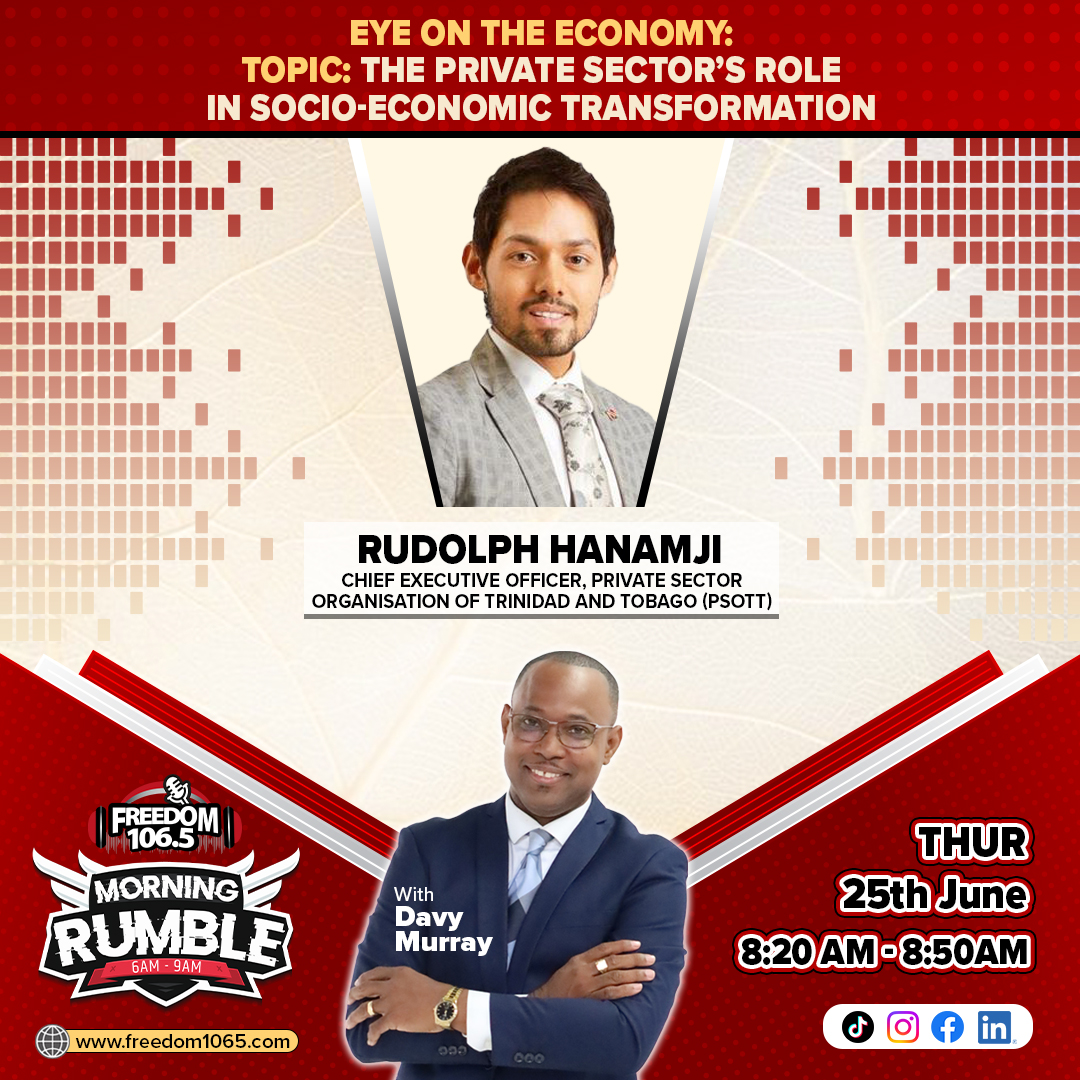
[00:00:13] Speaker B: Good morning and welcome back to another edition, part two. This morning of Eye on the Economy. We spoke with Andrea a few moments ago. Now we are speaking with another one of our elite guests. We have Rudy in the building. Good morning to you, Rudy.
[00:00:24] Speaker A: Good morning Davy and all our listeners. It's good to be in here back in person. Of course we sometimes chat on the line, but I love, I always love coming to visit the studio and thank you for your ongoing work every morning
[00:00:38] Speaker B: keeping the country informed to the best of my ability.
[00:00:41] Speaker A: Yeah, I, I definitely set a high standard and I appreciate that.
[00:00:44] Speaker B: I do try. I was accused recently of being unintelligent by saying good morning to people.
[00:00:49] Speaker A: Projection is a hell of a thing on atv.
[00:00:51] Speaker B: You see a projection, the man said you are. This is an unintelligent show. You come and went through a list of good mornings to people. How is that intelligent? So I'm thinking to myself, come on courtesy boy. Thanking persons who stay up at midnight to get the first message into the
[00:01:05] Speaker A: station to say hi, people don't understand what goes on in the engine room to produce this content and for you to make the effort to get up. Do you see? That's an example of productivity persons in the media who work 24 7, they do.
[00:01:20] Speaker B: So thank you especially and I am very happy to hear that coming from you. It means a lot. All right, so as we get straight into it, PSOT is in the building. We're talking about the socio economic transformation, the value of integrated lobbying and planning among the business community. And you know, the business community has shot into the limelight since the AG statement backed by the Prime Minister. Now the arrest of these two prominent business owners on blue waters. So are we seeing another sector of the economy coming under attack?
What is happening?
[00:01:53] Speaker A: The private sector organization of Trinidad and Tobago was recently formed in December 2012 as a new model in Trinidad and Tobago, DV.
However, these models have existed across the region and the globe for decades. As a matter of fact, our counterparts, the PSOJ in Jamaica, they have enhanced influence on public policy since the 70s.
In Guyana, the Private Sector Commission operates in much a similar way, especially now that Guyana's economy is expanding at an exponential rate.
To answer your question directly, interestingly brings into focus the value of having such an integrated organization representing the private sector. And I want to make it clear that we are fully established and funded by the private sector, which includes not simply large corporations, but a wide cross section of SMEs across the nation.
Because our board is made UP of the TTCSI, the TT Chamber, the Confederation of Regional Business Chambers, AmCham and the SEARA Business Chamber, the Chaguanas Business Chamber and the Energy Chamber of Trinidad and Tobago. So we are well represented as well as with the ttme.
And within all of those bodies you have the diverse private sector represented. From the largest corporations that are earning billions of dollars and paying hundreds of millions of dollars in taxes to the smallest operators who are managing day to day to sustain lifestyle businesses.
The business community in Trinidad and Tobago for many years, DEVI has always been targeted.
Unfortunately, over the decades for different reasons, we have found that the private sector has been demonized.
You see, you just have to look at social media. When private sector companies, for example, that are publicly traded on the stock exchange, when they issue their financial statements, you look at the comments and people attack the private sector and bemoan the fact that these companies are making these astronomical profits. But I want to contextualize that for a moment.
Those profits are after taxes.
A country earns its revenue in a capitalist society. We are a social capitalist country. We have to accept that. We have a large social support system that came with us from independence days to today.
But at the end of the day, from Eric Williams to Kamala Passad Bisesa today, governments past and present have always spoken about the role of the private sector because they understand governments earn revenue through taxes. Even in the energy sector sector, we do not earn revenues. When a barrel of oil is sold and that money comes into the coppers, it's the taxes on the sale of the oil and gas that come into our coffers for the most part.
So the private sector, Davy, has been unfortunately under attack and people make these generalized statements and it covers all ships, Davy.
When people look at business people in general, they tend to think of them as being totally profit driven, heartless, uninterested in their employees, their social development, their communities. And that, I will tell you, is the furthest thing from the truth.
As a matter of fact, if you take this media house for example, you all have invested in many social outreach programs, you've supported the civil society groups, you have been utilizing the resources at Guardian Media's fingertips, as other media houses do, to support a lot of good as well. But at the end of the day, do we not have to make profits to ensure that we can pay the staff we were talking about earlier who work 247 to support the entity?
So profits are not a bad thing.
There have unfortunately Been as with any jurisdiction across the globe. I mean, we saw years ago in 2008 when the world's largest banks put the entire globe at risk because of unethical business practices.
Even in Trinidad and Tobago and the region.
I don't have to call names, but we were all, and we are still all impacted by large corporations engaging in unethical business practices.
And because of that, Devi I believe that people generalize and they use these examples to cast wide nets. But we know of many SMEs, many large corporations that are running their businesses properly and they are not under any fear of attack.
To pull a little bit from what Andrea shared in the earlier segment, the wide cross section of the business community is committed to ethical business practices, operating under the ambit of the law and building business in the right way. But we do not shy away from earning profits. The more profits we can earn, the better the society will be. It is up to the government to implement the right taxation policies that will ensure that tax dollars are shared equitably. And we will also push back on the public sector side when tax revenue is wasted or it is not used for the right reasons because of corruption.
So on both sides, David, the public and the private sector, we have to make sure we're doing business the right way.
[00:08:12] Speaker B: You know, I want to get to PSOT because I want to understand. I know you're up for a position there and I want to highlight these things because the private sector organization of Trinidad and Tobago is something that I feel the need and I'm happy that you're here this morning. So persons become aware of psop. They become aware that there's an organization, an entity that is not just concerned, concerned about the economic growth of one elite in society, but for everybody across the board. You know, we are looking at it and I want to get to that. But something is hitting my mind with what you just said.
The vast majority thinks that the owners in the corporate world truly does not.
Their main goal is profitability. I myself said this morning that the corporate entity often does not care about you. You are a number that comes up in HR if there's a need to downsize, if they feel that their wage bill is a bit too high and it's cutting into their profitability.
I said that because of what I experienced, what others experienced, what Petrotrain went through and others.
I say petrotrend loosely because Petrotren at one time bleeding the economy similarly bwia. But then there was TSTT that operated at a at a profit Each and every time bills was paid, however, the profit margin was fluctuating and they blamed it on the wage bill. And within a two to four year period, a thousand persons was unemployed. My thing about this is how can we convince the mass, the mass majority, the masses, those coming up, those adolescents in schools that are coming in that list. And when you get your academic qualifications and you get into the public sector, the private sector and you start earning your degrees and you start making valuable contributions to an organization, you can be sustained and protected by said company. How can employers show their employees on the ground to not just provide EAP assistance and these things, but benefit in the profit sharing margin as well? How do we see care at the end of the year when some companies show the employees that they value them? How does that trickle from upper management from the owners to the 160 something thousand workers?
[00:10:37] Speaker A: Interestingly, as you mentioned that very specific example about sharing in the profits of the company.
Only yesterday we participated at the Trinidad and Tobago Stock Exchange's SME seminar and they hosted on their panel the Solis Group, which went public recently.
And they shared that a large percentage of the shares that were offered on the open market when they listed on the stock exchange were actually purchased by their employees.
That is an actual model in the private sector that is operating in a few companies across Trinidad and Tobago where employees are given the opportunity to buy into the company and in that way they're given a greater sense of ownership. Why am I here? What is my purpose? It is not only benefiting the owners, but it is benefiting myself as an employee. Now that as I said, does not pertain in all entities. However, many private sector firms have bonus programs which are tied to profitability.
And therefore, if you are productive and you are able to perform your tasks at the objective set and your performance is managed properly, you will benefit directly from the firm earning a larger profit or meeting its targets at the end of the year. And many medium sized companies, especially in the manufacturing space, because remember, in manufacturing productivity is king. You have to produce as much as you can with the leanest model as possible to be competitive not just locally, but to be able to export competitively in the international arena. So it is in their interest to ensure that the employees buy into the system and perform well.
How do we get this to be our common denominator DV across all business sectors and industries? That is is the challenge.
Larger companies, medium sized and larger firms, they do have access to additional resources that allow them to offer a different type of employment climate. So to speak, they can offer different wage structures, salary benefits, they can provide additional services, as you mentioned, EAP, etc.
Smaller companies, Davy, they are sometimes, especially in the economy that we've inherited for the last few years, the last decade plus, they have been in survival mode. So to your point, any businessman or woman is going to look at their business and they're going to make hard decisions. Now at the private sector organization Trinidad and Tobago, one of our key areas of advocacy is in integrating national standards around how businesses operate so that they are able to develop and execute the right strategies. Because it does take two hands to clap. If the owners or the management of a company X, if they are not developing the right strategy and managing properly, then the lack of performance is not necessarily a result of the staff's fault.
But on the other side you do have examples where you have a company that is well run, the strategy is clear, but you do have a lack of productivity on the employee side and that has a knock on effect on the overall profitability of the firm.
So we, as I said, we've been launched in December.
We are working with all of the different BSOs, the business support organizations that are members of ours and others to over time determine what these national standards of operation should be. And we are going to continue to encourage that as many S's and M's, the small and medium sized companies, they can effectively get up to that standard so that at a certain point we will be speaking about the productivity levels in an integrated fashion and there's going to be less risk then for employees to feel the brunt of decisions that are beyond their control.
[00:15:01] Speaker B: I like that. And that ties into psot. Now your values, the core interests. How are you all going to navigate these turbulent waters? How are you all going to integrate? Get government to buy in.
Lets get to psot, the private sector organization. Why its values and benefits, some of the strategic roles.
[00:15:21] Speaker A: So in a nutshell, you could imagine how difficult it is to develop national policy when you are bombarded as a policymaker by over 35 different bodies.
So for example we, we understand that over the last 20 to 30 years varying ministries would have received oftentimes 15, 20, 30 letters from different agencies asking about the same issue. So in more recent times you know that the government past and present has been faced with the challenge of VAC refunds.
Could you imagine having to respond independently to each of those requests?
So the state for many years has been asking the private sector to integrate more effectively and on certain national issues, why don't you all speak with one integrated voice so that the private sector gets its own act together, is able to generate consensus at different levels and define an integrated unified position. And that way we can actually negotiate better with the state because you are now speaking to them across the table with an enhanced position of strength.
So that is how we actually positively can influence national strategy. We can bring to the table not simply recommendations, but active projects that we are putting in place. So no longer are we simply going to say this is what we want, we're going to add a secondary layer to it, which is this is how we can work with the state to meet national strategy objectives. So, for example, the oil and gas fines that are expected to positively impact the economy in 2027, while welcomed from all intents and purposes, all projections suggest that Davy, those fines will simply sustain our economy where we are right now. It is not going to bring the windfall as it has in the past to exponentially grow the economy.
And therefore the government has conceded that where the difference in revenue is needed is from the investment sector.
Both local and foreign investors need to be converted devi hundreds of millions of dollars need to be unlocked from people's bank accounts. To put it plainly, we need to encourage entrepreneurs to unlock their fixed deposits and their cash investments and make the decision to invest in Trinidad and Tobago. And that is the other area where the PSOT adds value. Because we are already actively engaged with private sector players, again, medium and large players, who are willing to consider where they want to invest their capital. And we are so scoping actual projects. We had a meeting with our Energy Services Implementation Committee a few days ago and the energy services firms. So these are the firms that provide support services to the energy, the large multinationals and local large energy players. So the transportation providers, the divers, the rig operators, et cetera, they have already completed studies through the Energy Chamber that show with the right enabling ecosystem, if we enforce our own local content provisions. Dv, do you know that with that impending energy development in 2027, we will not only earn the taxes from the energy fines, but we can earn a few hundred million dollars extra from additional services being provided to the shells and exons of the world.
So right there, the Private Sector Organization of Trinidad and Tobago, working in conjunction with the Energy Chamber, we have already identified a how of unlocking additional capital and revenues for the country.
That is the difference. Because in the past the BSOs have been very good at mobilizing intent and positioning recommendations, but they were not structured and this is not their fault. They were not structured to undertake actual project work. We have come in to close that gap. So we complement what they are doing and we can start actual project work on their behalf and the wider private sector to unlock that capital that we need devi to really grow our economy.
[00:20:26] Speaker B: And I am there with you. I'm looking at PSOT's documents here. And when it comes to policy, to advocate for influence, you said offers a forum of influence, national strategic priorities and policy development enables the private sector to actively participate in shaping legislation, regulations and policies affecting the organizations you mentioned, the oil and gas sector, how are we going to regulate this? How is this, how is the average man sitting in a taxi this morning listening to this intellectual conversation would say, hmm, I can see where eventually, maybe not in the morning, but in the not too far off future, this will benefit me. I am home with my sons and my daughter and my wife and I can see where our economic growth is sustainable.
It's growing, even if it's growing on a snail, but it's moving in a forward direction.
[00:21:19] Speaker A: The easy answer to that question is, was answered for me actually when I started my road show coming into the role again. We are not, we do not want to be perceived as a Port of Spain operation.
So many of our members, as I said earlier, come from across the country and even in Tobago. So I started my onboarding with a road show which I'm continuing and I went to Grande because, interestingly, Davy, just to give you a bit of my personal story, my grandfather and his father family come from Sangri Chiquito in Grande. And my great grandfather was the owner of cocoa estates. And my grandfather grew up toting cocoa on his back and hands a fig that weigh 20, 30 pounds or more.
And he eventually went on to become a teacher and then an attorney at law, my grandfather.
[00:22:13] Speaker B: Wow.
[00:22:14] Speaker A: So I grew up visiting Grande and my family there. And over these decades, Grande has given Trinidad and Tobago a huge investment in human capital.
Many of our leaders and business people have come from Grande. And Grande has always had a local business community that, to your question, directly supports the average man, the everyday working class person from that eastern stretch of Trinidad and Tobago that sometimes many people don't even visit.
[00:22:47] Speaker B: They don't even pay attention to it.
[00:22:49] Speaker A: But the answer was given to me.
The members of the business community we met there, some in the retail sector, others in the light manufacturing space, in transportation, in the hardware sector, they told us through the San Fernando and East Eastern merchants at chambers, for example, because they are members of psot, through those regional chambers, they have provided three or four immediate projects. So for example, in Grande, one of the challenges to business is actually traffic management and parking, because for those who have visited Grande, the land space is very limited, right?
[00:23:32] Speaker B: And it's a very bustling and thriving community.
[00:23:34] Speaker A: So through those regional chambers, they have escalated this request to PSOT and we are going to be working with them to scope an investment project. Hopefully that will bring a solution to those two problems. And if we are able, when we are able to implement that solution, business will grow in Grande and persons who live there will get additional employment benefits so they won't have to sit in a taxi, Davy, for one to two hours in the dark of night to find employment elsewhere out of their regions. And that is a model that PSOT is committed to across this country. How can we grow business, small and medium sized business in various regions where people can find employment in their own immediate jurisdiction and their quality of life will immediately improve. So the man in the taxi listening to this interview, that is how public policy, when it is rightfully influenced by the private sector, can benefit you overnight in a direct way.
[00:24:40] Speaker B: And that falls right in line with the economic growth and stability. I tell you, I would run through it, don't worry. So the economic growth, sustainable growth and by advocating for policies that enhance economic development and competitiveness within your jurisdiction. So you'd rather leave Grande and come all the way to Port of Spain, say. And you're right, in the very pre dawn hours of the morning there are persons that leave a particular area housing development in Grande, that is about 15 minutes to 20 minutes on the outskirts of Grande and to get into Port of Spain to start a job at 8:00 in the morning. So they're reaching back home in darkness, whereas they can get work and employment sustainable within the area. But then when we look at the Forex and the ease of doing business, how is PSOT TT involved in mitigating those Forex challenges? And again, I've heard this many times, ease of doing business.
[00:25:35] Speaker A: So let me pick up the ease of doing business first and I will tie it back to the Forex.
For the first time in our nation's history, the private sector is actively in the room on a weekly basis with the Ministry of trade since PSOT's launch in December, every Friday. So tomorrow morning I will be at the Ministry of trade from 9 to 12 plus we sometimes stay there till 2, 3 o' clock in the afternoon. And I want to make a public call for technocrats in the different ministries across this country. I want to Commend the majority of you all. The private sector recognizes that many of you or the majority of the public sector are hardworking technocrats and they're simply trying to navigate a difficult ecosystem. And when we return on another show, dv, we will speak about the public sector at those meetings. On the agenda every Friday is a segment dedicated to the ease of doing business.
So in the room we are discussing with the technocrats who have to develop not just legislation, but the regulations and the ecosystem that unlocks existing legislation to make our lives easier.
And we are able to fashion it in real time in that room. The sailclair program that was launched recently through the ministry's efforts and input from the private sector players in the marine services space reduced the time required for vessels coming into Chaguaramus from as much as four to five hours to less than 45 minutes.
Yeah, already that has traveled across the yachting sector because it's a tight knit community and persons who had. The only reason they really started disliking coming to our beautiful twin island republic was because of the hassle in the bureaucracy of mooring and going through the necessary customs and health checks that is already seeing an increased participation of yachties returning to our shores. And guess what they bring with them when they come? Foreign exchange. Because outside of oil and gas, one of the best sectors to earn foreign exchange, literally while you are sleeping, is the tourism sector.
[00:28:10] Speaker B: But then let me ask you something with the yachties and the tourism sector. Remember in Trinidad and Tobago, if we travel and we come back with us, we are being told we have to deposit it in the bank. It's illegal for us to take that us and say, well listen, Rudy Checkman, I have 100 us here, I'll sell it to you even if I'm not.
It's called black market sales.
[00:28:30] Speaker A: Anyhow, you take the regulations are what they are, right?
[00:28:35] Speaker B: So if the yachties come in, are they able to. Are they allowed to trade with us for goods and services in the US currency?
And what happens when we as the business owners, when we get the US currency, are we allowed to keep that currency and say, well listen, when I'm traveling next year or next couple of months, I will go with my currency or do I have to, is it lawful that I have to take my US currency? So we. It's a two fold question. The yachties and foreigners, are they allowed to trade for US currency for goods and services here? And when the locals get it, is it mandatory that they must go to the bank and make that Deposit.
[00:29:13] Speaker A: That is a question that needs to be properly ventilated and formalized.
The honest answer is that already, Davy, in our economy there is an informal market that is happening where trade in US Dollars is taking place outside of the commercial financial institution system.
So ideally, money currency, whether digital or hard cash, should flow through a formal system. That doesn't only mean commercial banks. There are many other. Especially today with fintech applications, there are formal networks that money is supposed to pass through.
How do we then as a country find a balance to regulate this?
So I used to be the director of marketing for the Kruzen Group of companies in Chaguaramus many years ago, and I saw firsthand where foreign exchange transactions took place in an informal system. Because you would see things happening in the village, at the fishing depot, at the bars.
You go across Trinidad and Tobago, right here on Frederick street, there are signs that say we accept US Currency at a certain rate.
That now do. As a business community, do we call for harsh enforcement of regulations? On one hand we say yes, enforce regulations. But at the same time we say regulations must make sense and regulations must facilitate business.
So most of the yachting transactions at a higher level will actually pass through a formal system.
So for example, when people think yachties, they don't consider the repairs to the ships.
We don't consider the additional services that yachties require that must go through a formal system because of the volume of the work. What you're talking about are the smaller transactions.
So the answer is that obviously it's happening.
We want to take that up and I'm glad you raised it with the government and develop a balanced regulatory system that facilitates it in a more formalized
[00:31:36] Speaker B: manner out of time. But here's the thing, right? Two things come to mind very quickly. One, clamping of vehicles in a private car park. This have the sign$200,400 if you park and they clamp your car, pay that again back. That has been deemed illegal. You cannot hold somebody's property for ransom. Yes, that's against the law.
[00:31:55] Speaker A: So all that is common law.
[00:31:56] Speaker B: All them clamping signs in wrong.
We accept U. S here at $7 and 50 cents or more or more a dollar. Isn't that black market trading? Isn't it the same thing as clamping a clamping sign in a. In a car park where they want the threatening to clamp your property? Is it that when you come to my establishment I could take your US and give you tt for it or probably give you goods and services as
[00:32:27] Speaker A: we're running close to the end.
I will join both as a non practicing attorney and the head of this organization. I will join with you and make a call that we have to quickly determine what are the policies required to close these loops because in economics the these types of what we call exigencies or informal markets are created because public policy has not risen to match the moment that we are in. We have some archaic regulations and policies that the private sector organization with our members will be taking up to find the best solution. So you have. We are not shying away from the answer but we cannot change, we cannot wake up and change the system without consultation because we don't want to have a negative run on the, on these businesses that depend on some of these informal systems.
[00:33:23] Speaker B: Now even if you depend on the informal system, that doesn't make it right.
[00:33:27] Speaker A: It does not make it but. And that is why we have to find the right solution. But I know we'll be back for next week to continue these conversations.
[00:33:33] Speaker B: My last, last thought really, do I have to answer this now but should we make US Currency our second currency in this country? It is being done in Barbados, Jamaica and other Caricom nations. Why are we hell bent on the TT dollar being the only national currency in Trinidad and Tobago?
[00:33:50] Speaker A: So we'll take that up next week when I'm back guys.
[00:33:54] Speaker B: This eye on the economy segment being brought to you the kind compliments of Guardian Asset Management Ltd. We take that break.
[00:34:00] Speaker A: You're tuned into the all New Freedom 106.5 Formal 6.5.