Episode Transcript
[00:00:00] Speaker A: You're tuned into the all new freedom 106.5. 106.5.
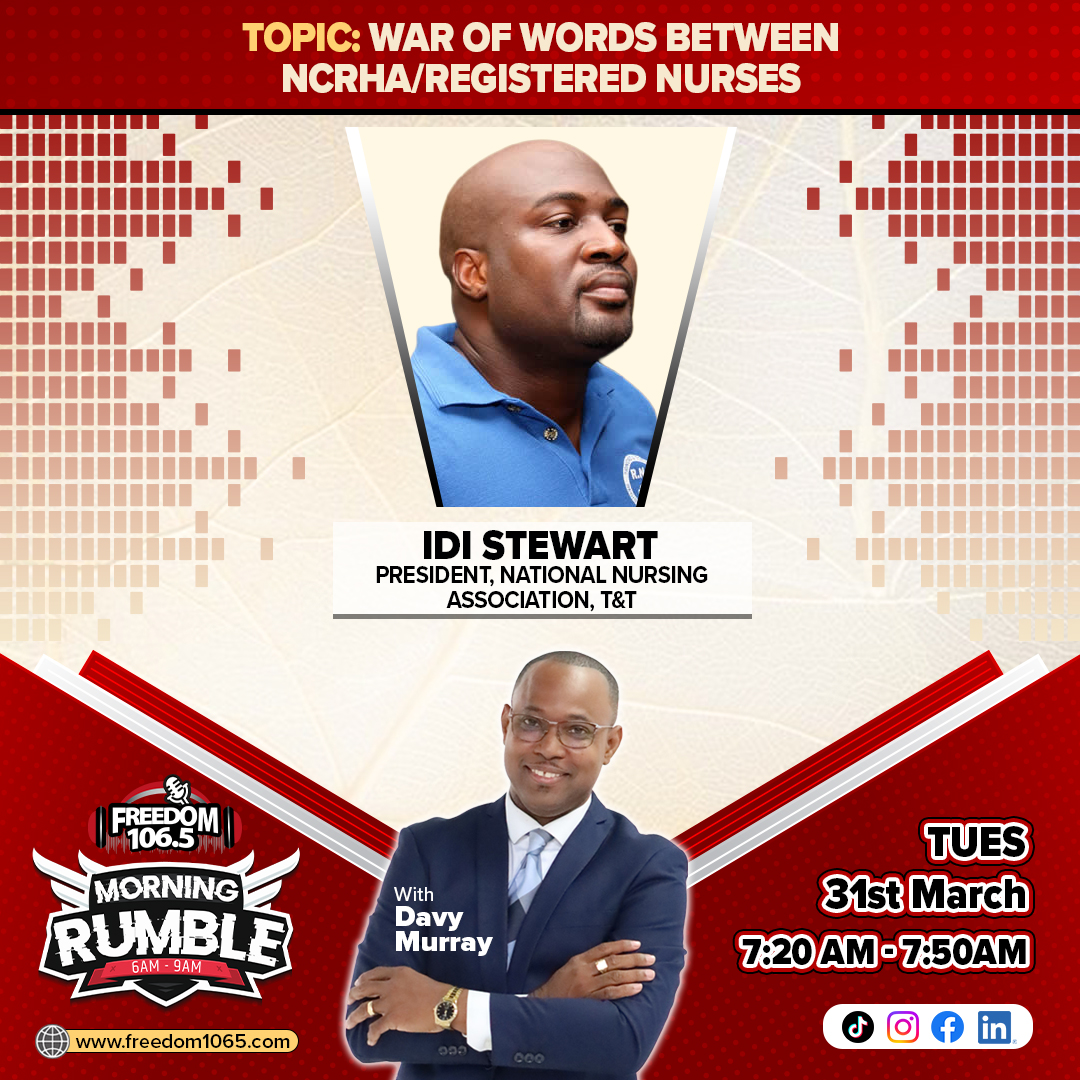
[00:00:06] Speaker B: Let me chat with Edie Stewart, always talking with me.
Good morning to you, Mr. Stewart. President Stewart, how are you this morning?
[00:00:15] Speaker A: Pleasant morning to you and your listeners. Thanks for having me. Great to be here this morning.
[00:00:20] Speaker B: Well, we see the narrative that is being spewed in the public's domain.
I love the list of demands. I don't have a problem with the demands. I think this is fair. We in 2026, you can't be functioning on 2013. 2013, you can't be doing that. That is ludicrous. All right, so I could understand that. The, the job security. So, but help me understand this pool, what is the nursing pool? What, what is this?
[00:00:48] Speaker A: All right, so in a nutshell, in the 90s, and hear me well, in the 90s, there was a situation, and ironically there still exists a situation where it is extremely short within the regional health authorities, extremely short in terms of nursing and midwifery personnel to properly, safely and efficiently deliver care to patients. So what the government tried to do at that time was to introduce this system called pool, where someone will sign on to a pool type arrangement, a contract, an extra duty type of arrangement, somebody who was not working in the regional health authority, they were probably working privately or they probably have retired or they will just have left the nursing totally. And you are now trying to encourage them to come back in to the system to fill the gaps.
So that was done back then. What the government tried to do is give them a rate higher than the average rate of nursing because the salaries were extremely low at that time. So they tried to create salaries that were attractive to bring those persons back into the fold.
So that was done and they created a system where it would have been about $60, $50, $60. And that brought back about 100 nurses back into the fold who otherwise were no longer interested in working in the regional health authority.
Unfortunately, things have gotten worse since then.
Meaning that yes, we would have had incremental increases over the years. Now the pool system is lower than your average salary now.
So that's 1, 2. The amount of shortage of nursing personnel has increased over the years because our wonderful governments over the years have expanding, expanded the number of secondary healthcare facilities, the number of primary healthcare facilities. So every time we add on all of these new hospitals and new health centers and new services, there was supposed to be a corresponding increase in the number of nursing personnel. Unfortunately, a number of the rhes, particularly ncrha, did not increase their staff establishment corresponding to the increases in services.
So now we have a worsening problem.
So let me give you a quick example.
Under Eric Williams, Medical science complex, you have a situation where the accident and emergency would require about 16 nurses to safely and properly operate the accident and emergency department.
On average. On average, on any given day you go, well, other than this weekend, on any given day you go to the accident and emergency department, you would see no more than eight persons. No more than eight.
I'm not saying you would see either. You would not see anything more than eight.
The average you would see is about four to five to seven around there. You. So you never see more than it. They don't even consider. But if you find out, and we have found out that information via FYE Freedom of Information Access request from the very authority, how many nurses is required to operate that accident and emergency department? And they have told us 16.
But how much do you have? You have less than half the persons actually working in that area.
So when you spoke about that patient to staff ratio, that is the fundamental problem, fundamental problem with what is transpiring right now in addition to the low salarys. But that fundamental issue of having inadequate numbers of nursing administrative personnel is really the cause of all of this problem, including pool and all of that. So what you have. But back to the pool issue.
So pool now salaries have slightly gone above the pool rate.
So no longer person from the outside, the retired persons, the persons who are working in private, what have you, no longer they are attracted to come in to the RHA to work because they can make more in the private sector.
So who is working in the pool? The very same nursing personnel who are attached to the rha. It was not originally designed for that. It was really designed for persons on the outside to come in and supplement those overburdened staff in the rha. Now you have the very same overburdened staff having to do extra duty to try to provide some measure of safe.
So that is the situation. And the only reason that you even need pool is because you don't have enough staff. So when Dr. Tim Gopi Singh makes his statements that his pool bill is extremely high, it must be high because you don't have enough nurses. From the minute you begin to bring up your nurses, the need for extra duty will drop. The need for extra duty will drop. But at this time there's no possibility, absolutely no possibility for that extra duty to drop because you don't have enough nurses. And what is worse, what is worse, and I don't think he understands that. In fact, I believe he understands is that nursing and midwifery personnel are not paid overtime. I see people conflating over time with pool. Overtime is a set structure within the state enterprises and indeed private where every four hours you work beyond your shift, beyond your initial eight hours. Every four hours you work, you're supposed to get time and a half every four hours. After that you're supposed to get double time. Every single hour. After that you're supposed to get triple time.
So you have a situation where nursing personnel who got stalked during this weekend and could not leave because if they left they would have no relief.
The patients would have no one.
[00:07:37] Speaker B: People got dead, people were dead. Let me break. If they leave people dead, I basically why not even go and sweeten up the pot. If the nurses had walked out of the hospital, they finished work and at our wedding to go to because they off somebody could dead. But go ahead.
[00:07:53] Speaker A: So you had a situation where there were nurses there 24 hours.
[00:07:59] Speaker B: So let me triple time payment.
[00:08:01] Speaker A: Now they should have reached triple time payments. But because NCRH and a number of the other regional authorities do not pay overtime, they save money because they will want to pay them poor pool which is one flat rate regardless of how
[00:08:21] Speaker B: much madness madness
[00:08:25] Speaker A: an hour.
[00:08:27] Speaker B: Madness, madness, madness. And I, and, and I thank you for explaining that because pool is like auxiliary fire officers and voluntary defense staff force personnel.
Pool to me is very unattractive. I, I disagree with that. That whole pool idea back in the 90s done away with that because the thing about it is you want to attract retired people to come back, people who reach the age of retirement to come back for pool or to get a little $60, $75 an hour.
I don't need. I mean I'm grateful if you come back, but you in the minority. I want to attract younger nursing personnel persons to come into the job.
Because if you are telling me accident and emergency now this is accident and emergency operating not on par but way less than half the mark. You're talking about four nurses at, at a point in time, nothing past eight. The most you might see seven. They're still under the half mark of the required 16. And I think 16 is a. Is still a little bit.
All right. I will think 22 nurses. This is Davy Marie. I don't know. I'm not in the profession but if you're telling me we functioning on five and, and four nurses and six nurses at any given time in accident and emergency is no wonder why people scrubbing bench it's no wonder why sometimes they have an attitude because they burnt out themselves, you know, and then they appear to be doing a job that is thankless.
Now you clear up the pool.
[00:09:59] Speaker A: We have just touch one more.
[00:10:00] Speaker B: Touch one more. Go ahead.
[00:10:03] Speaker A: So what also has happened with the pool over the years is that the association, several persons within the nursing and medicine community have indicated, you know what, there are specialized nursing personnel who operate in ICU Trauma dialysis. They would have gone on to uplift their educational skills development.
So those persons generally are paid a specialization allowance. So all specialized areas within nursing are paid a specialization allowance similar to doctors. See how doctors when they become consultants, they actually specialize in a particular field. So doctors will, their salaries will double basically. So then consultants like Dr. Tim Gupti Singh will be getting in the RHA upwards of, of 50, 60, $70,000.
Nursing personnel when they specialize, they get a whopping $420.
[00:11:11] Speaker B: Madness.
[00:11:13] Speaker A: $420. And on top of that they, they would now also supposed to get if they work extra duty again they're not entitled to overtime. They will get $75 an hour in the specialist areas. And so the $60 is supposed to be for the general areas.
$75 is supposed to be specialist areas.
Over the years the RHA have said look, this is really. You can. How going, how are you going to pay a specialistness extra duty rate the same as the general trademark $15 difference. So they have lobbied for that $15 difference over the years and they have brought it up. But what Dr. Tim Gopi Singh and the NCIHA is saying we're not going to pay that same federals across the board for all specialties. There's a memo back in the 90s where the CPO indicated that only ICU and Katla would get that 75. Everybody else, regardless of what specialty, including accidental emergency in that trauma department, they would remain on $60. So the very same specialist nurse who gets this large $420 a month as a specialist nurse must work for the same extra duty rate as a general training. And that, that, that is part of the whole big announcement by Tim Gopi Singh that he's going to slash this $15 off extra duty and it's going to save the country all of this money. You know this, this is the big rocket because nurses in trauma is getting $50 extra on their overtime salary because the CPO back in the 90s then foresee all of these specialist areas and he only limited to ICU and icu
[00:13:17] Speaker B: and you See, I stand in solidarity with you guys. I take a quick commercial break. When I come back, let's talk about Dr. Chattagoon's ask of nurses.
Do you think it's fair and on par? We'll talk right after this. Let's take a good morning and welcome back. If you're just joining us, we are chatting with president of the Nursing association, the Torontobago National Nurses Association Association President Eddie Stewart, now on page five this morning of our Guardian of the People Medical Director. The former medical director and current director of the Southwest regional health authority, Dr. Anand Chattagoon, is urging nurses to reflect on compassion and duty amid an ongoing impasse between the Trinidad and Tobago National Nurses association, the TTNNA and the Regional Health Authority. Now, he says that he's speaking in his private capacity and as a medical practitioner and not as a representative of the board.
Even though he is the director, he is speaking from a personal position and he says his comment comes as tensions escalate in the public sector with President Edie Stewart recently urging citizens to avoid public hospitals over the Easter weekend, citing ongoing industrial issues, staff shortages and unresolved concerns affecting nurses. How does the association feel with the call that is being made by Dr. Anand Chattagoon this morning?
[00:14:53] Speaker A: Well, first let me just clear up some misinformation presented.
I don't know if it's Dr. Chattagon or any media report. What have you where we indicated.
Well, the allegation is that we indicated persons to stay away from public institutions. We advise members of the public specifically regarding institutions that fall under the purview of the NCRH North Central Regional Health Authority. So that is the Eric Williams, the Mantle Bowmans and those institutions, not all public facilities. We actually advise persons to to go to the other facilities as opposed to NTRHA because we saw what was transpiring and also because we had little control in terms of what is transpiring because what went on over the weekend was as spontaneous as it can get.
No one called for what transpired.
We have to separate. What the association has been lobbying for for the last years, last decade, which is the salary issue and also safe staffing. That is two things we have been lobbying for. What transpired over the weekend is on Friday, nursing and midwifery personnel were shocked to react, to be informed when they looked at their pay slips is that they would not going to receive payment for work done since February.
So work completed in February that it should have been paid for in March.
NCRHA has decided to withhold that that income. Shockingly a clear violation of clear industrial relations offense which we would be definitely filing against the ncrg. You telling me you work for something in February, should have been paid for it in March. What would be your mindset at that time? And that is why?
[00:17:11] Speaker B: So that money, that money was supposed to be paid, it wasn't paid.
So these people see that totally with
[00:17:17] Speaker A: hell and no communication.
No communication to the worker. Imagine you depending on that to pay your bills. Yeah. Because your salary, salary is already so low and they just don't pay.
[00:17:29] Speaker B: Yeah.
[00:17:29] Speaker A: When you begin to ask and inquire then this chairman comes out. Well, we audited and you know how long it takes auditing in Trinidad and Tobago running into. Who knows.
[00:17:42] Speaker B: So could it be seen as disheartening or.
I'm going to use the word disheartening when it comes to the nursing returning to work.
[00:17:53] Speaker A: Yeah.
[00:17:54] Speaker B: The ask of Dr. Chatagoon that ask. Well that he's asking nurses.
Let's deal with that.
[00:18:02] Speaker A: Let me deal with that frontally. So most likely Madrite nursing administrative person will be returning today.
It's not going to resolve the issue totally because you still have an issue with you don't have enough staff and the authority. There's a policy which is stating that you cannot work more than a certain number of extra duty hours which would always be broken because you don't have enough staff.
So if you are working for the month they are saying you shouldn't work more than 80 hours extra duty.
But you are so short staff that if you don't work that more than 80 hours extra duty then we will be in the same position which went on over the weekend where you don't have enough staff.
That is the fundamental point. And if the Minister of health and I have to bring the silent Dr. Lakram Bodo into this discussion. 15 minutes. There's a paper before him which the entire nursing and military community, the entire internationally, regionally have Chinese on and give their input on to develop and implement a patient to staff ratio. A safe patient to staff ratio. It is something that the US just did the other day. There were individual states in the U.S. the California and whatnot who had a mandatory patient to staff ratio. But now the entire US have implemented this because they realize administrators will try to short change and save money by not hiring enough nursing personnel. So they had to bring in a standard. A standard that everyone can know do you need 16 or 20 or 22 nurses in a. Or you need four? No. Every nurse ought to have no more than four patients or four to five patients and not 24 patients as what goes on in NCRHE.
So all of that is happening and specifically to Dr. Chatty Gun.
We would like to it is the Achilles heel of nursing personnel where over the years we were not able to acquire the salary increases comparable to other health care practitioners or to other professionals across the board because that Achilles heel has always been used against us. This thing is caring. You have to show compassion and whatnot. And I want to know how much of this compassion we can accumulate and bottle and carry to the grocery. How much of this compassion and ethics and all of that can we bottle and carry to our land and Lord or to our babysitter who is charging us extra money when we cannot pick up our child because there's no staff to relieve us. How much if somebody could tell us how to bottle it and sell it and exchange it for goods and services, it will be good for us. And again, I want to ask Dr. Chattagoo when the doctors were protesting in south because he's from southwest where the doctors were protesting and they were demanding to be allowed to negotiate without recognized majority union status. Empath back then, and he would be familiar with them, doctors underwent tremendous protests. They wore black like I am wearing black though, because we're in protest mood.
They were prepared to resign en masse. In fact, some of them had already started resigning because they were no longer going to allow PSA to negotiate on their behalf. They were demanding that mpat negotiate for doctors going forward. And despite they didn't have the legal authority to negotiate for doctors, they demanded it and they were doing dramatic things. If some odd persons person just have to go back in social media and on newspapers and they will see the type of action doctors took to press home and get the salaries that they currently enjoy. So at some point, at some point we have to begin to think about ourselves at some point because that excuse, that Achilles heel, that pressure that hey, you're in the care profession, don't study yourself, study the patients that will always be used against nursing ability.
[00:23:09] Speaker B: Let's talk a little bit and I want it to be as graphic as possible with the next question I'm going to ask you because persons are of the opinion that some of these nurses, they don't perform their duties well.
They, I mean I said it this morning and I stand by it. Public servants on a whole and I am broad brushing everything now, right?
People get a sense of here's what's happening.
I am coming to you.
I see it is steered by the counter But I timid to talk to you because if I talk to you, that you could perceive an aggression. Because I'm urgent in my matter and I want it addressed. Well, a little upset because I was supposed to get this payment or this was supposed to happen. It didn't happen. So a little upset and I come to you.
It's as though you, the public servant doing me a favor if you attend to me. So I come in the hospital, I want to talk to the nurse in the triage or somebody just sit down and wait there. And you see the attitude of nurses in health centers. I saw it already.
I was doing the overshoot, the overdrive in the afternoon. And I went to a particular head center in the east and I sat down there with my son. And then I went to another health center right by. I went to Arua Health center and then I went to the health center by Mount Hope, by the bush road there. And I observe both nursing facilities, both medical facilities.
And I observe the way the nurses or the medical personnel, they're dealing with members of the public and they seem annoyed.
A person sitting down for two hours, I was there three hours plus. So a person for two hours and something asks a question, oh, gosh, boy, how long again I have to wait, ma', am, look how long I sit down here. And it's as though the nurse didn't care, boy.
So when persons see these things, you know, get graphic in what the nurses have to deal with when they're dealing with patients. Brutal. Be brutal.
[00:25:12] Speaker A: All right. So, so, so one issue first. To begin, we have to set.
We have to separate the issue.
Meaning when one goes to an Eastern Regional Health Authority facility or Tobago Regional Health Authority facility, I am seeing you going to experience a different level of service compared to facilities under the big tree. Northwest, north, central and southwest.
And the fundamental problem, the fundamental difference between the two is staffing.
If you are overburdened, if you are saturated with work, if you have to deal with, for instance, that accident emergency department, I will just keep using that as an example.
How many patients do you believe goes through the accident and emergency department of ercoleums on a daily basis compared to a facility under Tobago or eastern straw countries?
NCRHA would see 4 times the amount of patients on any given day compared to Scarborough General Hospital and Sandy Grande Hospital? Four times.
And here's the kicker.
If you pull the roster, if you pull the roster of how many nurses are on duty, you would see four times the nurses in Scarborough and in San Diego Hospital compared to the amount of nurses at Eric Williams.
So when you place persons in this scenario, I really would like the greatest, the most ethical, the most humble, the most pleasant person you have ever met in your life, Davey. And place them in that type of environment, environment where you are constantly overworked, where you are constantly under pain, where you are, your job is not permanent, even though it ought to be, where you don't have the resources. And you on the phone with your colleague in Port of Spain General Hospital to tell them hey, set up some incopads because the patient's urine is falling on the ground and set it up with the ambulance cause we don't have any incopads.
You lazy. With a colleague in Eastern Regional Health Authority. Hey, when you, when you're coming on, bring down some syringes because we only have 10 mil syringes, we don't have any 3 mil syringe. Or you laser with your colleague in San Fernando, hey, send on some needles, you know, the correct side needles. And this is an ongoing. So all you focus on is just trying to get through the day and trying to deliver care. It's not, unfortunately, unfortunately it's not going to be the compassionate care that persons would expect in these particular areas because the overwhelming, the overwhelming pressures that are on you, you're just going to be as regimented as possible to get through the day.
[00:29:05] Speaker B: Are running out of time. But when I say get brutal, brutally graphic. I want you to tell me when a nurse is on the ward, what are some of the things they have to do? The job function, what do they have to perform? What are the duties?
[00:29:21] Speaker A: Well, besides the duties that they were taught to perform, you also have to remember the nurse have to do other people's job and people don't understand that.
Especially after 4 o' clock you have to be the attendant, you have to be the wards maid, you have to be the hospital administrator, you have to be the muscle. If a patient is acting up, if a patient is going through a psychotic episode, you have to hold on that patient.
[00:29:49] Speaker B: What do you mean? After four and you are after four,
[00:29:52] Speaker A: after four in the afternoon, majority of the staff leaves.
[00:29:56] Speaker B: So there's, so there's not a, there's not a, there's not a. And quickly there's, there's not a, a system, a shift system in place where you have persons coming in water tendons, males or person with muscle as you say to assist during the night shift and things like that. Four o' clock, every, all the muscle
[00:30:13] Speaker A: gone, all the muscle born and they would be they will revert to the A area and if needed they will come up to the ward. But during the day you may have one or two on your madness. So.
[00:30:27] Speaker B: So who cleans the vomit when the person and the feces of. Of patients. And there you go.
[00:30:34] Speaker A: Whether it's only patient or on the floor is the nurse have to do
[00:30:38] Speaker B: that outside of administering medication, an injection tablets treating.
[00:30:44] Speaker A: Yes.
[00:30:44] Speaker B: That are clean.
[00:30:45] Speaker A: The doctor's orders.
The consultant who is in his private practice. And you have to be lazing with them even though they're on call. But they're not going to come back to you because they don't. They're focusing on their private patients. So a number of things.
[00:31:01] Speaker B: So you have certain people on call, but because they're in the private capacity, they're not returning.
[00:31:06] Speaker A: Edie, they're not ready.
[00:31:08] Speaker B: Stay with me.
You know what? I have to wrap the interview out of time, but thank you for sharing the concerns. We will chat again during the course of this week as we get closer and closer. I want to talk to you again on Thursday just before the Easter holiday. All right. That's before Good Friday, so we'll take a break. Thank you very much.
[00:31:25] Speaker A: You're tuned into the all new freedom 106.5. 106.5.