Episode Transcript
[00:00:00] Speaker A: When you need the independence to speak your mind, you take it on the all new Talk Radio Freedom 106.5 FM.
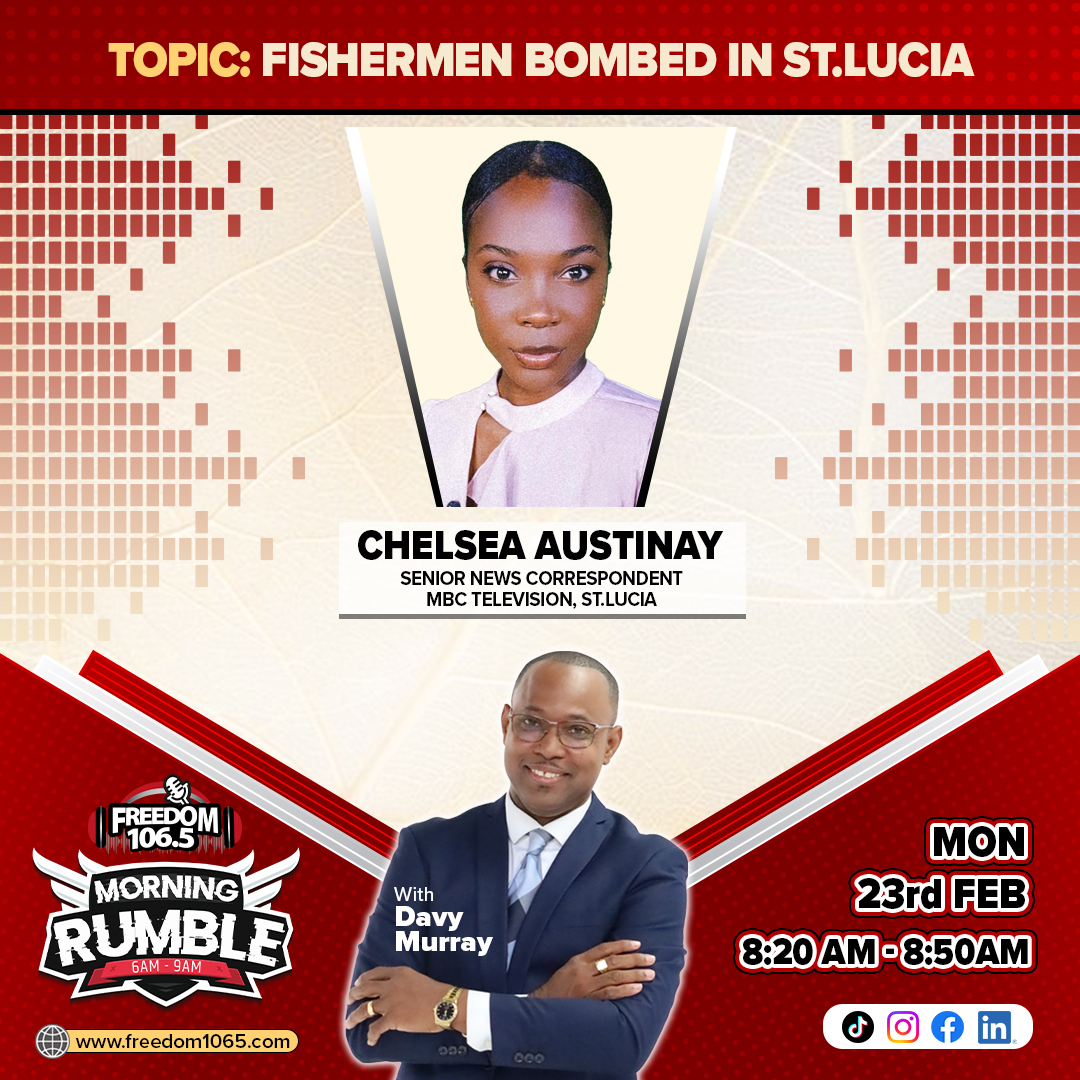
[00:00:08] Speaker B: Turn our attention over to our CARICOM friend, a senior reporter, no doubt, in St. Lucia. And we are very happy to be able to speak with her this morning as she shares some insight as to what's taking place in our Caricom nation neighbors. And she's coming from NBC as a senior news correspondent in St. Lucia. Good morning to you, Chelsea. How are you?
[00:00:37] Speaker C: Good morning. Morning. I'm okay.
[00:00:39] Speaker B: What is.
[00:00:40] Speaker C: Can you hear me?
[00:00:40] Speaker B: Of course we're hearing you.
We are hearing you. We are hearing you. Welcome to the Morning Rumble.
I believe this is probably the first time I'm chatting with you. I can't remember.
I chat with so many people. But welcome to the program all the same.
It's good to have you. And let's share. Let's start off by, you know, what is transpiring with this, with these fishermen? I mean, what is taking place? Remind our listening audience.
[00:01:08] Speaker C: Okay, so basically there was an incident on 13 February.
The US had already issued their correspondence stating that there was an airstrike and a boat was attacked. Now, this happened off of the coast in Kanawun in St Vincent.
So it really came in from there.
And there were reports of missing fishermen in St. Lucia. So the family were the ones who kind of confirmed it to the media. But we still have no actual official reports stating that, hey, these were in fact Saint Lucian fishermen. Because we still don't know the identity of the third person that was on that vessel.
There are alleged reports that there was another incident, but I don't think we've had official correspondence stating that another incident did actually happen.
But right now, the mood for fishermen is very what I would say. It's very tense. You're very careful. They're kind of confused as to what's happening.
Yeah, that's kind of where we are right now.
[00:02:33] Speaker B: What confirmation do we have that St. Lucian nationals were killed in that airstrike? Do you have, what confirmation does the government have that it can share with the wider public?
[00:02:47] Speaker C: No, the government doesn't have anything. The government is still, oh, hold on. It's a holiday and the baby is home with me.
[00:02:54] Speaker B: That's okay. That's okay.
That's okay.
[00:02:59] Speaker D: That's okay.
[00:03:00] Speaker B: All right. So similar to what's happening in Trinidad, what happened in Trinidad and Tobago, where we didn't have any, you know, we heard about the fishermen or these two gentlemen that journey to Venezuela, they're accustomed going and they were killed. You all remember that story out there in Maracas, Las Cuevas. The thing about it is, to me, to me we were able to.
In me, I don't know if it came out somewhere else, but we were unable to.
We were unable to say for sure whether fishermen were killed from Trinidad and Tobago. We talked about it, we had it out there. And now we have the same thing happening in St. Lucia. Now, the growing concerns politically where the US continue to be in the Caribbean Sea fighting narco trafficking, human trafficking and the drug cartels.
Now we having our neighboring Caricom neighbor experiencing fairly the same thing. But my whole take on it, and when she returns, we'll probably get some insight is to how do we come up with a narrative where nationals are being taken out allegedly and for want of a better term, mistaken identity. Because if they are fishermen, they're not into narco trafficking and gun smuggling and human trafficking, but they're being killed.
How do we confirm that this is indeed nationals of one particular Caribbean island or not? You know, so thank you very much, Melissa. So for me, I have to continuously want to know what is taking place. It is mind boggling that we could say something like this and not be able to back it up with proof, concrete evidence, something tangible to solidify the position that our nationals or nationals of any particular Caribbean island innocently was just fishing and died at the hands of the US Naval ships. So for me, it continues to be a cause of concern.
And whenever claims are made that nationals are killed by these US strikes, something tangible must come forward.
We have had those talks.
But then how do we know for sure if that is the case?
Welcome back. How is baby?
[00:05:48] Speaker C: Welcome back.
Okay, baby's a little bit settled now. You know, my savior.
[00:05:57] Speaker B: What corner is that?
[00:05:59] Speaker C: Yes, Gracie's Corner. Gracie's Corner.
[00:06:03] Speaker B: Oh, what is Racy's Corner.
[00:06:05] Speaker C: Oh, what is Gracie's Corner? It's a little show, you know, for. Educational show for the children.
They sing the alphabets, letters, shapes. Learn how to count money. Learn how to count by twos, fives and.
[00:06:19] Speaker E: Yeah, yeah, yeah.
[00:06:20] Speaker C: It's very educational.
And it's a lot of nursery rhymes as well. So if you want to keep your baby hooked for two seconds, hey,
[00:06:31] Speaker B: we had one. I remember my son's. It was called My Baby first tv.
I got sick to my stomach digesting the content on that. But they seem to love it.
The better part of three to four years in my house.
My Baby first tv. Every morning, every evening. That was it. I understand your Pain.
[00:06:57] Speaker C: Yes.
[00:06:57] Speaker B: Let's revisit the conversation.
Right, go ahead.
[00:07:03] Speaker C: Before I left off, I think we were speaking on the fact that the government still has nothing official, but the atmosphere is filled with conversation because what people are even now looking to is the maritime laws, the maritime laws that you probably have with the US and that's. Each Caribbean country actually signed those, whether it was bilateral agreements, memorandum of understandings way back in the 90s.
And so those things may have to be up for review because as we're aware, CARICOM is meeting starting today.
The Carica meeting is starting today and is going to go up until the 27th. So that's probably something on the table for discussion because the last official correspondence we had with the Prime Minister was that he would like to see regional unity on matters like that.
So, of course, when he comes back to press briefing next week, we will have something a bit more concrete.
But for now, it's just, how could the US do something like this? That's just everybody. That's the fishermen.
There were reports on Friday of drugs floating off of the coast of Bequia. I'm not sure if you saw that report.
[00:08:32] Speaker B: Yeah, we did. We did.
[00:08:33] Speaker C: $500 million.
[00:08:34] Speaker F: Yeah, we did.
[00:08:36] Speaker C: Yes. So, you know, everybody's still kind of searching and seeing what happens. What's wr.
Did it stop?
Okay, give it to Mommy. Thank you. Bs.
[00:08:51] Speaker B: I love these family moments.
I don't know. I. I'm. I'm. My heart goes out to you. I don't want no more babies. My children are teenagers. I'm good.
[00:09:04] Speaker C: That's good. This is my first one.
So here we are.
And I agree to the interview, never remembering that today was actually your holiday because yesterday was our independence.
And usually when the holiday, Independence is the Sunday, the following day is a holiday. So I was at the impression that I have to send him off to daycare, get ready for work and try to do the interview. How you go, baby? Good boy.
Okay. Going back size to see.
[00:09:34] Speaker B: Yes, but that's okay. We are very happy nonetheless to have you here with us chatting. The same happens in Trinidad when there's a holiday. So here's the thing that I have a concern with and I would, I wouldn't keep you too long, but if we have nothing tangible or concrete to suggest that nationals were taken out in a strike, why the alarm? Why the concern?
[00:09:58] Speaker D: Why the concern?
[00:09:59] Speaker C: Because we saw it happen when they first entered our waters off the coast of Venezuela. We saw it happen in Trinidad, okay? And now it's happening to us.
The Families, like I said, are the ones that have reached out to media houses and they were the ones saying, hey, this boat, it looks like my relative's boat that he went out in, and we haven't seen him. We cannot risk, we cannot get in touch with him. So you know, people know their people.
But again, all of the official reports are very vague.
So you can't tell a family member that believes that's their family member because they know a vessel that that's not your family member. You know what I mean?
[00:10:48] Speaker B: I want to employ government, including us here at home, to get a little deeper with this because we have had two fishermen on our end reportedly allegedly being taken out by a kinetic strike of the US Navy vessels.
Now, we saw the boats on a high speed movement on the sea.
We saw the kinetic strike, it evaporated.
Drugs were found floating.
Family members are saying that they were innocent, they were not involved in nothing nefarious or notorious and anything like that, but they would travel to Venezuela via P ever so often.
My question is, and this is not to negate or to in any way trivialize anybody who is missing a family member.
Why use a Pirog? Why journey if you are legitimate and not use the legitimate ports of entry, a plane ticket and if there was a ferry service available, maybe utilize it.
My thoughts, the kinetic strikes in Lucia, drugs from floating.
One has to wonder, you know, as you mentioned, we know people, but do we really know people when they're not in our presence?
[00:12:13] Speaker C: When they're not in our presence? It's true, people come with a lot of duality. So sometimes what they present is not exactly who they are or what they might be in. And I'm not saying this to implicate anybody. I'm not saying this to implicate anybody at all. I don't know.
But at the end of the day, if you know your people, if you know what they're doing, sometimes you have the very same insight that everybody else does because they're doing what they want to do for whatever goals or whatever aspirations that they have, however means or ways they choose to attain, that is them.
[00:12:54] Speaker B: One of the things I want to ask you, what is government in St Lucia's position as it relates to having US presence in the Caribbean Sea?
[00:13:04] Speaker C: They have not answered that question. We have not. And I would like to say we as journalists probably have not asked them that question, but they have not answered that question. From our. Our prime minister is very neutral. Not neutral, but very diplomatic, I should say. He's very diplomatic with the responses that he gives.
So whenever we've posed a question, especially when it happened when we first entered the waters, we were like, the Venezuela is our friends, the US Are also our friends. We going to let them handle the matter in terms of their sovereignty. And that. That's not the exact quote, but that's something to what he has said.
So he's very diplomatic about the situation because we also had an instance where with the Cuban doctors, for example, when the media reported that our students will no longer be going to study to Cuba, the US Embassy in Belgrade was issued something to the sort that we never told St. Lucia, to not send your students across to education. We don't have a right in the education of their people. However, what we do want to tell them is the medical mission, you know, because they say it's exploitative. So that's what they were alluding to. She's like, you can't, you can send them to study, but you, you cannot continue the medical mission. And when that came out, he basically said, I understand, and okay. His response responses have been very succinct when it comes to correspondence and dealing with the US out of their global friendship, I should say.
[00:14:57] Speaker B: And thank you for sharing. And finally, what is the fisher folk in St. Lucia doing?
Is it that they're going out to fish? Are we going to see an increased prices where the fishing is concerned? Given the fact that they have their serious concerns about being blown up, as it were, in layman's term, what is the fisher folk to government? How are they corresponding with government in terms of being protected while at the high seas?
[00:15:25] Speaker C: They're speaking with their unions, from what I can understand. They're speaking with the various unions. They are a bit iffy, I should say, when it goes, when it comes to going underwater. But the actual correspondent, well, not correspondence, but what is being said to them is that if you're doing what it is that you're supposed to do on the water and you know, you're not involved in any illicit trade or drugs or whatever, stay in communication with the land. Do your best to stay in communication with the land. So you always have an update or people are updated about your whereabouts because our boats actually have some of the boats, I remember that's something that we were implementing. They actually have GPS trackers. They have the satellite phones that they could use to talk to their people on the ground, on land. So, you know, our fisheries have actually been doing things since prior to all of this regional turmoil we're seeing in our waters. Right now prior to that, we've already been kind of stepping up our game to advance our fishes. So, you know, to see that you're doing all of that to kind of be legit and whatnot and see that happening, it's like, okay, what's happening?
[00:16:41] Speaker B: All right. I think I feel satisfied to understand that two things. One, the government has taken a very diplomatic stance as it relates to the US presence in the Caribbean Sea with Venezuela. And we are still in the pre the early stages of getting anything tangible to really bring forward to solidify a headline such as fishermen bombed in St. Lucia.
[00:17:09] Speaker C: Well, they were not bombed in St. Lucia. They were bombed in international waters, the coast.
The fishermen happened to be Saint Lucian according to the families.
[00:17:25] Speaker B: All right, so thank you very much, Chelsea. I would love you to get back to your family. I know it's a holiday and I thank you. We're getting some kind of feedback that we have to probably work on on our end or maybe yours going forward.
So thank you again, senior news correspondent of MBC Television. What does the NBC stand for?
[00:17:44] Speaker C: Dawell Broadcasting Corporation, second McDowell broadcast.
[00:17:51] Speaker B: All right, thank you very much to McDowell Broadcasting Corporation for allowing us to borrow their senior correspondent for an interview in Trinidad this morning and sharing some insight and the updates as to St. Lucia and this kinetic strike business. So thank you again.
Enjoy your holiday.
[00:18:07] Speaker C: Enjoy your holiday having me and enjoy your day.
[00:18:09] Speaker B: Thank you. Thanks.
We'll continue as we take this break. I'll be back.
[00:18:17] Speaker C: Your good health can't wait. At RD Good Health Medical center get advanced CT scans starting at just $1,000 and coronary angiograms for only $5,000. Visit them at 34B Southern Main Road, Montreal, Chagonas. Or call 233-3730 or WhatsApp 725. Good.
[00:18:38] Speaker A: Today when you need the independence to speak your mind, you take it on the all new Talk Radio Freedom 106.5 FM.
[00:19:02] Speaker B: People are saying ban Carnival.
All right, man killed. This is the guy who was killed in the early hours out there at Grand Bazaar Mall in Valseine. Curtis Bird Pier. All right, of go Paul Avenue and Diego Martin said to have gone to purchase pizza and they're saying that because of the carnival he died.
Now killed because of carnival. I can send you more proof. Send me the proof now. But I can't see him being killed because of carnival.
And that's what you're saying. So send me some honor. If you say I can send you more proof, send me the proof. I'll appreciate it. That's the point, Davy. If these persons were held rather than killed, we would have known the identity, nationality, etc. I got that.
[00:19:45] Speaker C: Morning, Davy.
[00:19:47] Speaker G: Yes, I do agree with you.
Words do have power and as any speaker will tell you, you speak positive. It does inspire an atmosphere that breeds our positivity. Likewise neg, I mean you must acknowledge negativity, but by speaking positive and having a positive frame of mind that can affect how you act.
And so if you have a positive outlook at the beginning of the day, you'll be surprised how things transpire for that day. As against the rivers,
[00:20:30] Speaker B: that's a very good thing. Thank you very much pt valley for sharing your thoughts this morning.
[00:20:35] Speaker H: Good morning, Mr. Davey.
[00:20:37] Speaker B: Morning.
[00:20:37] Speaker H: And to the citizens of Trinidad and Tobago.
Now a gentleman called in and he made reference to starting things in the community.
And I want to agree with that man.
Now it is best that you look at things from a micro perspective.
So when you start in the community, you use the elders or all those who have different skills and so forth. All the retired teachers who can come together and help the young people chart their way how to understand what the education is all about.
In doing so, we're going to meet the needs of the children in the community, community by community.
In schools there are so many nation building programs right inside the family. Hfle that program then you have social studies, we have a whole life skills program. The programs are already out there to help young people to build themselves. You know, it is about, it's a mindset. So if you start community by community, you're going to have a better effect on the minds of the children than wanting to do this thing from an entire micro macro perspective. So let's start from community by community. And I am saying that because I am involved in my community in Arima, in a small in Malaba where I am helping young people.
So it's not that we don't have these nation building programs, they are out there, but let us, let us take care of our village and we will, we certainly will have a better country. Thank you.
[00:22:45] Speaker B: All right. Hello. Good morning.
Good morning.
[00:22:49] Speaker D: Morning Davy.
[00:22:50] Speaker B: Good morning.
[00:22:51] Speaker D: Oh my word.
Oh Lord, what a morning. Davy, you saw any drugs when those vessels drop? I heard you said that a while ago.
[00:23:01] Speaker B: Well, that's. Listen, there were some reports on it. She asked me if I saw the report. I didn't see. I see. Listen, I'll be talking nation building.
[00:23:13] Speaker D: Just now. You know what, what I observe as you said that you saw we had a drug bus just recently.
[00:23:21] Speaker B: Yes,
[00:23:24] Speaker D: the same way the radar pick up them vessel. You're not taking any radar Pick up the same vessel that dock in Trinidad.
Okay, Understand my point.
There is no way that same vessel if they monitoring vessels the Caribbean. There is no way about leaving Venezuela and come trinidad with almost 100 million dollar drugs and embroider.
But we was able to apprehend it. And the police tell me proper information because the information came from where?
We are big here, Davy.
They're playing games with us, Davey.
All right, enjoy your morning.
[00:24:04] Speaker B: No problems, thanks.
Let me hear what napping have to say this morning.
[00:24:10] Speaker I: Hello and good morning, Davy.
So I would like the government to focus on dealing with flooding.
We need some meaningful change in this country.
Because with flooding in a couple of months now, there is so much a compensation, loss of time, waste and mismanagement.
That is one and this is in a couple of in two weeks time. We're going to be in March and this is time to create new rivers and stream diversion of the water courses.
And we need this to take place now.
And if the government could spend the 137 million, which I have no problem. We cannot stop carnival. Carnival is a good thing.
But I would like that in all the sectors, be it in education, in security and in health care.
Now there's a lot of school and in a couple years, I don't know who is paying attention, you're going to see a drastic drop and you'll see the school population is less. You don't need no more school in this country. What you need is proper management. And now to cut the waste and mismanagement. There is building that is still renting. I sure the government is still rented and you need to move away. I know you can't do it one time, you have to do it drastically. But you have to set the example. If there is school that is there on occupy, you could use it for government building. Repurpose point up here, right there, there's a built steel structure there that is back up. They could use that as a shelter or something. I'm saying cut the rental, cut the waste and mismanagement in this country. Cut the 10% and kickback from the contractors and them they need to give back in their community. And you'll see the change coming about slowly but surely. Have a good day.
[00:25:48] Speaker B: Thank you so much for that recommendation, Davy. I appreciate your effort with this show. My suggestion is the restriction on a lot of the carnival costumes and allow the band owners to make use of the many trade persons who learned how to sew, etc. Not just important costumes. Well, some of them do the wire bending right here in Trinidad. But I see the point and I love it. Good morning.
[00:26:13] Speaker J: Good morning. When you have bikini and beads, where you put in that wire.
Alright, next.
Well, I'm just responding there.
You see, Davy, when I said that crime is like dirty gasoline.
Well, you know what? Dirty gasoline or dirty diesel. Well, diesel. Diesel vehicles are more tolerant.
They make to work with a heavier fuel. It doesn't have to be the best diesel. It will work.
You will not shut down. Hardly likely to shut down because of dirty diesel. But you will shut down because of dirty gasoline. You would lose performance, you would get all kind of issues, right? You'd have to service more regularly and so on.
But we have a kind of attitude here that the criminals are really those little boys and they're not really smart and somebody giving them the gun and somebody misleading them and it's not really their first.
They have a kind of infantile brain and some other layer of people above them. People with money, people with brains, people with organization.
Have these little criminals running around doing criminal activity and filling up Remanyard and the jail. And these higher level people are causing the problem.
My mother never thought like that, you know, all right. She used to say if they tell you go and eat dog, so and so you go eat it. If they tell you drink water from the drain, you go drink it. Listen. And I did not show any signs of clean. Yes. I was just a little boy with a little boy brain. And she let me know that you are responsible for what you do and you will pay the price. That's what we need to tell them. Thank you.
[00:28:01] Speaker B: Well said. Well said. I like that. You know, so not be. I mean it takes, you know,
[00:28:10] Speaker C: in
[00:28:10] Speaker B: the animal kingdom there are certain animals from birth they need to adapt to the environment that they're into.
The gazelles need to learn to walk within minutes of birth. Within an hour or two, they need to be able to run.
How long does it take for a human, a human being to be able to crawl, forget. To roll on their own, to move on the crib, to crawl, to creep, to walk, to even talk?
[00:28:50] Speaker A: This takes
[00:28:53] Speaker B: months, not weeks.
Months and years.
It takes us a minute and then some to reach adulthood. Maturity.
The brain has been proven as inhuman to not really reach full maturity. And even at the age of 21, you're still learning until 25 when this is developed. It takes years, Two decades and more for humans to develop the vast majority of us.
But the animal kingdom has to do it within mere Hours to survive.
If we have all this time to develop, why we do still develop and turn out to be crappy sometimes. Boy, I just would've thought it thinking out loud. We still turn out to be crappy. You know, we still turn out to just do dotishness and say dotishness. And we spend all them years developing and the ones that are developed, how are we helping the younger ones? You see when the animals born in the animal kingdom and they drop out in the. In the Serengeti the matriarch or whoever pushing them stand up, pulling them thing.
How are we helping our younger society?
We take decades to get right, to reach, to develop. We take months to be able to roll on the bed.
We take a while supposes could understand what we saying or want to say. It will happen right away. No.
Hi. Some parents need policing too. Good morning. For nation building I think we should introduce entrepreneurship in schools and encourage more young people into building their own business when they graduate. Well said. I am happy to see that a couple of the callers have built on tourism and welfare of providing safe secure restrooms. So we can clearly see that our tourism sector needs to be developed to be a better standard of what we have today. And by extension let's clean up the graffiti. The graffiti.
Let's go clean. On a cleanup drive throughout the country one was once was previously done under the NAR administration came into power. We also need to make our young citizens give back to society through some form of compulsory service. Example the forestry program, beautification program, flora and fauna programs. There was an agricultural shield that was given to schools when they performed well in agriculture. By revitalizing these programs our youth will be trained and a sense of purpose. I wrote a letter. Thank you very much, Dexter. I wrote a letter to the prime minister years ago to have a best village competition for most aesthetic village give incentive and motivation. This will automatically beautify the whole country.
Nobody took me on. Good morning Davy. I agree with police officers speaking to a student up to uplift their lives and become better student and honestly some police officer they themselves need help towards their own lives.
Good morning Davy. Can I suggest for the implementation of more farmers market so that the local produce can be more accessible to customers and for the promotion of entrepreneurial growth.
That's a good suggestion. SEA starts from standard 3 post. SEA is secondary school prep. All levels are important and let me listen to this one very quickly.
[00:32:34] Speaker E: Listening to the lady about the village council but in every community they have a community center which is normally locked up by the Ruling party and nothing goes on.
The community center should be the live wire of a village and they should rotate the leaders all the time.
If a party in power for five years, they take. They have the keys for five years and they're picking and choosing who they want. So many different courses could be had at community centers.
You know, doctors, psychologists come in and talk with community people.
But that is not what's happening. Somebody should take a poll. All them. Community center, when you pass, they're locked up.
[00:33:23] Speaker B: I agree. All of them locked up. Make father. Make absent fathers accountable and responsible. That community center thing, I love that idea. Make fathers accountable and responsible. Set up a system of reporting back to some institution. Get feedback from children in their progress, emotionally, mentally and in general school settings. The recommended ratio to the school social work association in America is 1 to 250 students, though many schools operate with higher ratios. Child welfare specific cases standard of often recommended. 1 in 20 for children of in need of special protection. 1 in 15 for children in conflict of law, 1 in 25. I love the idea. I love the idea. So guys, you all did well this morning with your recommendations, your thoughts on how we can better perform, have a better Trinidad and Tobago futuristic one of that. So that is good. Good morning, Davey. Totally enjoyed the program this morning. I would like all people to take a garbage bag to visit the. The beaches and take their trash home with them. Keep our beaches clean. Good morning, Davy. I like the idea of farmers market, but the prices are just too high.
All right, so with that being said, guys, I gotta go.
Hello, Good morning. Quickly.
[00:34:38] Speaker F: Good morning to all. Davy. I saw on the news last night where someone was killed because he stopped off to get a pizza. That was a foreigner, you know, he came to enjoy Carnival.
Where are we going? Can you imagine? You just killed someone like that who might be hungry or something like that. You just kill them like that. You know, I really cringe, you know, I couldn't.
I thought, oh my God, we've gotten to this, you know, time in Trinidad where you, if you're hungry, you're afraid to stop off to get something to eat if it's late in the night. And I really hope that these people who do these things, I don't know this gentleman, but I really, I feel really upset about it. All right, you stop.
[00:35:20] Speaker B: All right, thank you.
[00:35:21] Speaker F: Thanks.
[00:35:21] Speaker B: I gotta go.
[00:35:22] Speaker A: When you need the independence to speak your mind, you take it on the all new Talk Radio Freedom 106.5 FM.