Episode Transcript
[00:00:00] Speaker A: You're tuned into the all new freedom 106.5. 106.5.
[00:00:06] Speaker B: Good morning to you, Andre.
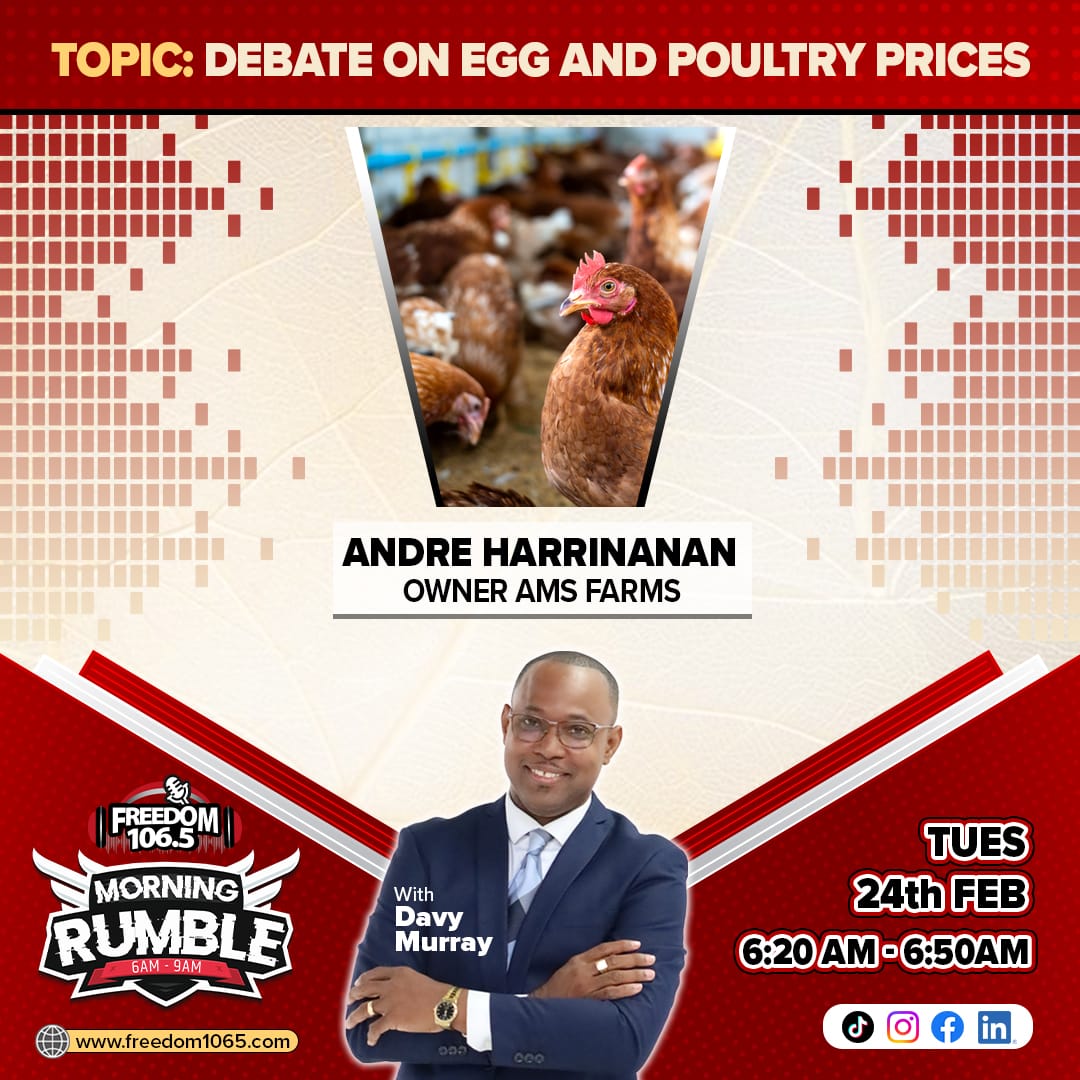
Morning, morning, morning and welcome to Freedom 106.5 FM. You as the owner of AMS Poultry of Farms. You know, we in Trinidad and Tobago and you know, have debated the prices of eggs. I mean for me personally over the years and when I look coming from paying $1.75 and this is just back in even 50 cents to $1.50 for an egg at a point in time now we are reaching somewhere in Figures $3, $3.50. Some shops will charge you $4 for one single egg.
You know, I mean, share some thoughts. I know it's a very. You are not on the macro scale, but still you're in the industry and maybe you are the best person that can speak to us on these happening within the last. Within the recent years.
[00:01:01] Speaker A: Okay.
We're coming from a background that we are not governed.
The prices may affect us at our greater scale coming from the cost of feed, cost of buy chicks, cost to buy supplements, you know, and they keep increasing slowly over time. Not in big jumps, but which I thought saw somebody goes. But after maybe three price hikes in raw materials, we have very low prices and all that to stay afloat.
[00:01:36] Speaker B: Yeah, right. So.
And this has been happening over the years where there were slight increases continuously that forced the jump.
Now, what is the current price in the farms? I mean, as a farm producer yourself, you are selling wholesale. What is the current wholesale prices that eggs are being sold for?
[00:02:01] Speaker A: Actually, I do not sell.
[00:02:04] Speaker B: Or you sell retail?
[00:02:06] Speaker A: Yes, at the farmers market.
[00:02:10] Speaker B: Well, explain that process to me. In terms of what you're paying and you selling on the farmer's market, what is the price pushing out from the farmer's market these days?
[00:02:19] Speaker A: Okay, so.
Well, I can only speak for my pricing because there may be slight variances, but we all try to remain competitive with each other.
So that does not ex. For my farm cost $25.
And beyond that I have crates. But these are outgraded crates from theory that jumbo. And they start at $40 a crate and they have to.
[00:02:46] Speaker B: Wow.
So you have eggs per crate? Because I saw some eggs at $55 and I said to myself, wow, I wouldn't be buying that because at the end of the. That's a lot. So you're now saying the crates can start off at 40 and reach to 70?
[00:03:04] Speaker A: Yeah.
[00:03:05] Speaker B: Whoa. Hello. Good morning.
[00:03:07] Speaker C: I guess. I don't know. Can I snap? I think we know me the egg industry. I use a lot of boiled egg. I love eggs. Right. And it's ridiculous that being sure and Tobago paid more than Tobago Tobago need and they need freight and transport and Then get it $7. Them eggs sold the government farm at $7. Now it goes to 15. That's still good. What is going on with egg in this country? It's golden egg. Something has to be done. It's ridiculous. That price is too high. We need to buy cut this egg thing now and don't buy none TNT don't buy no damage.
[00:03:37] Speaker B: Oh gosh if I know call and that's one of my one of our callers. Now the thing about it is this you have explained because it. When we look at what is taking place in Tobago Tobago prices are significantly lower and we have to transport the eggs over there and some farms over there probably producing their own eggs. I don't know if you know why those prices are.
[00:04:06] Speaker A: Well, I can only go from what I've read on the papers or heard on the news and they keep mentioning government funds. So I presume they are in a highly subsidized or funded by the government which we are not benefit to.
[00:04:28] Speaker B: I can go with that because I found it weird that we are paying such a high price in Trinidad and Tobago was paying a lesser price. Now when we look at this whole situation where the eggs are concerned and the poultry is it that farmers like yourself are forced now your price at $25 for a dozen that is standard for you, is it? That is it paraded. If the eggs are really small it is less or 25 is your base mark and then it goes up. What is, what is your benchmark on on your farm with your pricing?
[00:05:07] Speaker A: Well that $25 per dozen would come from a calculation to say as the beyond just selling eggs we have to know package and transport and so on and that comes at a cost. So let us say that my $25 doesn't come from or medium eggs which are sold at $55.
You would find that the the ratios in buying lesser amounts would cost you more than if you go to buy at home which gives the 30 eggs
[00:05:43] Speaker B: Aria. Okay. Hello, good morning.
[00:05:46] Speaker C: Morning.
[00:05:47] Speaker A: I suggest if any last budget they didn't jump freeze on taxes or something. I ain't sure.
[00:05:56] Speaker B: Ask him the last budget were there any decreases in the taxes or the feed prices?
One caller is saying you think that they think that it was adjusted. Was that the case? Are you experiencing any decrease in pricing?
[00:06:10] Speaker C: No.
[00:06:11] Speaker B: So it's the same for us. Yes, it's the same pricing for you all. And you're saying this morning it is better to buy the eggs in. In wholesale.
30.
[00:06:22] Speaker A: Well, in greater numbers. As I say, we sell. We do not sell in wholesale, but obviously for other farmers, they would give you a better price if you buy in bulk.
[00:06:37] Speaker B: So when we look at what are the retail prices of eggs, they say trying to keep yourself competitive. Normally when you look at a crate of a dozen eggs, it range in all 29.95.
Some places they tell you 31, you know, hello, good morning.
[00:06:54] Speaker C: $50. I buy by the crate. Buy the crate. $50. And that's another large eggs man, I'm telling you.
[00:07:02] Speaker B: No. Well, he did.
[00:07:03] Speaker C: I wouldn't almost them pay for you to be selling this thing for $50.
[00:07:07] Speaker B: All right, he clearly not listening. We.
What Andre is saying is that the price of feedback, the price to keep the poultry running, that has been increasing over the years till it reach a price where if they have to pay more, you, the consumer will be paying more. So I want to ask Andre, in conclusion here this morning, is there anything that you think would be done in the not too distant future that will help reduce the cost of eggs? Are you foreseeing that?
[00:07:41] Speaker A: No, I don't see that happening in the near future. But I do believe if we were to set up proper subsidies for the farmers, that should help.
[00:07:53] Speaker B: What, what area of subsidies as a farmer you think would make an impact on the consumer prices? That if we get this, if this is done, if we can get this assistance, this could help us. What I mean, and I'm not asking, let's at least go to the most crucial things that you think would benefit you as a farmer and the consumer.
[00:08:15] Speaker A: Number one thing is the major cost, which would be feed secondary to that cost of chicks.
[00:08:24] Speaker B: What's the price for chicks now?
[00:08:26] Speaker A: Last time I bought it was $20.
[00:08:30] Speaker B: $20 each.
And when you started off this business, where was the price of the chicks then? To. And I just want to gauge the gradual growth in pricing.
[00:08:43] Speaker A: It was around $15.
[00:08:45] Speaker B: I have only paid in this business $15.
[00:08:48] Speaker A: Yeah.
[00:08:48] Speaker B: So you've been in this business for what, five, six years?
[00:08:51] Speaker A: Five, six years.
[00:08:52] Speaker B: All right, so within five, six years, you would have seen an increase from $15 to $20 in six years.
[00:09:00] Speaker A: Yeah.
[00:09:01] Speaker B: All right, so that could almost tantamount to be a dollar a year kind of thing. All right, Andre, thank you very much for the short burst of the interview. We really appreciate you waking up this morning. I know you well. You probably get up early every morning to tend to your poultry. But you know, you help us to appreciate and understand what is taking place are still left in the, in the, in the wind. But then subsidies is the order of the day that I can see that will help us to really understand what's taking place on the sister isle.
[00:09:29] Speaker A: Yeah. And that would allow the government to have greater price control. If they afforded us something, we would be obligated to stick to their price.
[00:09:37] Speaker B: Yeah, but remember with Trinidad and Tobago we was on this dependent syndrome thing where we want the government to pay for this, pay for that, but yet still, you know, when we face certain taxes, we quarrel it. The thing about it is, can government afford to subsidize farmers across the country in such a manner where, I mean, you're getting the subsidy on this side because the farmers will bill the government for whatever packaging, whatever labeling that they need so that they can sell it to the consumer to reduce cost. But then where's, where's the backlash because we subsidizing government paying for everything. And you know, so yeah, yeah, you know, from an economical standpoint, is it, is it, you know, sustainable for government to do that? But let me take one message before we go.
[00:10:25] Speaker D: Good morning, brother David.
I believe any budget, the prime minister and them did say that the imports are free. There was taken off somebody duties from that to make it cheaper. And then the purchase of feed here in Trinidad, there's no what on most agriculture stuff. And I want to believe that is also the feedback feed. But these business people in Chennai, I don't know if they're greedy or what because I remember when chicken price had gone up, they were saying that the, the container price had gone up from 3,000 to 20 to $25,000 per container. So you know, obviously feed price, but when, when it went down back to $3,000 to bring in a container, we did not see no dropping, no pricing, no chicken, nothing that they had said that because container price was high, everything went up and nothing came down back. So these business people have been making a lot of money and when they get a little squeeze like natural gas going on everything, they quick to pass it on to the consumers on it, which is unfair to us because we're not living like them. We don't have the ability to live luxury. I struggle to make a little taxi walk in the morning, come here fighting with these PA drivers. I don't know that my, my mantra. Yeah. Get rid of the phrase. Okay, have a good one.
[00:11:43] Speaker B: You know, and that's an interesting point. A Guyana Prison Service sells surplus eggs to the public at reduced prices.
I've been seeing this story coming out of Guyana within recent days. Andre, were you paying attention? Are you able to. Did you know about it?
[00:12:00] Speaker A: No, no, sorry.
[00:12:01] Speaker B: Yeah, it was happening for a while. Anytime the cost of labor goes up, the price of the product will go up. But let me take this call quickly. Good morning.
[00:12:11] Speaker A: I know in, in the budget they say no duties on feed.
It's come like. It's come like when them flower gonna buy a dollar and double sweepers clear up the doubles them fellas and everything for the. Everything is subsidized and compensation. They're running our business. Anybody governmental subsidiary and pay charge more. Thank you.
[00:12:32] Speaker B: The thing about it is we keep here, I'm doing some research as we're speaking and there was talks about reducing the fee, but from your standpoint, the talks happened. But as it relates right now, there has been no reduction. When you go to buy feed, you have, you have seen no price reduction. You're paying the same price you was paying prior to this government's installation. Is that what you're saying?
[00:12:53] Speaker A: Yeah, that's right.
[00:12:55] Speaker B: So the price, even though there are talks about it. All right, let's take this call quickly. Good morning.
Oh, God. Yeah. So what I'm saying, so even though there were talks to remove VAT and VAT and all, you are you, you have not experienced that. You have not seen that.
All right, Andre, again, thank you very much for weighing in to the best of your ability and have yourself a wonderful day. And I, I telling you, I hope that some of the initiatives you talk about this morning could really materialize. Have a great day, sir. Take care.
[00:13:25] Speaker A: Okay, Good man. Thank you.
You're tuned into the all new freedom 106.5. 106.5.