Episode Transcript
[00:00:00] Speaker A: You're tuned into the all new Freedom Formal 6.5, 106.5.
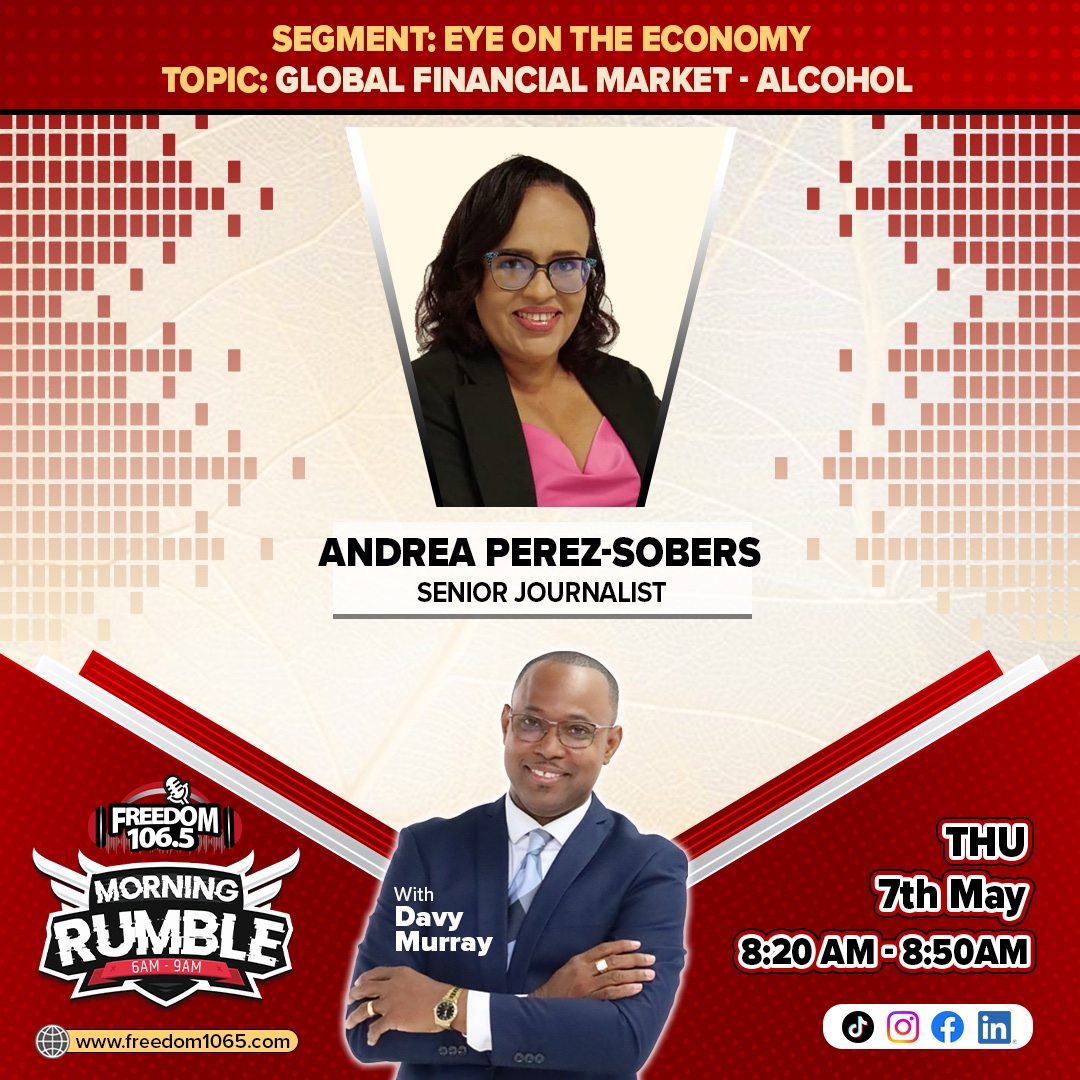
[00:00:06] Speaker B: Morning Trinidad and Tobago, 22 minutes after 8 o'. Clock. Good morning to you, senior reporter from CNC3, Andre Perez Sobers. Good morning, Andrea.
[00:00:15] Speaker C: Good morning, Davey. Good morning to your listeners.
[00:00:17] Speaker B: Good morning. And so happy to have you on this morning as we continue with our eye on the economy.
It's been a minute to know you document a couple Thursdays.
[00:00:28] Speaker A: Yeah.
[00:00:29] Speaker B: And you see and you don't know your hydra already. So when you duck, I ain't seen you at all.
Good morning, Andrea. Always good to have you. Global financial market. As we talk in alcohol this morning, eye on the economy. We'll try to keep the program as positive as possible and regular. So Andrea Dortmund, next weekend we have to keep the eye on the economy. We're watching them with one eye. All right, so this morning we're talking you had an article recently dealing with the alcohol prices, the increases the bar owners were complaining. There was one particular alcoholic company in Trinidad talked about decline in revenue and not revenue, sorry, in profits.
But you know, I always say even if it's a decline in profits, they still make a profit end.
[00:01:14] Speaker C: Agreed.
[00:01:14] Speaker B: I just don't understand these people. In order to talk like this, declining profit is you're still able to make a profit. You was able to pay your monthly bills or your yearly bills. So your extent, your expenditure did not supersede that of your income. So after your expenditure, keeping the lights on and so forth and the phone and the water running, you had a profit.
Okay, in one year you had 23 million and the last profit was 14.2. Just saying, calling loose figures. It's still a profit less, but still a profit. Andrea, talk to me. You had an article dealing with it.
Let's get your thoughts.
[00:01:54] Speaker C: Okay, so today I had my article with Angostura chairman Gary Hunt. So he spoke about that they had a dip.
Well, it was a significant dip. It was 14.5% decrease as opposed to last year.
And he said that he's not shaken by this because they have other portfolios. So you do know that Angus Roh is. Well, they were in 180 markets. But when I did the one on one interview with him on Tuesday, he told me that they are now in 200 markets internationally.
So he said here is not only the only portfolio that they have, but because of the alcohol, 100% tax on alcohol that would have affected them. But he said that they're not shaken by it because they are coming up with Other innovative ways to make sure that they stay stabilize and make sure that the company runs effectively as they would want to. I also asked him about workers if because of this decline, if this will affect workers. And he said, no, they are not about to send home any workers because they are about to do things differently. And this was his.
This was the reason that he was put into that position to do that changeover and make things stable and go on to that trajectory that Angostura will want to have.
[00:03:55] Speaker B: Because I am seeing where their tax profit of 19.4 million in the first quarter that ended March 31, 2026, which marked a 14.5% decline. Now they move from 22.7% million which was recorded for the same period last year. Now he says two reasons for this. Two external factors. One, firstly, the full implementation of the increased excise duties at the local market significantly impacted on the cost of goods and the global financial market volatility arising from geopolitical tensions involving the United States, Iran and that kind of thing. Now, right. Should we be.
I mean, you did ask a very pertinent question about employees. The drop in profit. Because one of the first things the big wigs to say, hey, what going on? All you gotta go. Because my profit margin dropped, my profit to nobody. I still able to pay all, you know, all. You get all of their money where the salaries was paid on time. Everybody get pain. And I still have a profit, but I don't like it. It dropped. Boy, I was making 50 million. Now I come down to 30 million, all paying for my yacht. I just talking loosely, are we just making joke? But at the end of the day, should we seriously, I mean, is it that the alcohol company are foreseeing an increase, an upward spiral to profit margins in their second and third quarters of this year?
Why? The reason, hence the reason why they're not looking at employees are relatively safe for the time being.
[00:05:24] Speaker C: Well, I think that that is actually a good reason. And because as I said that their portfolio is so big, right. They have revenue coming in from different streams. So that makes the company so sustainable at this point in time. Now, he said obviously about the war, there have been some shipping issues and stuff, but they were still able to make their targets across the global sections.
Unlike him and unlike Angasura. Well, Angasura is the company that people will say, oh, you know, if, if they get a little hit. Why. Why say something about them? But people don't understand that if they start to get hit every single quarter of their financials, then that will affect workers.
But as he said to me it was temporary and he sound very confident as the innovation and the different things that they want to do. So I think that's a good projection for Angostura and the workers as well. Unlike Angostura, as I said, many other companies, smaller companies, smaller alcoholic companies are not able to weather the storm like Angostura. So I don't know if you would have seen earlier this year and late last year a lot of bars closed their doors because of this 100% alcohol tax.
So the bar association have been put calling for talks with the Minister of Finance but I don't think that they have been successful in getting those talks with him because they're saying that this is putting extra pressure on them. They would have us a smaller cool of people as opposed to like Angostura and they wouldn't have that diverse divestment like how Angus Tour has in different markets. So the bars only have like let's say just Trinidad and it's just a small pool. So it affects them bigger than these
[00:07:54] Speaker B: larger companies that do it, that do export and sell products in varying countries.
I want to agree with you there. But as we continue to pay attention to what is happening on our economic standard front, where it relates to the local bars in Trinidad and Tobago being affected by this, you said that they so far have been unsuccessful. But based on your investigation so far, you paying attention to what's taking place, speaking with various luminaries in the, in the sector, would you say, or can you even maybe issue a prediction that in the coming months leading up to the next financial budget, fiscal budget that we are expected to hear by September, October of this year, that government would look to reduce some of these customs and excise tax duty taxes imposed currently on the alcoholic manufacturer.
[00:08:49] Speaker C: Well, I think all of them are hoping and praying that that is what happens in this budget.
When we spoke to the Minister of finance, which is earlier this year, he didn't sound like he was backing down from that 100% tax increase.
So I don't know if it is that there will be a change of heart for the budget because I think what they're looking at is for monies coming in from different sections and this was their way of gathering more money by having these taxes at 100%.
So they're trying to find monies from all sectors in order to pay their bills and that kind of thing and their debts, their debt deficit. So I don't know, it depends on how much they have allocated thus far, well collected Thus far and whole there how to say their finances look that they may consider it, but at this point I don't think that they are considering that as one of the taxes to be removed.
[00:10:05] Speaker B: As we pay attention to the increases in the alcoholic sector in Trinidad and Tobago. You mentioned that when you spoke with him. He talked about diversification in terms of other areas in which they can look to sustain their profit margins.
Did you ask him? Or if you can, in the not too distant future, it asks if they can look at a reduced cost given the fact that they are able to handle it.
The finance minister did make some suggestion that these increases in fees, he was talking about the landlords and all these things and different things, that the businesses could sustain it. They should not pass it on to the consumer, right? Not even by 50 cents. They should be able to withstand it. Have you asked him, based on the diversification efforts or that they have in the pipeline for sustaining their profit margin, would they look at even reducing their cost in terms of what they sell to the bars and the local alcoholic companies who have to then resell these products?
What do you think?
[00:11:09] Speaker C: Well, I did ask him something similar, but not quite because I, I asked him. Well, you know, we are seeing that a lot of bars have been closing their doors and they're saying that this is too much for them.
So is it that you're going to have that tax break for them? I mean, even if, okay, you say I want to tax them, but not a whole hundred percent tax because we are also seeing like less foot traffic in some restaurants because of the alcohol price.
Some are able to keep their prices at the same that they've had before, but some others have not. And when I, I told him that, he said, well, as he said to me, he's not going. He is not something on their cards that they've been reviewing now. But yes, he's spoken about diversification. But all of that needs to come into play in terms of they seeing actual monies from it and they haven't yet seen monies from it. So they can't take off taxes that they have already put on in the different sectors.
[00:12:30] Speaker B: One of the things I wanted when
[00:12:32] Speaker C: they start to see actual monies from the diversification, then they might be able to lower taxes in the different sector.
[00:12:40] Speaker B: Because one of the things I'm looking at, you mentioned that is it that the alcoholic companies can set a price that local bars must sell their product at, their products at. And I'll tell you why, because take for example, there's a Particular beverage in this country that was $10 went to $11 and now it's 13 and $14 at some institutions. But still that local product, that beverage at one particular institution that I discovered just about two weeks ago, selling that product still at $10. How are they able to do it? They're still selling the product at $10. A particular product, Liquor Mart, selling the product at $10 while other persons are selling it at $14. Is it that you met the companies that we're looking at right now?
Do they send out a mandatory pricing list that their products must be sold at or is it that they mark up their products and they leave it up because to the other businesses to do their markups because they. The said bottle is sold in various supermarkets at varied prices.
So is this something that you would ask him or maybe could ask him in the future, your thoughts?
[00:13:59] Speaker C: Yes. Yes to your point. Yes. So like a lot of the alcoholic beverage beverages companies, what they do, they send out a price, they send out a pricing list, right? So they will say okay, $10 for that particular bear, right?
But it's up to the company or the bar owner or the restaurant owner to, to go with that price or opt it. It's not something hard and fast that the companies give out. They say this is the selling price that they, that they project.
But if the, the various companies want to give it at a different price so that they could get a profit from it, that's all up to them. They don't. It's not a hard and fast thing because as you can see, a certain hotel, right, that is on Ryson Road, they sell that particular beverage, right, for 22.
[00:15:07] Speaker B: Yeah, yeah, they do. But when you look at certain establishments like hotels and, and certain restaurants, they charge you a Service charge now $22 on a product that they are purchasing at $10 and $11. Just saying. And when you look at it, It's. That's almost 100 markup, right? But the thing about it is, and then they want to charge you for service charge for being able to get somebody to bring it to your table. I mean, it's ridiculous, alright?
[00:15:32] Speaker A: But
[00:15:34] Speaker B: as a CEO, a chairman of a company, I would be concerned that you, on the local markets, you, the local supermarkets, the bars, the restaurants are selling my product at such a high rate. What if the consumers decide to not purchase my product? My product stands up on your hands, then I can't sell you nothing more because you're not willing to buy back, to buy any, to restock because you can't there's no need for it to restock because you still have my product.
I am pushing out millions and different metric tons of this product every day, every hour. My plan does not stop. I am manufacturing for both local, regional and international.
And if you locally are not able to push my product off the shelves as quickly as possible, it backs up. Can I not be concerned about that? That you are selling my product too high and you need.
Is there no regulation in place to. To govern these things?
[00:16:31] Speaker C: That's very true, but I have not heard any issues of like beers or, or any other alcoholic products staying on.
On bars hands or restaurants hands and that kind of thing. What they're doing now because of the hundred percent tax increase, they are now ordering less.
[00:17:02] Speaker B: But there goes my point, right? So if as a company I was pushing out X amount 100 cases per day, I am now pushing out 75 cases or in some instance 50 cases. You know, it interferes because prices are so high. I was just thinking out loud.
[00:17:21] Speaker C: Yeah. So it's, it's for the alcoholic company to have that discussion with them as to the pricing, to work out a pricing with them because they are now ordering less. Because obviously, like when you go to the bar daily, I'm sure you're not ordering five and six beers as you usually do.
[00:17:45] Speaker B: No, no, no, no, no.
[00:17:47] Speaker A: Right.
[00:17:47] Speaker C: You, you'll order two.
[00:17:48] Speaker B: Matter of fact, if I carry you out, you want to buy one, I buy one.
I have a call on the line. Hello, Good morning.
[00:17:58] Speaker A: What I wanted to ask is all the only prices in the bar, something went up. Alcohol went up a lot. Why was the tax increase if chandeliers always buying beers and alcohol and they're always making a profit, why did they increase the amount of. For the, for the alcohol and the beers? I think it don't make sense because I'm supposed to go before a committee and present the reasons why they wanted to increase the tax. And then when the committee say, all right, well, there's a good reason and the population could afford to raise the tax. Yeah, we, we allow it to raise it. Why? How are they able to just raise it 100 and the next thing, right. I'm assigned this. You understand? We are information around.
But why. Why producing alcohol is such a big thing? You know, easy it is to produce alcohol, you know, easy to do fermentation. We have something national called baba, you understand, which is free. So, so why. Why this big thing about making alcohol and call anybody to make alcohol?
[00:18:53] Speaker B: All right, thanks for your contributions. Thank you.
You want to talk about nothing that's illegal. Babash is illegal, you know. Yes, but just like we, we, we're still illegal, but they find a way to monetize it. Maybe they might legalize babash. I don't know.
But I mean, I see a point.
It's an interesting thought. Let me listen to this one as well. Andrea, good morning.
Well, that vision might be angasura vision whereby the, the customer who buying their products could adjust the price due to the circumstances, I think. But it have a beer company that set their prices. They. They went to the bar and give the bar a list of prices they have to sell at. I agree, I agree. I, I agree. I was told that by another bar owner as well. Good morning.
[00:19:47] Speaker A: Hey, David. Good morning. Yes, interesting topic. Until I guess there.
I think what the company does is that they give us suggested retail.
[00:19:55] Speaker B: Yeah, they use the word suggested. Yeah.
[00:19:57] Speaker A: Yes. And it's adjusted retail. You can either up or down based on your environment and your ambience and so forth. Right. But also I want to ask your guest there how I found it very interesting. We have some products that carry high quantity of alcohol that could be sold, could be sold without a license. I know I'm not going to call names any products, but I guess you and I and her will both know all will know what we're talking about. Right. And they've been sold under various names as you know, not continue because the content of alcohol is very, very high and it has become very relatively easy for access for underage to access it because it's sold all over the country without any license or any regulation.
[00:20:48] Speaker B: A particular alcoholic beverage sold without license all over the country.
[00:20:55] Speaker A: All over the country. And it goes very high percentage compared to a beer or something that is
[00:21:01] Speaker B: that by rubbing alcohol?
No, no, no, no. I can send my WhatsApp send my WhatsApp to 3061065 because I want to know what it is too. So I can't think of it. So yeah, yeah.
[00:21:12] Speaker A: There are, I know two products with very high content of alcohol sold across
[00:21:16] Speaker B: the country with all the regulation alcohol. Where's the next one?
[00:21:20] Speaker A: No, boy, check it and see. I feel you had a bubble drink a couple already. You know me, no problem.
Do the research and you would see it. There is products with high level of alcohol without license and it's not regulated.
[00:21:36] Speaker B: All right, thank you. Thanks very much. Well, in conclusion, one texter is saying, Andrea, I went to a particular place And I paid $32 for a bottle of that beverage. $32 boy, $32. Yeah, boy. And they're calling. They tell me the name. I mean, $32 for that beverage.
No, man. So $100 gave me what?
[00:22:01] Speaker C: That's a lot.
[00:22:02] Speaker B: That. Nah, I. That would have stayed right there.
That 32. Would I stay right there?
You know, if I want to. If I want to drink three of three of that beverage. 32, 96.
You crazy for three. You matter. I not paying that. And that's the problem. That is the problem. If you stand up and leave it on their hands, but you're playing big tantos.
Well, probably I get catch. You probably ordered it thinking, well, you know, it could be around 18. And then when I hit the belly, realize, what is this? Next time ax don't just jump out. Andre, I want to thank you so much for coming in and sharing some insight and on the matter this morning. I truly appreciate you. And next week, again, again, messages here coming in by Andrea WhatsApp. Gil, free to look at it. The message is coming in. So thank you very much, Andrea, for coming in for another edition of Eye on the Economy as we continue to look at some of these economic developments happening across our country. Next week, installation and no doubt, we look for another daily report, another, you know, financial topic that we can choose. Andrea, I look out for you. Next week, Thursday, please, God.
[00:23:18] Speaker C: Okay.
[00:23:19] Speaker B: All right. Have a good.
[00:23:20] Speaker C: I will try my best, but I will not be in the country next week. I will be doing a tourism conference
[00:23:25] Speaker B: for media limited Wonderful. Splendid. I get a job like you where they will send me outside of the country. You and Ryan beu and so forth. I get jobs like that.
Yeah, right. I. Ryan went Dubai the other day.
I think it was cop 28. Yeah, them fellas is all about the place. But I had a gar job, so carry freedom.
[00:23:44] Speaker C: He just come back.
[00:23:45] Speaker B: I know.
[00:23:45] Speaker C: Come back from Columbia.
[00:23:46] Speaker B: From Columbia, yeah. Good morning to Ryan. I'm a brethren, you know.
All right, Andre. Have a great day, guys. All right, take care.
[00:23:52] Speaker C: You as well.
[00:23:53] Speaker B: Okay, bye. Bye.
[00:23:54] Speaker C: Bye bye.
[00:23:55] Speaker B: Your turn. To the all new freedom. 106.5. 106.5.